Weak Car Battery Symptoms: What They Look Like and How to Confirm the Cause
The short answer
The most common sign of a weak car battery is a slow or labored engine crank, especially on the first start of the day or in cold weather. Other frequent signs include clicking when you turn the key or press the start button, dim lights or a flickering dashboard at startup, warning lights that appear briefly during cranking, and electronics that reset or behave oddly. None of these symptoms proves on its own that the battery is the problem. A faulty alternator, a poor cable connection, a failing starter or something draining the battery while the car is parked can produce similar results. Testing is the only reliable way to separate these causes.
This guide covers the conventional 12-volt battery that starts the engine and powers the vehicle's electronics. Hybrid and electric vehicles also have a 12-volt battery, but it usually does not crank an engine directly, so its symptoms look different. Those differences are covered in a separate section below.
Common symptoms of a weak battery
Slow, sluggish or uneven cranking before the engine starts. A single click, rapid clicking, or no response when you try to start. Headlights, interior lights or the instrument cluster that dim noticeably during cranking. The engine starts normally after a drive but struggles after sitting overnight or for several days. Dashboard warning lights or messages that flash on during startup and then clear. The clock, radio presets, power window positions or seat memory settings resetting. The engine start-stop feature no longer shutting the engine off at stops, on vehicles that have it. Key fob, central locking or alarm functions that work intermittently. Visible issues at the battery itself, such as a swollen case, leaking fluid, heavy corrosion on the terminals or a rotten-egg smell.
How a weak battery affects a modern vehicle
Beyond starting problems, low battery voltage can upset electronic control modules. A voltage dip during cranking can cause modules to lose communication with each other briefly. The result can be a cluster of unrelated warning lights, stored diagnostic trouble codes (DTCs) in several systems, or temporary loss of features such as stability control or parking sensors. These can look like serious faults when the root cause is supply voltage.
Many newer vehicles use a battery monitoring sensor, sometimes called an intelligent battery sensor (IBS). It is usually fitted on the negative battery cable. When it detects a low state of charge, the vehicle may switch off comfort features, disable start-stop or show a battery-saving message. How a particular vehicle behaves depends on its make, model year and equipment. The owner's manual or service information for that vehicle is the authority on what its messages mean.
Symptoms are observations, not diagnoses
Treat what you notice as a clue rather than a conclusion. A slow crank tells you the starter is not getting or not using enough electrical power. It does not tell you why. The usual explanations fall into five groups:
The battery itself is worn out or damaged. It may accept a charge but can no longer deliver enough current under load. The battery is healthy but discharged, for example after lights were left on, after short trips or after a long period parked. The charging system, usually the alternator and its regulation, is not recharging the battery properly while driving. Current is not flowing properly between the battery and the vehicle because of loose, corroded or damaged terminals, cables or ground connections. Something keeps drawing current after the vehicle is switched off. This is known as a parasitic drain.
A failing starter motor can also cause slow cranking or clicking, even when the battery is fine. A mechanical problem that makes the engine hard to turn over can do the same, although this is less common.
Which check separates the causes
Observation | Possible causes | Check that helps distinguish them; Slow crank after sitting, normal after driving | Aged battery, parasitic drain, short-trip undercharging | Rested voltage test, then a load or conductance test; parasitic draw test if the battery tests healthy; Clicking but lights stay bright | Poor connection, starter or starter relay fault, low battery under load | Inspect and clean terminals; measure voltage at the battery during cranking; check voltage reaching the starter; Lights dim heavily and engine barely turns | Discharged or failing battery, high-resistance cables | Charge fully, then load or conductance test; inspect cables and grounds; Battery repeatedly goes flat while driving or soon after | Charging system fault, slipping drive belt, wiring fault | Charging voltage test with the engine running; belt inspection; alternator output test; New battery goes flat within days | Parasitic drain, charging fault, wrong battery or not registered | Parasitic draw test; charging test; confirm correct battery type and any registration requirement; Multiple warning lights and stored codes after a hard start | Low voltage during cranking, not necessarily faulty modules | Test battery and charging system first; clear codes and recheck after the electrical supply is confirmed good
1) Inspect the battery and connections
Start with a visual check, because it costs nothing and can reveal an obvious cause. Look for corrosion on the terminals, loose clamps, frayed or swollen cables, a cracked or bulging case, and signs of leaking. Also check the main ground connections between the battery, engine and body. A connection that looks fine can still be faulty, so a clean visual check rules out only the obvious problems.
2) Check the resting voltage
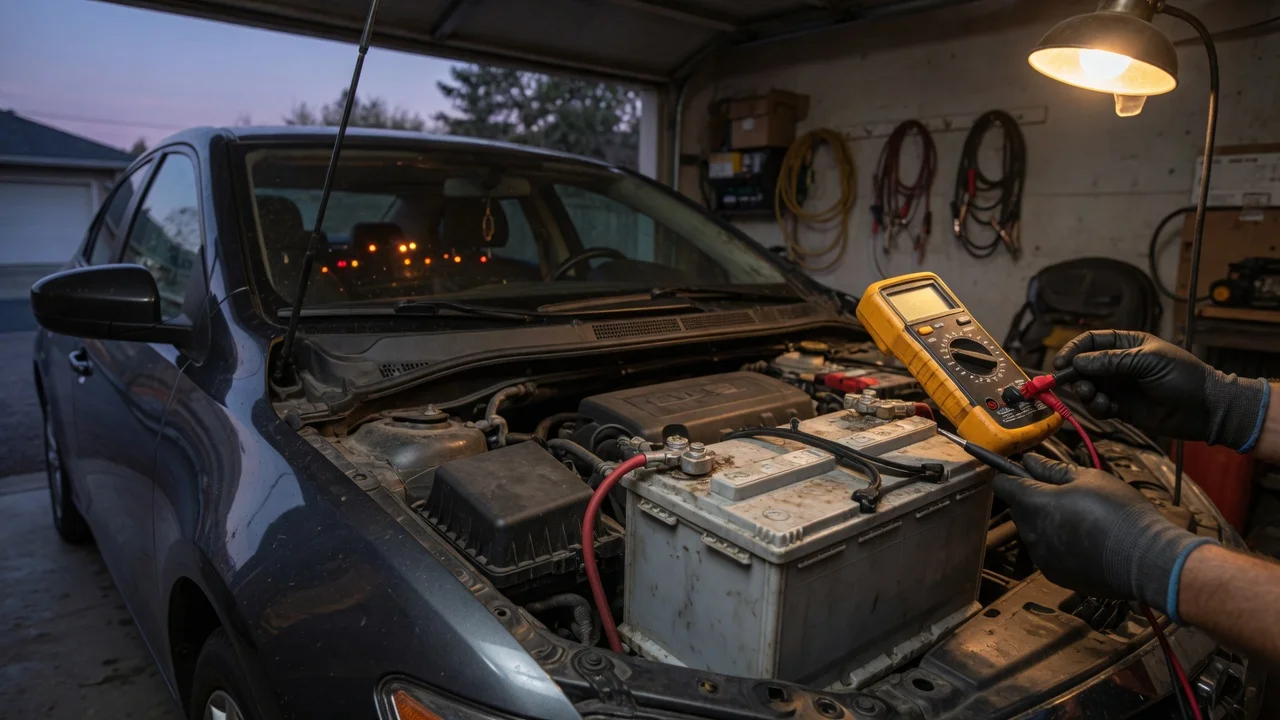
Measure the voltage across the battery terminals with a multimeter once the vehicle has been off for several hours. This lets any surface charge from recent driving or charging dissipate. As a general guide, a fully charged conventional 12-volt lead-acid battery usually reads around 12.6 volts or slightly higher at rest. Lower readings indicate a lower state of charge. Exact figures vary by battery type and temperature. Absorbent glass mat (AGM) and enhanced flooded batteries (EFB) can read slightly differently from standard flooded batteries.
A resting voltage reading tells you the state of charge, not the battery's health. A worn battery can show a normal voltage with no load on it and still collapse when asked to crank the engine. A low reading tells you the battery is discharged, but not whether it is faulty, was simply drained, or is not being recharged.
3) Test the battery under load
To judge health, the battery needs a load test or a conductance test. Conductance testers are common handheld units used by parts stores and workshops. Either test should be done on a fully charged battery, because a discharged battery can fail even when it is healthy. Results are usually compared against the battery's rated cold cranking amps (CCA), the rating printed on most batteries that indicates its ability to deliver current in cold conditions. Pass and fail criteria come from the tester manufacturer and battery specifications. No single universal threshold applies.
A simpler, rougher check is to watch the voltage at the battery while someone cranks the engine. A large drop suggests the battery cannot sustain the load, but high resistance in the cables can produce a similar result. Applicable minimum values depend on the vehicle and battery, and none were supplied for this guide.
4) Check the charging system
With the engine running, measure the voltage at the battery. A working charging system should show a voltage noticeably higher than resting voltage, often somewhere in the low-to-mid 13 to mid 14 volt range on many vehicles. Many modern vehicles use smart charging, which deliberately varies alternator output depending on battery state, load and driving conditions. On these vehicles, a single reading outside the typical range is not automatically a fault. The correct expected values and test conditions come from the vehicle's service information.
If the battery tests healthy but keeps going flat, a charging system test should come before replacing the battery again. Also inspect the accessory drive belt that turns the alternator.
5) Test for a parasitic drain
If the battery and charging system both test good but the battery still drains while parked, measure the current draw with everything switched off. Many vehicles keep modules active for some time after shutdown, so the measurement has to wait until the vehicle has gone to sleep. That can take anywhere from a few minutes to much longer, depending on the vehicle. Acceptable sleep current also varies by vehicle. Interpreting the result requires the manufacturer's specification, which was not supplied here. Removing fuses one at a time while watching the reading is a common way to narrow down which circuit is responsible.
6) Interpret fault codes with care
A diagnostic scan through the on-board diagnostics port, known as OBD-II on most modern passenger vehicles, may show codes for low system voltage, battery sensor faults or lost communication between modules. These codes record what a module observed under specific conditions. They do not confirm that a part needs replacing. A low-voltage code can be caused by a weak battery, a charging fault or a bad connection. Communication codes stored during a hard start are often a side effect of the voltage dip. Look up the code definition and its setting conditions for the specific vehicle, confirm the battery and charging system are sound, then clear the codes and see whether they return.
Vehicle-dependent points to keep in mind
Start-stop vehicles typically require an AGM or EFB battery. Fitting a standard flooded battery in their place can lead to early failure and poor start-stop operation. Some vehicles require a replacement battery to be registered or coded to the vehicle so the charging strategy matches the new battery. Whether this applies depends on the make, model and year. On hybrid and electric vehicles, a weak 12-volt battery may show up as the vehicle failing to power on or enter ready mode, a dark dashboard, or electronic faults, rather than as slow cranking. Cold weather reduces a battery's available output and increases the effort needed to crank the engine, so a marginal battery often shows symptoms first in winter.
Safety when checking a battery
Lead-acid batteries can release flammable hydrogen gas and contain corrosive acid. Wear eye protection, keep sparks and flames away, and avoid letting tools bridge the terminals. A swollen, cracked, leaking or very hot battery should not be charged or jump-started. Have it handled by a professional. Follow the jump-starting procedure in the owner's manual, because some vehicles specify dedicated jump points rather than the battery terminals.
Gaps in this guide
No vehicle-specific specifications were supplied. This guide therefore does not give exact pass and fail values for load tests, charging voltage on smart-charging systems, parasitic draw limits, module sleep times or fault code definitions. The voltage figures given are general approximations for conventional 12-volt lead-acid batteries. For a firm diagnosis, use the battery manufacturer's ratings and the service information for your vehicle's model year, engine and market.