Weak Battery Symptoms: How to Recognize Them and What to Check First
The short answer
A weak 12-volt battery usually shows itself first when the engine is started. The engine cranks slowly or sluggishly, the starter clicks without turning the engine, or the car starts fine one day and struggles the next, especially after sitting overnight or in cold weather. Other common signs include dim lights during cranking, a dashboard that flickers or resets when you turn the key, electronics that behave erratically, and a stop-start system that stops shutting the engine off at traffic lights.
These symptoms tell you the electrical system is not delivering enough power at the moment it is needed. They do not prove the battery itself is at fault. A failing alternator, a corroded or loose cable, a weak starter motor, or a circuit that drains the battery while the car is parked can produce the same complaints. That is why the order of checks matters more than any single symptom.
This guide covers the conventional 12-volt battery used to start the engine and run accessories. Hybrid and electric vehicles also carry a 12-volt battery that can show similar signs, such as the car refusing to power up. Their high-voltage traction battery is a separate system with its own warnings and should not be tested by the owner.
Common signs of a weak battery
Slow or labored cranking, where the engine turns over more slowly than usual before it starts. A single click or rapid clicking from the starter area when you turn the key or press the start button, with little or no engine rotation. Hard starting that is worse in cold weather or after the car has been parked for a day or more. Headlights, interior lights or the instrument cluster dimming noticeably while the engine cranks. Dashboard warning lights flashing, gauges sweeping, or the infotainment screen rebooting during a start attempt. Clock, radio presets or seat and mirror memory settings resetting. Power windows, door locks or the remote key fob responding slowly or inconsistently. The automatic stop-start feature no longer shutting the engine off, often with a message that the system is unavailable. The car needing a jump start repeatedly, or starting only after a jump and failing again later. Visible problems at the battery itself, such as a swollen or cracked case, heavy corrosion on the terminals, or leaking electrolyte.
A single slow start on a very cold morning is not necessarily a sign of failure, because cold reduces how much current any lead-acid battery can deliver. A pattern that keeps getting worse, or symptoms that appear in mild weather, is more meaningful.
Why a battery becomes weak
It helps to separate two situations. A battery can be discharged, meaning it is healthy but not charged enough, or it can be worn out, meaning it can no longer hold or deliver a full charge even after proper recharging. The symptoms look the same at the moment of starting, but the fix is different.
Normal aging: lead-acid batteries gradually lose capacity as their internal plates sulfate and shed material. Heat tends to shorten battery life, and cold exposes a weak battery because starting demand rises while available power falls. Repeated deep discharge: leaving lights on, running accessories with the engine off, or letting the car sit for long periods can draw the battery down far enough to cause lasting damage. Undercharging: many short trips may not give the alternator enough time to replace the energy used for starting. A charging system fault: if the alternator, its drive belt, its wiring or its regulator is not working properly, the battery is never fully recharged and runs down while driving. Parasitic drain: a module that fails to go to sleep, a stuck relay, a glove box or trunk light that stays on, or an aftermarket accessory can slowly drain the battery while the car is parked. Poor connections: corroded, loose or damaged terminals, cables or ground straps add resistance, which mimics a weak battery even when the battery is fine. Wrong battery type: some vehicles, especially those with stop-start, are designed for an AGM (absorbent glass mat) or EFB (enhanced flooded battery) type. Fitting a conventional flooded battery where one of these is specified can lead to early weakness.
Symptoms that point to something other than the battery
Several faults are often mistaken for a weak battery. The clues below do not prove the cause, but they suggest where to look after the battery itself has been checked.
Observation | Possible causes | Check that helps tell them apart; Battery goes flat after the car sits for a few days, but starts fine when driven daily | Parasitic drain; aging battery that cannot hold charge | Charge and test the battery; if it passes, perform a parasitic draw test; Car runs, then battery dies while driving or soon after; battery warning light may be on | Alternator or charging circuit fault; slipping or broken drive belt | Measure system voltage with the engine running and check the belt; Strong lights but a single click and no cranking | Starter motor or solenoid; poor connection at the starter; ignition or neutral safety switch circuit | Measure battery voltage while attempting to crank; check voltage at the starter; Intermittent no-start that clears after wiggling cables | Loose or corroded terminal, damaged cable or bad ground | Inspect and clean connections; perform a voltage drop test across cables; Slow cranking even with a known-good, fully charged battery | Starter drawing excessive current; engine mechanical drag; undersized or damaged cables | Starter current draw test and cable voltage drop test; New battery fails again within a short time | Charging fault, parasitic drain or incorrect battery type | Test charging output, measure parked current draw, confirm specified battery type
A sensible order of checks
Working from the simplest observations toward more specific tests avoids replacing parts that are not at fault. Each step either narrows the cause or tells you what still needs to be ruled out.
1) Look at the battery and its connections
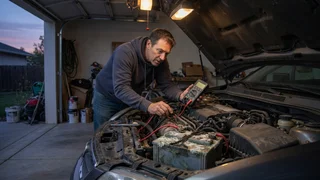
Check the terminals for white, green or bluish corrosion, make sure the clamps are tight and cannot be twisted by hand, and look along the cables for swelling, fraying or heat damage. Check that the battery is held firmly by its hold-down. A bulging or cracked case or leaking fluid means the battery should be replaced and handled with care. Batteries can release flammable hydrogen gas and contain corrosive acid, so avoid sparks near the battery and wear eye protection when working on it.
Cleaning and tightening connections can cure a no-start on its own. If it does, the battery may still be partly discharged from the failed start attempts, so the next steps remain worthwhile.
2) Check the resting voltage
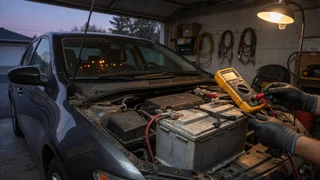
With a digital multimeter, measure across the battery terminals after the car has been off for a while, ideally several hours, so that surface charge from recent driving or charging does not inflate the reading. As a general guide, a fully charged conventional 12-volt lead-acid battery at rest reads roughly 12.6 volts or slightly higher, and readings that fall progressively below that indicate a lower state of charge. AGM batteries often read a little higher when full. The battery label or the battery maker's guidance gives the exact values for a given type.
Resting voltage shows state of charge, not health. A worn battery can show a reasonable voltage with no load and still collapse when the starter engages. A low reading shows the battery is discharged but does not yet show whether it is worn out or whether something else drained it.
3) Fully charge, then test under load
If the battery is low, recharge it with a suitable charger, using an AGM setting where applicable, and let it rest before testing. Then test its ability to deliver current. Many auto parts stores and repair shops use electronic conductance testers that estimate battery condition against its rated CCA (cold cranking amps), the figure printed on most battery labels. A traditional carbon-pile load test serves the same purpose. A battery that fails a load or conductance test after a full charge is likely worn out.
A simpler check is to watch the voltage while someone cranks the engine. A steep drop during cranking suggests a weak battery or a high-resistance connection, but it can also reflect a starter drawing too much current. Treat it as a clue rather than a verdict.
4) Check the charging system
With the engine running, measure voltage at the battery. On many conventional systems, a healthy charging system holds voltage noticeably above resting battery voltage, commonly somewhere in the range of about 13.5 to 14.5 volts. Many modern vehicles use smart charging, where the engine computer deliberately varies alternator output with battery condition, temperature and driving situation, so a lower reading at certain moments is not automatically a fault. The vehicle's service information defines what is normal for a particular model.
Also inspect the accessory drive belt for cracks, glazing or looseness, and listen for squealing. A voltage that stays at or below resting battery voltage while running, or that climbs well above the normal range, points toward the charging circuit rather than the battery. A shop can test alternator output under load and check the wiring between the alternator and battery.
5) Test for parasitic drain if the battery keeps going flat
If the battery tests good and the charging system works, but the car still goes flat after sitting, measure the current drawn with everything switched off. This is done with an ammeter or clamp meter after the vehicle's modules have gone to sleep, which can take some time on modern cars; opening a door or the hood can wake them again. An abnormally high draw is then traced by removing fuses one at a time, or by measuring voltage drop across fuses, to find the circuit responsible. Acceptable draw varies by vehicle, so compare the result with the manufacturer's specification rather than a generic number.
6) Check voltage drop across cables and the starter circuit
When the battery is good and charged but cranking is still slow or inconsistent, measure the voltage lost across the positive cable, the ground cable and the engine ground strap while cranking. Excessive drop means resistance in that path, even if the cable looks fine on the outside. If the cables pass, the starter motor and its solenoid become the next suspects.
Warning lights and fault codes
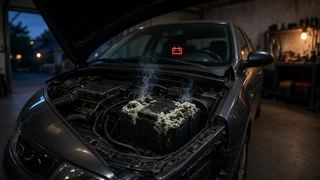
The red battery-shaped warning light on most dashboards generally indicates a charging system problem, not a weak battery. It typically comes on when the vehicle detects that the alternator is not supplying the expected voltage. A worn battery often produces no warning light at all until it fails to start the car.
A low battery can, however, trigger a wide range of warnings and stored DTCs (diagnostic trouble codes) in unrelated systems, because control modules misbehave when supply voltage dips. Messages about stability control, steering assist, parking brakes or communication between modules sometimes appear together after a hard start and disappear once the battery is charged or replaced. Codes that describe low system voltage or charging performance indicate where to look, but they do not on their own prove which component has failed. Interpret them alongside the measurements above and the definitions in the service information for the specific vehicle.
Vehicles with stop-start or battery monitoring
Many newer vehicles have a battery sensor, usually on the negative terminal, that reports battery condition to a BMS (battery management system) or the engine computer. When the system judges the battery to be weak, it may disable stop-start, reduce power to comfort features, or display a low-battery message before starting problems appear. These early warnings are worth taking seriously.
On some makes and models, a replacement battery must be registered with the vehicle using a scan tool so the charging strategy adapts to the new battery. Requirements vary by manufacturer, model year and battery type, so check what applies to your vehicle before or after a replacement. Skipping a required registration can lead to undercharging or overcharging and a shorter battery life.
Recharge, replace or keep looking?
Battery was simply drained, for example by lights left on, then recharges fully and passes a load or conductance test: it can usually stay in service, though deep discharges can shorten its remaining life. Battery fails a load or conductance test after a full charge, has a damaged case, or will not hold charge overnight with no abnormal drain present: replacement is the likely answer. Battery passes testing but keeps going flat: look for a charging fault or parasitic drain before buying a new battery. New battery replaced recently and the same symptoms return: the original cause has probably not been found; check the charging system, parked current draw, cable connections and whether the correct battery type was fitted.
When replacing a battery, match the group size, terminal layout, battery type and cold cranking rating specified for the vehicle. The owner's manual or the existing battery label is usually the easiest place to confirm these details.