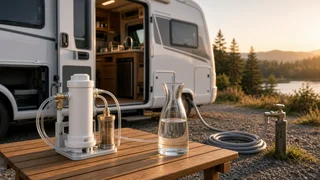
Water Conditioners vs Water Softeners for Motorhomes
The Short Answer
A water softener removes the hardness minerals, mainly calcium and magnesium, from your motorhome's fresh water. A water conditioner leaves those minerals in the water and tries to change how they behave so they are less likely to form scale. If you want water that lathers easily, rinses spot-free more readily and is verifiably lower in hardness, a softener is the more direct tool. If you mainly want to reduce scale buildup with minimal weight, storage and upkeep, a conditioner can make sense. One qualification matters: conditioners vary widely in technology and in how well they work, so the label alone tells you little.
Also note that "water conditioner" is used loosely in the RV world. Some sellers use it for products that are actually ion-exchange softeners. The term is also used for chemical tank treatments, which are a separate category. Check how a product works before you compare it.
Why Hard Water Matters in a Motorhome
Hard water is water with a high dissolved mineral content. When it is heated or evaporates, those minerals can leave scale, a chalky crust, behind. In a motorhome, that affects several parts of the habitation water system:
Water heater tank and heating element, where scale can reduce efficiency and collect as sediment; Faucet aerators, shower heads and valves, which can clog or stick; Water pump check valves and fittings exposed to mineral deposits; The exterior paint and glass, where washing with hard water leaves white spots; Everyday comfort, since soap and shampoo lather poorly and leave residue
Hardness varies a great deal from one campground or region to another across the US. Full-time travelers may move between soft and very hard water within a single trip. Inexpensive hardness test strips let you check the supply at each stop, which helps you decide whether treatment is worth it.
How a Water Softener Works
RV water softeners are usually portable canisters filled with ion-exchange resin. As water passes through, the resin captures calcium and magnesium and releases sodium in their place. The water that comes out has lower hardness, so it causes less scale, lathers easily and leaves fewer spots.
The resin eventually becomes saturated and must be regenerated. Most portable units do this by flushing the canister with a salt solution. Salt is commonly the regular salt sold for softeners or table salt, depending on the unit's instructions. Regeneration takes time and produces salty wastewater, called brine, which you need to dispose of in line with campground rules.
How a Water Conditioner Works
A salt-free water conditioner does not remove hardness minerals. Instead, it aims to keep them from sticking to surfaces as scale. Common approaches include:
Template-assisted crystallization (TAC): a treated media converts dissolved minerals into tiny crystals that tend to stay suspended in the water rather than form scale; Polyphosphate cartridges: release a small amount of a compound that binds to minerals and slows scale formation; Magnetic or electronic devices: clamp onto or inline with the plumbing and claim to alter mineral behavior
Of these, TAC is generally regarded as having the stronger support for scale reduction. Results for magnetic and electronic devices are inconsistent, so treat bold claims cautiously. Because a conditioner leaves the minerals in the water, a hardness test after treatment will still show hard water. Soap will not lather like it does with softened water, and washed surfaces can still spot.
Side-by-Side Comparison
Factor | Water Softener | Water Conditioner; What it does | Removes calcium and magnesium | Leaves minerals in place but reduces scale formation; Measurable hardness after treatment | Reduced | Largely unchanged; Scale protection | Strong, as long as the resin is not exhausted | Varies by technology; TAC is typically the most credible; Soap lathering and soft feel | Noticeably improved | Little or no change; Spotting when washing the vehicle | Reduced, though dissolved solids can still leave some marks | Little improvement; Ongoing upkeep | Regular regeneration with salt | Periodic cartridge or media replacement; magnetic types need little; Waste produced | Brine during regeneration | None from regeneration; Size and weight | Larger canister, plus salt to carry | Usually compact and light; Effect on water composition | Adds some sodium | Does not add sodium (phosphate types add phosphate)
Which One Fits Your Situation
Choose a softener if
You regularly stay in areas with hard water and want the most dependable scale protection; You wash your motorhome often and want fewer water spots; You value easy lathering for showers, dishes and laundry; You have room to store a canister and salt, and do not mind periodic regeneration; You spend long stretches at campgrounds where brine disposal is practical
Choose a conditioner if
Your main goal is reducing scale in the water heater and fixtures, not changing how the water feels; Storage space and cargo weight are tight; You want a low-maintenance, fit-and-forget setup; You boondock or move often and do not want to deal with salt or brine; You or your passengers need to limit sodium and prefer not to add it to the water supply
Consider neither, or something else, if
If the water where you usually stay is already soft, extra treatment may add cost and complexity for little benefit. If your concern is taste, odor, chlorine or sediment, neither device addresses that; a sediment filter and carbon filter are the relevant tools. If you need a truly spot-free rinse when washing, a deionization system removes dissolved solids more completely than a softener does.
Practical Points Before You Buy
Filtration still matters
Softeners and conditioners are not filters. Many owners run a sediment and carbon filter at the hose connection alongside either device. Chlorine can shorten the life of softener resin, which is one reason a prefilter is often placed ahead of a softener. Follow the device maker's guidance on placement.
Water heater considerations
Motorhome water heaters with steel tanks use a sacrificial anode rod to slow corrosion. Softened water is often reported to wear anode rods faster, so check the rod more frequently if you switch to a softener. Heaters with aluminum tanks typically do not use a replaceable anode, so confirm your heater type in your owner's documentation. Whatever you choose, periodically flushing the water heater remains good practice.
Sodium and drinking water
Softening adds sodium in proportion to how hard the incoming water was. For most people this is minor, but anyone on a sodium-restricted diet should take it into account. Some softeners can be regenerated with potassium chloride instead of sodium chloride; check whether your unit supports that. Another option is to drink from a separately filtered supply.
Brine disposal
Regeneration brine is salty wastewater. Some campgrounds have rules about where it can go, and dumping it on the ground can harm vegetation. Ask about local rules and use designated drains or sewer connections where permitted.
Flow and fit
Any inline device can reduce water pressure and flow somewhat, especially a small softener or a clogged cartridge. Check the rated flow against how you use water, for example running a shower and a faucet together. Also consider where you will keep the unit when you travel and how you will connect it at each site.
Freezing weather
Water left in a softener canister or conditioner housing can freeze and damage it. Include these devices in your winterizing routine. Drain or store them according to the maker's instructions, and keep them out of RV antifreeze unless the manufacturer says it is acceptable.
Bottom Line
A water softener actually removes hardness and delivers the clearest, most measurable results. In exchange, you carry a larger unit and deal with salt and brine. A water conditioner is lighter and easier to live with, but it only manages scale, and how well depends heavily on the technology. Test the water where you usually camp. Decide whether scale protection alone is enough or whether you also want softer-feeling, less spot-prone water. Then choose the device that matches that goal and the space you have on board.