VW Tiguan Check Engine Light: Causes and Next Steps
What the warning actually means
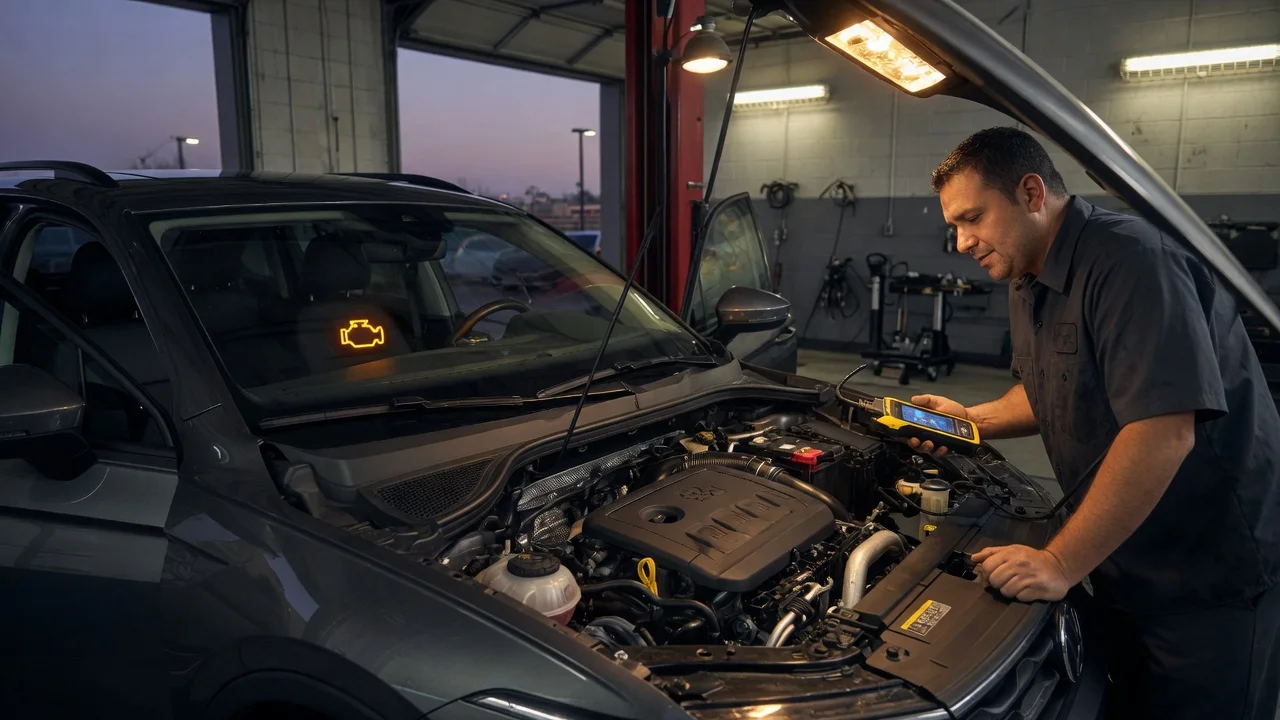
A check engine light on a Volkswagen Tiguan is the OBD-II malfunction indicator. The engine control unit has stored at least one fault that can affect emissions, fuel control, ignition, or related aftertreatment. The lamp reports a stored condition. It does not, by itself, identify a failed part or tell you how urgent the repair is.
That reading holds across Tiguan generations in markets that use OBD-II or EOBD, including the first-generation model, the second-generation Tiguan and Tiguan Allspace/L, and the third-generation model. The likely systems behind the lamp change with powertrain: gasoline TSI and related turbo fours, diesel TDI in markets that offered it, and plug-in hybrid variants where fitted. Exact sensors, code lists, and service tests are year-, engine-, and market-specific, so a code or symptom on one Tiguan should not be copied onto another without checking the matching engine code and model year.
Steady light versus flashing light
How the lamp behaves is the first split that changes what you should do. A steady light means a fault is stored and the vehicle can often be driven with caution while you arrange a scan. A flashing light means the control unit is detecting a misfire severe enough to overheat the catalytic converter. Reduce load, avoid hard acceleration, and stop as soon as you can do so safely if the flash continues, power drops, or the exhaust smell changes.
Lamp behavior What it typically indicates Immediate action; Steady (illuminated) A stored emissions or engine-management fault; drivability may still feel normal Note any other lamps or running changes, then scan for stored codes before they are cleared; Flashing Active misfire with catalytic-converter damage risk Reduce throttle, avoid hills and towing if you can, and stop driving if the flash, shake, or power loss continues; On at start, then off Normal bulb check when the ignition is switched on No action if it goes out after start and stays out; On with other warnings Possible related cooling, charging, oil-pressure, or diesel aftertreatment fault Treat the combination as more urgent than a lone steady check engine light
The Tiguan also uses other engine-related lamps that are easy to mix up with the malfunction indicator. The EPC (Electronic Power Control) lamp points at throttle or related engine-management limits. Diesel models can show a glow-plug or diesel-exhaust warning for aftertreatment, which is a different system from the check engine lamp even when both appear together. Record every lamp that is on, because the combination is part of the diagnosis.
Plausible causes and what each check suggests
Several faults can turn the lamp on. A stored diagnostic trouble code is evidence to investigate that circuit or system. It is not proof that a sensor, converter, or coil has failed. Confirm that any test you run matches the engine family in the car: a gasoline TSI diagnosis does not apply to a TDI, and hybrid high-voltage interlocks sit outside a basic emissions scan.
Fuel cap, tank, and evaporative emissions
A loose, damaged, or missing fuel filler cap is a common evaporative-emissions (EVAP) trigger after refuelling. If the cap clicks down fully, the seal looks intact, and there is no fuel smell, the cap may still be innocent. A failed EVAP purge valve, leaking vapour hose, or tank-pressure sensor can store similar codes. Recheck the cap first because it is the only item you can inspect without tools. If the lamp appeared right after a fill-up and the cap was not seated, tighten it and arrange a scan rather than assuming the fault has cleared; many EVAP monitors need several complete drive cycles before the lamp goes out on its own.
Misfire, coils, and spark plugs (gasoline)
On petrol Tiguan engines, a flashing light, rough idle, or a shudder under load often points at ignition: a coil pack, spark plug, or injector on one cylinder. Direct-injection TSI engines can also misfire from intake-valve carbon, a vacuum leak, or a failing high-pressure fuel pump. A misfire code names the cylinder or a random-misfire condition. It does not by itself prove the coil is the failed part, especially if plugs are overdue or fuel quality is in doubt. Stopped use is warranted while the lamp is flashing, or if the engine shakes, loses power, or a hot catalytic-converter smell develops.
Air measurement, mixture, and oxygen sensors
A dirty or failing mass air flow sensor, an intake leak after the sensor, a stuck diverter or boost-control fault on turbo models, or an ageing upstream oxygen (lambda) sensor can all set mixture codes and turn the lamp on. Downstream oxygen-sensor codes are often about catalyst monitoring, not automatically a bad sensor. If live data shows plausible airflow and the engine runs smoothly, treat mixture codes as a system result and look for leaks, unmetered air, and fuel delivery before replacing parts.
Catalytic converter and exhaust leaks
Catalyst-efficiency codes appear after the control unit compares upstream and downstream oxygen-sensor activity. An exhaust leak before the first sensor, a misfire that has already overheated the converter, or genuine catalyst ageing can produce the same code family. A converter should not be condemned on the code alone. Professional diagnosis typically includes confirming there is no active misfire or leak, then evaluating converter temperature or efficiency with the tests specified for that engine.
Turbo, PCV, and related gasoline running faults
Turbocharged Tiguan petrol engines rely on crankcase ventilation (PCV or oil separator), charge-air hoses, and boost control. A torn intake hose, split PCV diaphragm, or under-boost or over-boost condition can store a check engine light with or without a noticeable whistle or oil residue in the intake. These are model-year and engine-code dependent; the EA888 family used in many second-generation petrol Tiguans is not identical to earlier or later engines. A boost or PCV suspicion belongs on a smoke or pressure test and a matching wiring check, not on a parts swap from a forum code list.
Diesel aftertreatment, EGR, and NOx systems
Where a Tiguan was sold with a TDI engine, the lamp may reflect EGR flow, diesel particulate filter (DPF) regeneration, NOx-sensor, or reductant (AdBlue/DEF) dosing faults rather than spark or a fuel cap. A blocked DPF, failed regeneration because of short trips, or a NOx-sensor heater code can illuminate the malfunction indicator, sometimes together with a diesel-exhaust warning. Continuing to drive in limp mode can soot the filter further. Those systems need the manufacturer guided functions and, for DPF or reductant work, workshop equipment. A petrol EVAP or coil diagnosis does not apply.
Cooling, wiring, and recent work
A thermostat, coolant-temperature sensor, or wiring fault can store an engine light if the control unit sees implausible warm-up. So can a connector left unplugged after service, a low battery that corrupted a monitor, or an aftermarket hitch, alarm, or tuner. If the lamp appeared immediately after workshop or DIY work, start with what was disturbed. Temperature-related codes plus a climbing temperature gauge or heater that blows cold are a cooling-system problem first; stop if temperature rises out of the normal band. Specific opening temperatures and cap ratings vary by engine and are not interchangeable across Tiguan years.
What to check next
Work from what you can observe, then from stored codes. Do not clear codes until they are recorded, because freeze-frame data (engine speed, load, and temperature when the fault set) is often more useful than the code number.
Confirm whether the lamp is steady or flashing, and write down every other warning that is on, plus any shake, loss of power, fuel smell, or change in exhaust note. If the lamp is flashing, reduce load immediately. Continued driving with an active misfire can damage the catalytic converter. Stop if flashing continues or drivability is poor. Inspect the fuel filler cap for a full click, a cracked seal, and a missing tethered cap after the last fill. This check applies to EVAP-equipped petrol models; it does not explain diesel aftertreatment codes. Note recent fuel, very short trips, a jump-start, or any repair that involved the intake, exhaust, battery, or engine covers. Scan the engine control unit with a reader that can show manufacturer-specific codes and freeze frame, not only generic P0 codes. Record the code list before any reset. Compare each code with the fitted engine (petrol, diesel, or hybrid) and with related symptoms. A catalyst code after a misfire is a reason to fix the misfire first. Arrange dealer or independent VW diagnosis when the lamp flashes, the engine is down on power, temperature or oil warnings join the light, or a basic scan cannot identify a system you can inspect safely.
When to stop using the car
Stopped use, or a tow, is the safer choice if the check engine light is flashing; if the engine misfires, stalls, or will not rev; if coolant temperature climbs, steam appears, or the oil-pressure warning is on; or if a diesel Tiguan enters a severe limp mode with aftertreatment warnings. A lone steady lamp with otherwise normal running still needs a scan, but it is a different urgency from a flashing lamp or a combined overheat.
Diagnosis, not a parts verdict
A Tiguan check engine light is a stored-fault alert. The useful next action is to capture the lamp behaviour, any drivability change, and the actual codes for that vehicle’s engine and model year, then test the circuit those codes describe. Replacing an oxygen sensor, catalytic converter, or coil because a generic code names it is a guess. Workshop guided fault finding, smoke or leak tests, and fuel or ignition checks remain the point at which a part is confirmed. Public code lists and typical Tiguan patterns can rank likely systems; they cannot close the diagnosis for a specific car.
Gap: tightening values, sensor part numbers, reset procedures, and official drive-cycle steps are not included here because they vary by generation, engine code, and market and need the matching manufacturer service information for the vehicle in front of you.