VW "Oil pressure: engine speed max 4000 rpm" warning
A Volkswagen cluster message that reads “Oil pressure: engine speed max 4000 rpm” is a driver-facing protection response, not a routine reminder. The warning tells you the engine control strategy has seen an oil-pressure condition and is limiting allowable revs to reduce bearing and turbocharger load. On many VW models this accompanies a low oil-pressure warning, an illuminated oil can symbol, or an audible chime. The correct response is to treat it as an active lubrication-system alert, avoid high rpm and load, and gather observable clues before deciding whether continued low-speed driving is safe or whether the vehicle should be shut down and diagnosed.
Essential answer
The essential answer is that the warning is a protective limit tied to a measured or inferred oil-pressure problem. When the cluster shows “Oil pressure: engine speed max 4000 rpm,” the vehicle is telling you that engine speed is being restricted to reduce the demand placed on a lubrication system that is not meeting expected pressure. The warning is not an instruction to test the limiter. In practice, it usually appears alongside a red or yellow oil-pressure warning and may be accompanied by an immediate drop in allowed performance. The cluster wording is specific: it caps engine speed at 4,000 rpm, but the underlying condition can range from a false level reading to actual low pressure.
For some owners, the message appears when oil level is only modestly low and the pickup briefly loses pressure during cornering or hard braking. For others, the alert accompanies a failing oil-pressure switch, wiring concern, restricted pickup screen, or a worn oil pump. The distinction matters because the engine-speed cap alone does not identify the failed part. Instead, it defines an operating limit while the fault is active. A stored fault code or an oil-pressure warning that persists at idle may point to a pressure-sensor or oil-delivery issue, but the code is only evidence to investigate. Driver action should begin with checking oil level and listening for unusual engine noise under safe conditions.
Diagnosing a problem
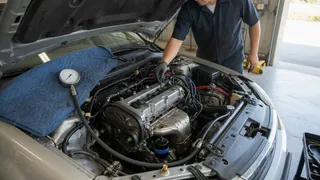
Start with the simplest observable check: park on level ground, let the engine sit briefly, and read the dipstick according to the owner’s manual method. A level near or below the minimum mark can explain the alert because the oil pump may draw air during acceleration, cornering, or braking. If the engine is noisy, especially with a hot idle clatter or a low-end rumble that worsens with rpm, stop driving and arrange professional diagnosis. Do not rev the engine to test the 4,000 rpm restriction when low oil pressure is suspected, because that can add bearing and turbocharger damage before the cause is confirmed.
If the level is correct, consider whether the warning appears immediately at start-up or only after the oil warms and thins. An immediate warning with a quiet engine may indicate a faulty oil-pressure switch, wiring issue, or incorrect oil-pressure signal rather than a mechanical delivery failure. A warning that occurs only when the engine is hot and at low idle is more consistent with low actual pressure from bearing clearance wear or a weak pump. Vehicle-specific testing is required to confirm manufacturer-dependent codes or pressure thresholds. Observations of when the message appears, engine sound, and oil level give a technician useful evidence without creating a guess-driven parts replacement.