Understanding VIN Numbers: Structure, Decoding and Why They Matter
A vehicle identification number, or VIN, is a unique 17-character code assigned to an individual vehicle. It identifies who built the vehicle, where and when it was built, and key details about its configuration, ending with a serial number that separates it from every other vehicle. In the United States, the standardized 17-character format has applied to on-road vehicles since the 1981 model year. Vehicles built before then used shorter, manufacturer-specific formats that cannot be decoded with the same rules.
Why the VIN Matters
The VIN is the reference point that connects a physical vehicle to its paperwork and its history. Because no two vehicles in the standardized system share the same number, it is used whenever an exact identification is needed rather than a general description such as make, model and year.
Registration and titling: state motor vehicle agencies record the VIN on titles and registrations. Insurance: policies and claims are tied to the VIN. Recalls: manufacturers and federal safety regulators let owners check open recalls by VIN, because recalls often apply only to specific production ranges. Vehicle history reports: accident, title-brand and odometer records are organized by VIN. Parts ordering: the VIN helps confirm the correct engine, trim or production-specific part when a model changed during a year. Theft prevention and recovery: law enforcement uses the VIN to identify stolen vehicles and components.
Where to Find the VIN
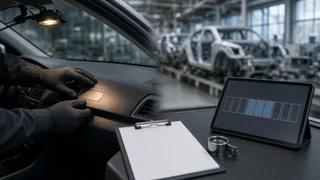
On most modern passenger vehicles, the VIN is visible through the windshield on a plate at the base of the driver's side of the dashboard. It also commonly appears on a label in the driver's door jamb, and it is printed on the title, registration and insurance documents. Some manufacturers stamp it on additional locations such as the frame or engine. Comparing the VIN on the vehicle with the VIN on its documents is a basic check when buying a used vehicle; a mismatch, or a plate that looks tampered with, is a reason to stop and investigate.
The Three Main Parts of a VIN
A standard 17-character VIN is divided into three sections. Letters I, O and Q are never used anywhere in the VIN, so they cannot be confused with the numerals 1 and 0.
Positions | Section | What it identifies; 1–3 | World Manufacturer Identifier (WMI) | Region, country and manufacturer; 4–8 | Vehicle Descriptor Section (VDS) | Model and configuration attributes defined by the manufacturer; 9 | Check digit | Mathematical verification of the VIN (required in North America); 10 | Model year | The vehicle's model year; 11 | Plant code | The assembly plant; 12–17 | Production sequence | The vehicle's serial number
Positions 10 through 17 together are often called the Vehicle Identifier Section (VIS). Positions 4 through 9 are sometimes grouped as the descriptor section, since the check digit sits inside that block.
Positions 1–3: World Manufacturer Identifier
The first character generally indicates the region or country of manufacture. For example, 1, 4 and 5 indicate the United States, 2 indicates Canada, 3 indicates Mexico, J indicates Japan, K indicates South Korea and W indicates Germany. The second character, usually combined with the first, identifies the manufacturer, and the third often indicates the vehicle type or a manufacturing division. Note that the country code reflects where the vehicle was assembled, not where the brand is headquartered, so a vehicle from a foreign brand built in the United States will typically begin with 1, 4 or 5.
Small manufacturers that build relatively few vehicles per year may use a 9 as the third character. In that case, positions 12 through 14 carry additional manufacturer identification, which leaves fewer characters for the serial number.
Positions 4–8: Vehicle Descriptor Section
The vehicle descriptor section describes what kind of vehicle it is. Each manufacturer decides how to encode these five characters, so the same character in the same position can mean entirely different things for two different brands. For passenger cars, U.S. rules require this section to capture attributes such as the model line, series, body type, engine type and restraint system; for trucks and other vehicle types, the required attributes differ and may include items such as gross vehicle weight rating or brake system.
Because the coding is manufacturer-specific and can change between model years and generations, decoding positions 4 through 8 accurately requires the manufacturer's coding scheme for that particular year. This is the main reason general-purpose decoders sometimes return incomplete or generic results for the descriptor section.
Position 9: Check Digit
The check digit is a calculated value that confirms the other 16 characters form a valid combination. It catches most typing errors and many crude forgeries. It is required for vehicles sold in North America, while other markets do not always use position 9 this way, so a non-North American VIN may not pass a North American check-digit calculation even if it is genuine. The calculation is explained later in this article.
Position 10: Model Year
The tenth character encodes the model year, which can differ from the calendar year the vehicle was built. The code cycles every 30 years and skips the letters I, O, Q, U and Z as well as the numeral 0.
Code | Model years; A | 1980 / 2010; B | 1981 / 2011; C | 1982 / 2012; D | 1983 / 2013; E | 1984 / 2014; F | 1985 / 2015; G | 1986 / 2016; H | 1987 / 2017; J | 1988 / 2018; K | 1989 / 2019; L | 1990 / 2020; M | 1991 / 2021; N | 1992 / 2022; P | 1993 / 2023; R | 1994 / 2024; S | 1995 / 2025; T | 1996 / 2026; V | 1997 / 2027; W | 1998 / 2028; X | 1999 / 2029; Y | 2000 / 2030; 1–9 | 2001–2009 / 2031–2039
Since each code repeats, context is needed to tell, for example, a 1989 from a 2019. Under U.S. rules for passenger cars, multipurpose vehicles and light trucks, position 7 helps resolve this: a letter in position 7 indicates the 2010–2039 cycle, while a numeral indicates 1980–2009. This convention does not apply to all vehicle classes, and in practice the vehicle's design, condition and documentation usually make the decade obvious.
Position 11: Plant Code
The eleventh character identifies the assembly plant. Plant codes are assigned by each manufacturer and are not standardized across brands, so the same letter can represent different factories for different automakers.
Positions 12–17: Production Sequence Number
The last six characters are the serial number assigned as the vehicle comes off the line. Manufacturers often use this sequence, together with the plant code and model year, to define which vehicles are affected by a recall or a mid-year production change. That is why two vehicles of the same model and year can need different parts or have different recall status.
A Sample VIN Decoded
The following example is an illustrative VIN commonly used to demonstrate the check-digit calculation. It is used here only to show the structure and is not meant to describe a particular vehicle.
1 M 8 G D M 9 A X K P 0 4 2 7 8 8; |-- WMI -| |---- VDS ----| | | | |-- serial --|; | | |; check digit | plant code; model year
1M8 (positions 1–3): World Manufacturer Identifier; the leading 1 indicates the United States. GDM9A (positions 4–8): manufacturer-defined vehicle descriptors. X (position 9): check digit; X represents a calculated value of 10. K (position 10): model year 1989 or 2019. P (position 11): assembly plant code. 042788 (positions 12–17): production sequence number.
How the Check Digit Is Calculated
The North American check-digit method converts each character to a number, multiplies it by a position weight, adds the results and divides by 11. The remainder is the check digit, with a remainder of 10 written as X.
Step 1: Convert letters to numbers. A=1, B=2, C=3, D=4, E=5, F=6, G=7, H=8, J=1, K=2, L=3, M=4, N=5, P=7, R=9, S=2, T=3, U=4, V=5, W=6, X=7, Y=8, Z=9. Numerals keep their own value. Step 2: Multiply each value by its position weight. The weights for positions 1 through 17 are 8, 7, 6, 5, 4, 3, 2, 10, 0, 9, 8, 7, 6, 5, 4, 3, 2. Position 9 has a weight of 0, so the check digit itself does not affect the result. Step 3: Add all 17 products. Step 4: Divide the sum by 11 and take the remainder. A remainder of 0–9 is the check digit; a remainder of 10 is written as X.
Applied to the sample VIN, the weighted products add up to 351. Dividing 351 by 11 leaves a remainder of 10, so the check digit is X, which matches position 9. If even one character were mistyped, the remainder would almost always change and the VIN would fail the check.
Decoding a VIN in Practice
For most owners and shoppers, the practical route is to enter the VIN into a decoder rather than work through it by hand. The National Highway Traffic Safety Administration offers a free decoder that draws on information manufacturers submit, and it also provides a separate recall lookup by VIN. Commercial vehicle history services decode the VIN as part of their reports. Dealers and parts counters can often pull more detailed build data, such as factory options, from the manufacturer's own systems.
Copy the VIN directly from the vehicle, not only from an advertisement, and confirm it matches the title and door-jamb label. Check that it has exactly 17 characters and contains no I, O or Q. Run it through a decoder and compare the reported make, model, year, body style and engine with the actual vehicle. Check for open recalls using the VIN. Treat any mismatch between the decoded details and the vehicle in front of you as a reason for further inspection.
Limitations to Keep in Mind
A VIN describes how a vehicle was built, not its current condition. It will not reveal later modifications, engine swaps or maintenance history on its own, and decoders may not list every factory option, since the descriptor section captures only selected attributes. Decoding rules for positions 4 through 8 and position 11 vary by manufacturer and model year, and vehicles built before 1981 or for markets outside North America may follow different conventions. Used within those limits, the VIN remains the most reliable way to identify a specific vehicle and connect it to its records.