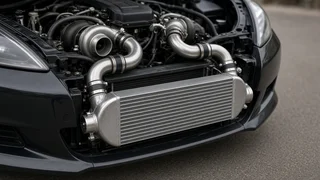
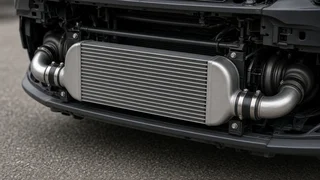
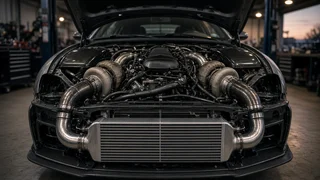
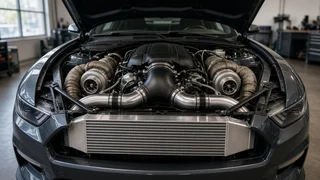
Twin turbo intercooler for 1000–2000 hp
A twin turbo intercooler rated for 1000 to 2000 hp must remove enormous heat from compressed intake air before it reaches the engine. At these power levels, charge-air temperature and pressure loss directly control knock resistance, air density, and reliable output. Choosing a core based only on a peak horsepower number can mislead because plumbing, ambient conditions, and turbocharger efficiency change the actual cooling demand. The right intercooler supports the compressor outlet flow with minimal restriction while keeping intake air dense enough for sustained high-load pulls. Buyers searching for a 1500 hp twin turbo intercooler should evaluate the complete airflow path rather than the core alone.
The direct answer
For a twin turbo setup targeting 1000 to 2000 hp, the intercooler must be treated as a system decision, not a single badge rating. The core needs enough internal volume and ambient face area to lower charge-air temperature after both compressor outlets merge, while the end tanks and hose connections must avoid creating a pressure loss that erases the benefit of cooling. A unit advertised as a 1500 hp twin turbo intercooler may work at that level only under favorable airflow, moderate boost pressure, and short-duration pulls. Under sustained load or high inlet temperature, the same part can become a restriction.
The practical starting point is an air-to-air core with generous frontal surface area and short internal flow paths for a 1000 hp twin turbo intercooler, moving toward a thicker or larger core as demand rises toward 2000 hp. The measured boost pressure at the intake manifold and the temperature before and after the cooler give more useful information than a horsepower label alone. If the discharge side shows high temperature or the pressure drop climbs with RPM, the intercooler is undersized for the actual compressor outlet flow. In that case, increasing core volume or improving inlet ducting helps more than adding a second unit.