Truck Battery Tester: What to Check Before You Buy
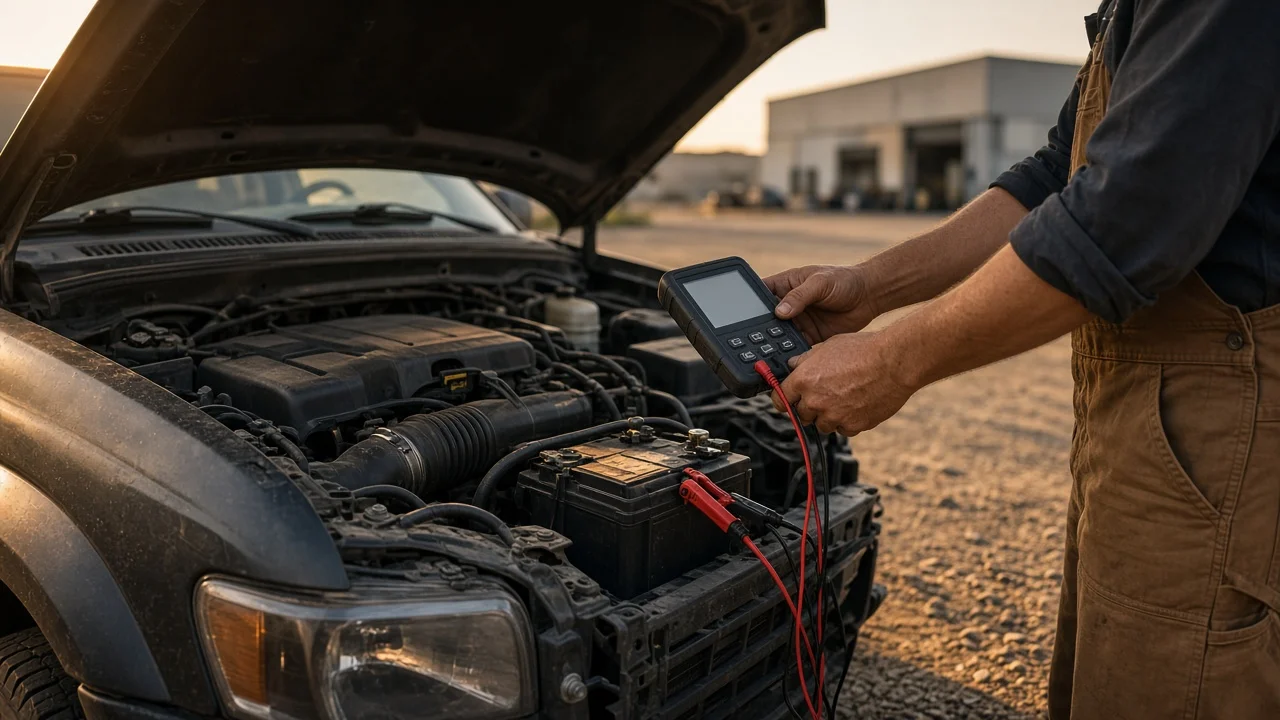
For most pickup and light-duty truck owners, the most practical choice is a digital conductance tester that works on 12-volt systems, supports your battery type (flooded, AGM or EFB), lets you enter the battery's rating in the standard printed on its label, and includes cranking and charging tests as well as a battery health test. Two conditions change that answer. If you work on heavy-duty trucks with 24-volt systems or several batteries, you need a tester rated for that voltage and for the higher cold cranking amp range those batteries carry. If your truck uses a lithium starting or auxiliary battery, confirm the tester explicitly supports lithium, because many conductance testers are designed only for lead-acid chemistry.
What a Truck Battery Tester Actually Tells You
A battery tester estimates whether a battery can still deliver the current it was rated for, not just whether it holds voltage. That distinction matters. A battery can show a normal resting voltage yet fail under the heavy demand of starting a diesel engine in cold weather. Voltage alone shows state of charge; a load or conductance test shows whether the battery's internal condition can support real cranking demand.
Most testers sold for automotive use report some combination of resting voltage, estimated cold cranking amps (CCA), state of health, and a pass, recharge-and-retest, or replace result. Better units add system tests that look beyond the battery itself.
Types of Battery Testers
Type | How it works | Strengths | Limitations; Digital conductance tester | Sends a small signal through the battery and estimates its condition from the response | Fast, no heavy load, safe to repeat, often includes cranking and charging tests | Accuracy depends on correct battery type and rating input; may not support lithium; can be misled by surface charge or poor clamp contact; Carbon pile load tester | Applies a large, adjustable electrical load and watches voltage under that load | Tests the battery the way starting does; trusted for heavy-duty work | Bulky, gets hot, drains the battery during the test, battery must be well charged first; Fixed-load handheld tester | Applies a set load through a resistor for a few seconds | Simple and inexpensive | Fixed load may be too small for large truck batteries; less precise; Digital multimeter | Measures voltage, and current with the right setup | Versatile; needed for voltage drop and parasitic draw checks | Does not test battery health on its own; Hydrometer | Measures electrolyte specific gravity cell by cell | Can reveal a single weak cell in serviceable flooded batteries | Only works on batteries with removable caps; messy; not for AGM or sealed units
Many truck owners end up with two tools: a conductance tester for quick health checks and a multimeter for tracing wiring and charging problems. A carbon pile tester makes more sense in a shop or fleet setting where large batteries are tested often.
Key Features to Check When Buying
System voltage support
Pickups, vans and most light and medium trucks in the US run a 12-volt system, even when they carry two batteries. Many diesel pickups wire two 12-volt batteries in parallel, which keeps system voltage at 12 volts while increasing available current. Some heavy-duty trucks, buses and equipment use 24-volt systems, with batteries wired in series. Check your truck's wiring diagram or battery layout before buying, and choose a tester labeled for 12/24-volt use if you work on both.
Battery chemistry compatibility
Conductance testers interpret readings differently depending on battery construction, so the tester should let you select flooded, AGM, EFB, gel or deep-cycle as applicable. Trucks with start-stop systems often use AGM or EFB batteries, and testing them on a flooded setting can produce a misleading result. Lithium batteries behave differently again; use only a tester that states lithium support.
Rating standards and CCA range
Battery labels state cranking ability under different standards, such as SAE (common in the US), EN, DIN, JIS or IEC. A good tester accepts the standard printed on your battery so it can compare the measured result to the correct rating. Truck and commercial batteries are often rated higher than car batteries, so confirm that the tester's CCA input range covers the batteries you own.
Cranking and charging system tests
A battery that keeps going flat is not always the problem. Look for a tester that can check cranking voltage while the engine starts and charging output while the engine runs. A cranking test shows how far voltage falls during starting, which can point to a weak battery, a struggling starter or poor connections. A charging test checks whether the alternator is raising system voltage into its normal range and whether it holds there with accessories switched on. Some testers also flag excessive ripple, which can indicate a failing diode in the alternator.
In-vehicle testing
Removing batteries from a truck can be heavy, awkward work, especially with dual-battery setups. Choose a tester that can test a battery while it stays connected in the vehicle. For parallel dual-battery systems, accurate individual results usually require disconnecting one battery from the other, because the connected battery affects the reading; check whether the tester's instructions address this.
Clamps, cables and build
Clamps should bite firmly onto battery terminals, including side-post terminals found on some GM trucks, either directly or through adapters. Cable length matters on trucks where batteries sit low, deep in the engine bay, or under a cab step. A readable display in bright light, a sturdy housing and insulated clamps are worth more than extra menu features.
Data, printing and fleet features
Shop and fleet buyers may want built-in printing, app connectivity, stored test history or VIN-based records. For an individual owner, these features add cost without adding diagnostic accuracy.
How to Get a Reliable Reading
Clean corroded battery terminals before testing; corrosion adds resistance and can make a good battery look weak. Remove surface charge after driving or charging by switching on the headlights briefly with the engine off, then switching them off and waiting a few minutes. Enter the battery type and rating exactly as printed on the label. Clamp directly to the battery posts rather than to remote jump points when testing battery health. If the result says recharge and retest, fully charge the battery with a proper charger before deciding to replace it. Test in moderate temperatures where possible; very cold batteries read lower.
As a general reference for a 12-volt lead-acid battery, a resting voltage of about 12.6 volts indicates a full charge, and readings in the low 12-volt range indicate a substantially discharged battery. A running charging system typically holds somewhere in the high 13s to mid 14s, though the exact target varies by vehicle, temperature and battery type, and some trucks use variable-voltage charging that deliberately runs lower at times. Treat the vehicle's own specification as the authority.
Problems a Battery Tester Won't Find
If the battery tests good but the truck still won't start reliably or keeps going flat, the cause is often elsewhere in the electrical system. These checks need a multimeter, and sometimes a clamp-type ammeter.
Voltage drop: measuring voltage across a cable or connection while cranking reveals resistance in battery cables, ground straps or the starter circuit that a battery test won't show. Parasitic draw: a module, light or accessory that stays powered with the truck off can drain a healthy battery overnight. Measuring current with the ignition off, then pulling fuses one at a time while watching the reading, helps isolate the circuit. Follow the fuse box layout and the fuse rating marked for each position, and reinstall each fuse in its correct slot. Intermittent charging faults: a loose alternator connection or failing regulator may test normal one moment and fail the next. A wiring diagram for your specific model year and powertrain helps trace these circuits. Aftermarket accessories: winches, light bars, inverters and upfitter equipment can add load or draw that the factory charging system wasn't sized for.
Choosing the Right Tester for Your Situation
Single gas pickup or light truck: a 12-volt conductance tester with battery, cranking and charging tests, plus a basic multimeter. Diesel pickup with dual batteries: the same, with a CCA range that covers higher-rated batteries and clear instructions for testing each battery separately. Truck with start-stop: confirm AGM and EFB settings are available. Heavy-duty or mixed fleet: a 12/24-volt tester with a wide CCA range, durable clamps and record keeping, with a carbon pile tester as a second check. Lithium auxiliary or starting battery: a tester that explicitly lists lithium support, or the testing method recommended by the battery's maker.
Safety Basics
Lead-acid batteries can release hydrogen gas, especially during charging or heavy load testing, so avoid sparks and flames near the battery and connect clamps in the order the tester specifies. Wear eye protection, keep metal tools from bridging the terminals, and let carbon pile testers cool between tests.