Transmission Fluid Maintenance and Repair
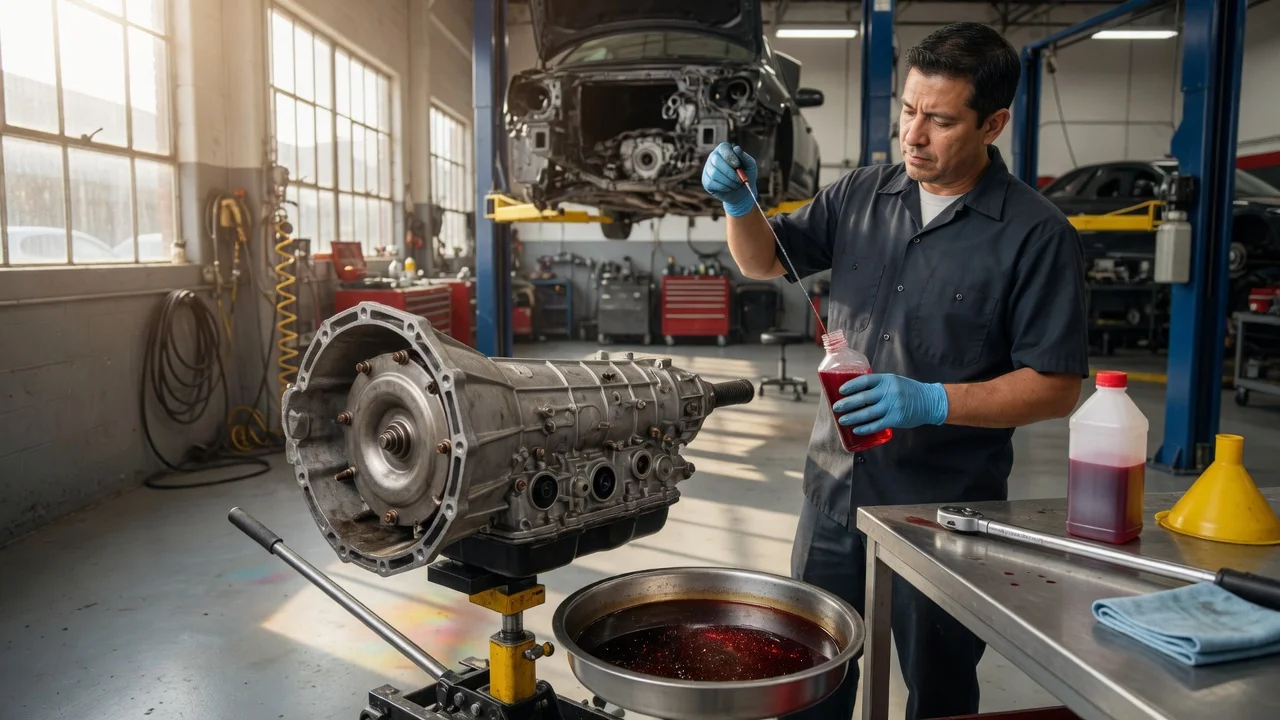
What a transmission fluid leak repair actually involves
Repair means finding the leak, replacing the failed seal, gasket, line, cooler, pan, or related hardware, then refilling with the fluid specified for that transmission and setting the correct level. The job ranges from a pan gasket or cooler-line fitting to a torque-converter or input-shaft seal that requires removing the transmission. Until the source is identified, the only safe assumption is that fluid is leaving the unit and the remaining volume may already be low.
Automatic, dual-clutch, continuously variable (CVT), and manual transmissions use different fluids, fill procedures, and leak points. Color, smell, dipstick presence, and service interval all depend on model year, generation, powertrain, and market. A procedure that fits a conventional automatic with a drainable pan does not automatically apply to a sealed unit or a CVT.
Confirm the fluid and how serious the loss is
A leak under the vehicle is evidence to investigate, not proof of a failed part. First confirm it is transmission fluid rather than engine oil, power-steering fluid, coolant, or brake fluid. Fresh automatic transmission fluid is commonly dyed red or pink and feels oily; aged fluid can turn brown or dark red and may smell burnt. Some CVT and dual-clutch fluids are amber, green, or nearly colorless. Engine oil is typically brown to black and pools farther forward. Coolant is watery. Brake fluid is thinner and usually near a wheel or the master cylinder.
If the transmission has a dipstick, check level and condition with the engine at the temperature and selector position the owner’s literature specifies. Many later automatics, dual-clutch units, and CVTs have no dipstick and are checked at an overflow plug with the fluid in a stated temperature window. Do not add fluid of an unknown type to “top it off” while diagnosing; the wrong specification can damage clutches, valves, and pumps.
Park on a clean surface or cardboard after a short drive and note where the drip sits relative to the engine, transmission, and wheels. Wipe the transmission case, pan rail, cooler lines, and nearby exhaust so a fresh wet trail can show the origin. Look for fluid on the bellhousing, pan, cooler hoses, radiator end tanks, axle seals, and the area around the shifter cable or electrical connectors. Note slipping, delayed engagement, harsh shifts, a burning smell, a transmission-temperature or check-engine lamp, or a stored transmission-related fault code. Treat a code as a reason to inspect the hydraulic and electrical system, not as proof that a solenoid or the whole unit has failed.
Likely sources and what each finding points to
External seepage at a joint or hose is often repairable in place. Fluid appearing at the front of the transmission, between the engine and the case, often traces to the torque-converter seal, pump bushing, or a cracked converter; those repairs usually require separating the transmission from the engine. Fluid at an axle or output flange points to an output or drive-axle seal. Fluid only at the pan rail after a recent service often means a damaged pan gasket, warped pan, or overtightened or uneven bolts.
What you observe What it commonly indicates Typical next check; Red or dyed oily drip under the center of the vehicle External leak from pan, cooler lines, case plugs, or seals Clean the case, idle in park, and watch for a fresh trail; Wet cooler hoses or fittings at the radiator or a remote cooler Line, clamp, O-ring, or cooler leak; heat and vibration fatigue rubber and fittings Inspect hoses for cracks, abrasion, and seepage at crimps; Fluid on the bellhousing or converter cover Converter seal, pump seal, or front case leak Inspect after a short drive; a large wet area here is not a pan-gasket job; Fluid at an inner CV boot or output flange Axle or output-shaft seal Check the seal lip, the axle journal for a groove, and the vent for overpressure; Fluid around the fill, drain, or level plug Loose plug, missing crush washer, or damaged threads Confirm torque and washer type before assuming a case crack; Low level with no obvious external drip Internal consumption, leak onto a hot exhaust that burns off, or a slow weep that only shows after driving Reinspect when hot; a shop may use dye and a lift; Slipping, flare, or delayed drive/reverse with a low reading Insufficient line pressure from low volume Stop using the vehicle if engagement is unreliable
A wet vent or widespread misting on the case can mean overfilling, a blocked cooler, or fluid that is overheating and expanding. A cracked case, porous casting, or damaged electrical connector sleeve is less common but will not seal with a pan kit. If the leak only appears after a fluid and filter service, recheck pan-gasket alignment, filter-seal seating, drain-plug washer, and cooler-line fittings disturbed during the job.
When to stop driving and when a shop diagnosis is required
Stop using the vehicle if the level is below the safe mark, if Drive or Reverse engages late or not at all, if the transmission slips under load, if a burning smell is strong, or if a transmission-temperature warning is on. Continued operation with low fluid starves the pump, overheats clutches and the converter, and can turn a seal repair into a full rebuild. A small, slow weep that leaves the level in range can often be driven a short distance to a repair facility if the unit still shifts normally.
Professional diagnosis is the next step when the source is not visible from above or on a driveway, when fluid is at the bellhousing, when a sealed unit has no owner-accessible level check, or when shift quality has already changed. A fault code related to ratio, pressure, or temperature supports further testing of the hydraulic and control system; it does not by itself identify a leaking pan gasket or a failed solenoid.
Repair path once the leak is located
Match the repair to the failed part. A pan gasket is replaced with the pan down, the filter inspected or replaced if the design uses one in the pan, the magnet cleaned, and the pan bolts tightened in a crossing pattern to the specified torque. Cooler lines are replaced as assemblies when the rubber is cracked or a crimp weeps; reuse of a crushed sealing washer is a common reason a “tightened” fitting still leaks. Axle seals need a clean bore, the correct depth, and a smooth axle journal; a grooved journal may need a repair sleeve.
Converter and pump seals, most input-shaft seals, and many internal leaks are not driveway repairs. After any repair, fill only with the fluid named in the factory service information for that transmission family. Capacity after a pan drop is less than a dry fill because the converter and cooler retain fluid. Level is set with the method for that unit: dipstick hot in a stated gear, or overflow at a stated temperature. Road-test, then recheck for seepage and level.
Fluid and filter kits when service is part of the repair
A typical pan-service kit for a conventional automatic includes a filter, pan gasket or reusable pan seal, and sometimes drain-plug washers or a filter O-ring. It does not usually include the fluid, cooler-line washers, or axle seals. Kit contents vary by transmission code, not just by vehicle nameplate; the same model year can use more than one gearbox. Confirm the transmission identification tag or service code before ordering.
A kit is appropriate when the pan is coming off to replace a gasket or when scheduled service coincides with a pan leak. It is not a substitute for a converter seal, a cracked case, or a failed cooler. After a leak that left the unit low, inspect the pan magnet and filter for heavy clutch material or metal; large amounts of debris argue for inspection beyond a gasket and fill, and that finding belongs in the repair decision rather than being treated as normal dust.
Use the fluid specification printed for that transmission (for example a specific ATF, CVT, dual-clutch, or manual oil), not a generic “universal” claim unless the maker lists it as equivalent. Replace crush washers and cooler-line O-rings whenever those joints are opened. If the pan is a one-time RTV joint, follow the sealant type and bead path in the service procedure; a cork gasket from a different design will not seal it. For sealed units, a “change kit” may be a drain-and-fill quantity plus a level-plug washer, with no owner-serviceable filter.
What this guide cannot settle without your vehicle details
Exact leak points, torque values, fluid type, fill quantity, and whether a dipstick exists depend on the transmission family fitted to the vehicle, which can differ by model year, engine, drive type, and market. Those figures are not stated here because they are not supplied for a specific vehicle. If shift quality is already poor, the leak has been present for an unknown time, or the source is at the converter housing, treat the next action as a lift inspection and a measured level check rather than a parts-cannon pan kit.