Transmission Cooler Lines Repair Cost: What Shapes the Price
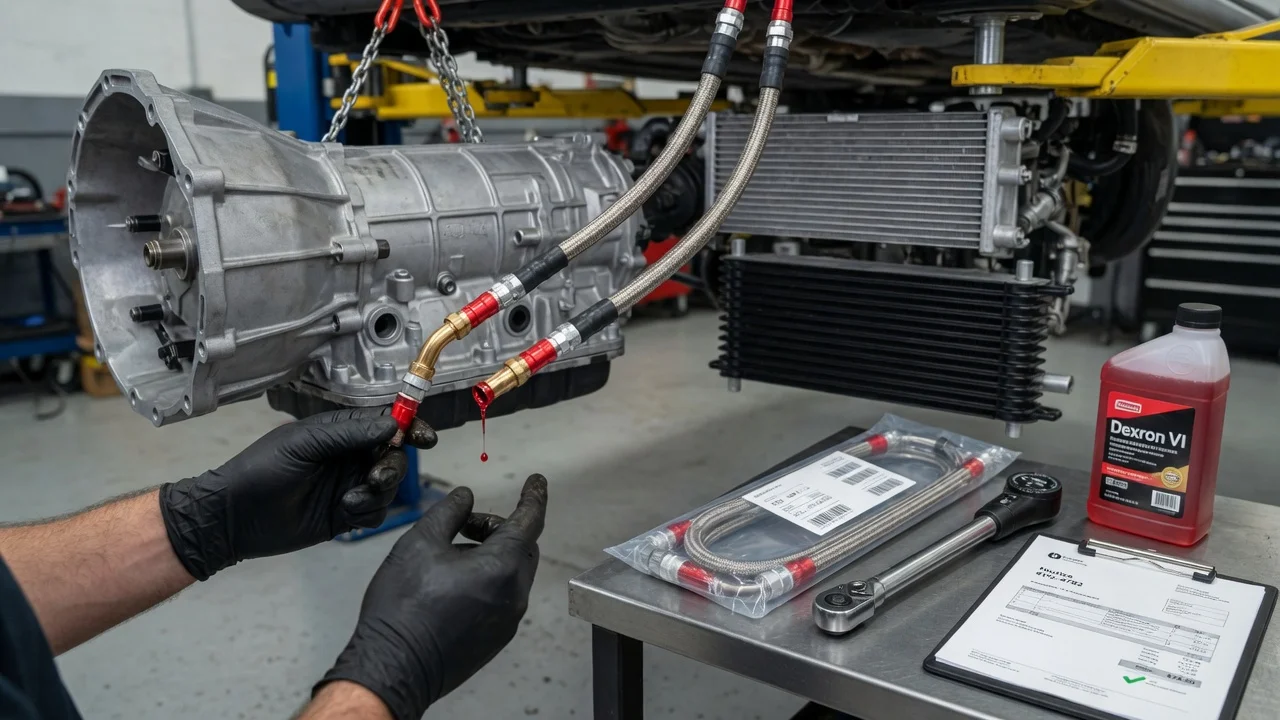
Transmission cooler lines carry fluid between the transmission and its cooler, usually a heat exchanger in the radiator tank or a separate auxiliary cooler mounted ahead of the radiator. When a line leaks, the final bill often depends less on the tube itself than on what the job requires around it. This guide covers what an estimate should include, what moves the price, and how to compare offers for your specific vehicle.
What the estimate includes
A complete estimate for repairing transmission cooler lines normally covers confirming the leak source, the replacement line or line assembly, any fittings, O-rings or retaining clips, labor, the fluid needed to refill the transmission, a level check using the manufacturer's procedure, and shop supplies, disposal fees and tax. Many numbers you see are only part of that total. A parts-only price for a line assembly says nothing about labor, and a labor quote may leave out fluid or the inspection needed to find the leak in the first place. Before comparing, make sure each number represents the same finished job.
Most vehicles have two cooler lines, a supply and a return, and they may be sold separately or as a single assembly. A wet line does not by itself prove that line has failed. Fluid travels along tubes and underbody panels, so the actual source could be a fitting, the connection at the cooler, the pan gasket, an axle seal, or a different fluid altogether. A proper inspection, often after cleaning the area, should confirm the source before anyone prices the repair.
What changes the cost
Configuration comes first. Transmission type matters, whether it is a conventional automatic, a CVT, a dual-clutch unit or a manual equipped with a cooler, along with the engine, drivetrain and whether the vehicle has a towing package with an auxiliary cooler. Line construction varies: some are all steel, some combine steel tubing with crimped rubber sections, and many use quick-connect fittings at the radiator. On some models the manufacturer only sells the line as a full assembly running from the transmission to the cooler, which affects both part price and fitment.
Labor depends heavily on access. Lines may run behind the engine, along the oil pan or above a crossmember, and reaching them can mean removing splash shields, intake components, the battery tray, or on some vehicles exhaust parts or a subframe support. Corrosion adds risk in areas that use road salt, because seized fittings can twist or break and occasionally damage the cooler connection. Your location and the shop's labor rate, dealer versus aftermarket parts, and the required fluid specification all shift the total. Some transmissions also need a temperature-controlled level check with a scan tool, which adds time.
Associated work can change the scope entirely. If the leak ran the fluid low, the shop may want to evaluate shift behavior and check for diagnostic codes before calling the job finished. If the cooler inside the radiator has failed and mixed coolant with transmission fluid, that is a far larger repair than replacing a line. Ask the shop to separate those findings from the line repair so you can see what each part costs.
Compare like-for-like options
Repair options usually fall into a few groups: an original-equipment line assembly, an aftermarket preformed assembly, or a section repair where the damaged portion is cut out and replaced with hose rated for transmission fluid, compression fittings or newly flared tubing. A section repair can cost less, but these lines carry hot, pressurized fluid, and a clamp on smooth tubing without a bead or barb can slip. Some manufacturers do not approve splicing for certain lines, and aftermarket assemblies vary in how well they match the original routing and mounting points.
To compare fairly, check that each offer is based on the same confirmed leak source, the same lines and parts quality, the correct fluid specification and quantity, and similar warranty terms on both parts and labor. Confirm whether the level check and a road test are included. A cheap section repair with no warranty and a full assembly replacement with a parts-and-labor warranty are not equivalent quotes. Your service history matters too: if an earlier shop already spliced the line, a new section repair may not be a sensible option.
Read an itemized quote
A useful quote identifies the vehicle by VIN and names the transmission. It should list part numbers and say whether they are OEM or aftermarket, and specify which line is being replaced: supply, return or both. Fittings, O-rings and clips should appear as separate items or be clearly included. Labor should show hours and rate. Fluid should be named by specification and quantity, not just as transmission fluid. Look for the diagnostic or inspection fee and whether it is credited toward the repair, plus shop supplies, disposal charges and taxes.
Then look for what is excluded. Common add-ons include seized or broken fittings, cooler or radiator damage found during removal, extra fluid or a recommended fluid service if the level ran low, a cooler flush, and a follow-up level check after driving. Ask how the shop handles discoveries mid-job. A good practice is that they stop and call you with a revised figure before doing any additional work.
Decide the next step
Before contacting shops, have your VIN ready and note the transmission type if you know it. Record where you see the drip, when it appears, the fluid color, any changes in shift behavior and any warning lights. Look through your service history for earlier line or cooler work. If the leak is significant or the transmission slips, flares or shifts harshly, limit driving or consider towing, because running low on fluid can damage the transmission.
Ask each shop to confirm the leak source first, then request itemized quotes covering the same scope and warranty. Avoid shortcuts that can cost more later: using fluid that does not meet the required specification, treating a stop-leak additive as a fix for a damaged line, splicing in hose not rated for transmission fluid, or skipping the manufacturer's fill and level check procedure. Choose the offer that fixes the confirmed problem with appropriate parts and a clear warranty, rather than the lowest headline number.