Toyota Tundra brake repair
Toyota Tundra brake repair covers the predictable wear of pads, rotors, and fluid as well as less frequent issues involving calipers, hydraulic pressure, and electronic controls. Because a full-size truck works hard while towing, hauling, descending grades, or managing trailered loads, brake components see higher heat and stress than a commuter sedan. Understanding how the friction system behaves on a Tundra helps you decide whether a repair is routine maintenance, a targeted part replacement, or a warning sign that needs prompt attention. Observable symptoms usually point to the likely area of concern before significant damage spreads.
Essential answer
The essential answer to a Toyota Tundra brake repair question is that the work should begin by identifying which part of the system has reached its wear limit or lost proper function. Brake pads are the most common replacement because their friction material is designed to sacrifice itself gradually. Rotors also wear or develop thickness variation, and brake fluid absorbs moisture over time, reducing its resistance to heat. A repair is not a single fixed procedure; it may involve resurfacing or replacing rotors, fitting new pads, flushing fluid, or addressing a sticking caliper.
Tundra brake work differs from light-vehicle service mainly because of vehicle fitment and duty cycle. The same fundamental system uses a pedal, booster, master cylinder, lines, calipers, pads, and rotors, but the components selected for a heavy pickup must handle higher kinetic energy during stops. Repeated mountain descents, trailers without integrated braking, or oversized tires can accelerate wear even when the odometer reading looks low. For that reason, an estimate based on mileage alone is less useful than a physical check of lining thickness and rotor condition.
Diagnosing a problem
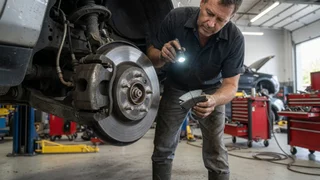
Brake diagnosis starts with separating normal wear from behavior that indicates heat damage, contamination, or uneven application. A high-pitched squeal may come from a wear indicator contacting the rotor, glazed friction material, or a thin layer of rust after sitting. A pulsating pedal often suggests rotor thickness variation or runout rather than a pad defect. Pulling to one side can point to a caliper that is not releasing evenly, while a low or spongy pedal more commonly relates to air or moisture in the brake fluid. Each result narrows the repair path instead of assuming the wrong component.
Because manufacturer-dependent codes and vehicle-specific thresholds vary, a stored fault code is evidence to investigate rather than proof that a particular part has failed. On vehicles with electronic brake distribution or stability control, a code may reflect a sensor input, hydraulic unit condition, or communication issue affecting operation. If the pedal becomes hard, the truck loses braking force, or fluid is visibly leaking from a caliper or line, stop driving and arrange professional diagnosis. Routine friction inspection can be done without unsafe shortcuts, but any open hydraulic circuit or active fault requires careful, system-specific confirmation.