Towing a travel trailer without sway control
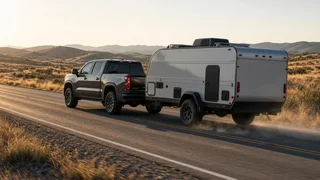
Towing a travel trailer without sway control is possible, but it changes how weight, speed, steering, and braking interact. A trailer can follow steadily until crosswinds, passing trucks, pavement ruts, or an evasive maneuver introduce side forces. Without a sway control device, the driver is the only active correction system. This overview explains why a trailer begins to oscillate, what that feels like from the driver’s seat, and which loading and speed decisions matter most. It also clarifies how weight ratings and axle placement affect stability before the first mile.
Essential answer
The essential answer is that towing a travel trailer without sway control is not automatically unsafe, but it leaves a smaller margin for error. Sway control resists the side-to-side yaw motion that starts when wind, truck wake, downhill speed, or steering input pushes the trailer off its straight path. Without that resistance, the driver must prevent the motion from growing by lowering speed, adjusting trailer loading, and avoiding abrupt inputs. The risk is not constant; it rises sharply when the trailer is lightly loaded at the tongue or when speed is high for the trailer’s size.
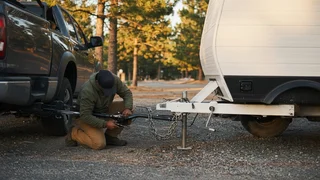
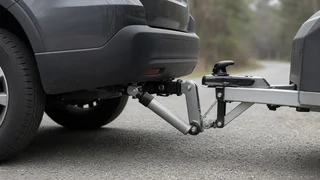
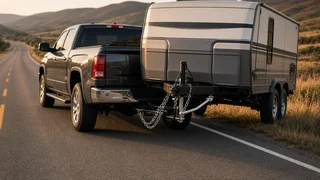
A travel trailer becomes a long lever pivoting at the hitch ball. Its stability depends on tongue weight, axle position, payload distribution, and the relationship between the tow vehicle’s rear axle and the trailer axles. Without sway control, the setup relies more heavily on mechanical balance. If enough tongue weight and proper weight distribution are present, the combination can track reasonably well. If the trailer is tail-heavy or the hitch is underloaded, small disturbances can build into a repeating side-to-side oscillation that the driver must correct early.