Skoda Octavia engine oil capacity
What oil capacity does a Skoda Octavia take?
A Skoda Octavia does not have one engine-oil capacity. The volume you put in at a service is set by generation, the exact petrol or diesel engine, and whether the oil filter is replaced at the same time. From Octavia I through Octavia IV, a normal drain-and-refill with a new filter typically falls between about 3.6 and 5.7 litres. The litres listed in the owner’s handbook for that engine, or in Skoda workshop data against the vehicle identification number, are the figures to follow. Oil always remains in galleries, the cooler and the filter housing after a drain, so the handbook service fill is a starting quantity. The dipstick, or the car’s electronic oil-level reading, is what confirms a correct fill.
What changes the fill volume
Capacity is an engine attribute, not a trim or body-style attribute. A hatchback, estate and four-wheel-drive car with the same engine code share the same engine-oil quantity. A vRS uses the capacity of its 2.0 TSI or 2.0 TDI, which is larger than the three-cylinder and 1.5-litre petrol units. Plug-in hybrid Octavia iV and G-TEC compressed-natural-gas models still take the oil volume of their petrol engine; the hybrid battery and the gas system do not set that figure. Marketing names such as TSI, TDI and MPI are not enough on their own, because two engines with the same badge can use different sumps and cooler circuits.
Generation and model years: Octavia I (1996–2010), Octavia II (2004–2013), Octavia III (2012–2020) and Octavia IV (from 2020) use different engine families. Engine code and displacement, which appear in the service book, on the type plate and on the sticker in the spare-wheel well or luggage floor. Whether the oil filter is changed. A new filter typically adds a few tenths of a litre compared with oil only. Service fill after a drain versus a dry fill after a rebuild or after the cooler and lines have been emptied. A dry fill is higher. Later TSI and TDI engines that carry extra oil in a filter module or cooler, which can raise the book figure compared with an older engine of similar size.
Typical service-fill bands by engine family
The bands below are approximate service fills with a new filter. They are a planning range for how much oil to buy, not extracts from a specific owner’s handbook, and they are not a substitute for the figure printed for your engine code. Exact tenths of a litre were not verified here against handbook pages for each code. If two sources disagree, the handbook and the data sticker on that car take priority.
1.0 TSI, 1.2 TSI and many 1.4 TSI petrol engines: about 3.6–4.5 litres. 1.5 TSI petrol: about 4.0–4.5 litres. Older 1.6 MPI and similar naturally aspirated petrol engines: about 4.0–4.5 litres. 1.8 TSI and 2.0 TSI petrol, including vRS: about 4.6–5.7 litres. 1.6 TDI, 1.9 TDI and 2.0 TDI diesel engines: about 4.3–5.5 litres.
Service fill versus a dry fill
The number owners need at a routine oil change is the service fill: engine drained, new filter fitted, cooler still holding residual oil. A dry fill, used after an engine rebuild or when the cooler and lines have been emptied, is several tenths of a litre higher and is not the volume to pour into a car that has simply been drained. Pouring a dry-fill quantity into a service-fill sump will overfill the engine.
How to get the figure for your car
Read the engine code from the service book, the type plate, or the sticker in the spare-wheel well or luggage floor. Open the owner’s handbook section on capacities, usually under technical data or engine oil. Use the with-filter figure for a normal service. If the handbook lists more than one engine, match the code, not only the badge on the tailgate. A Skoda dealer or independent specialist can confirm the volume against the vehicle identification number when the printed sources conflict.
Filling and checking the level
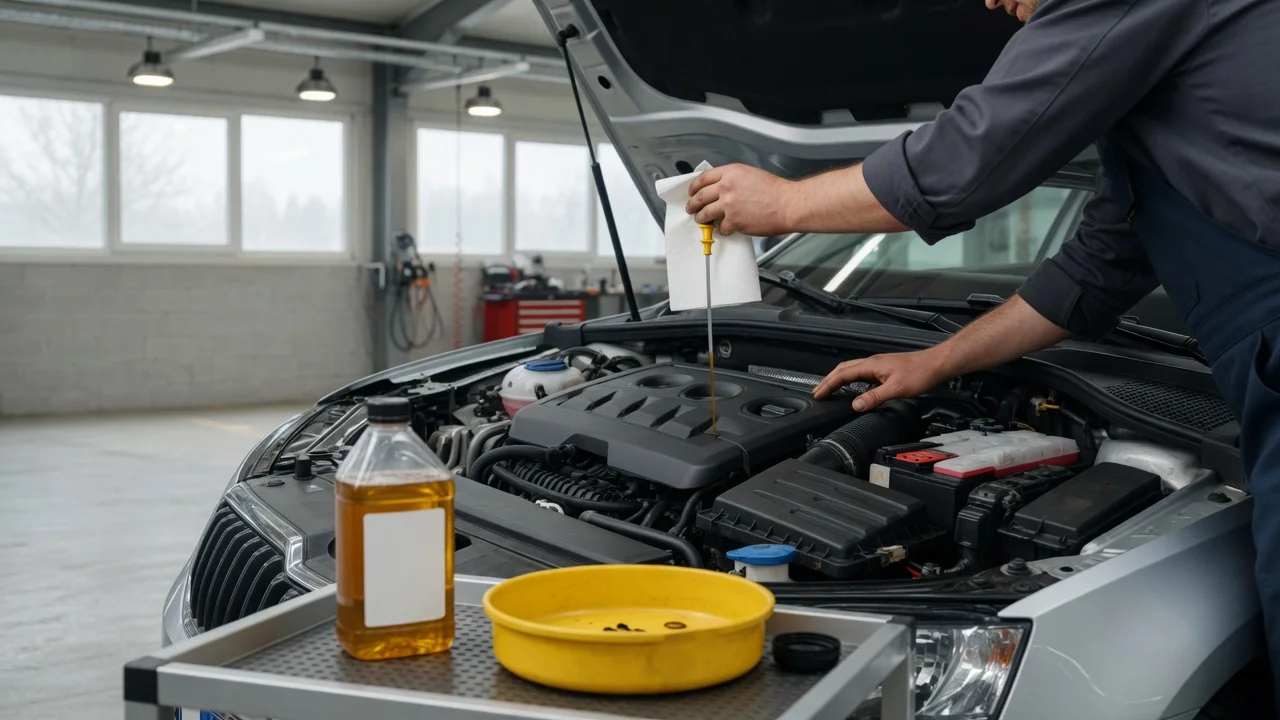
Drain the engine warm, replace the filter and the sump-plug washer, then refill most of the handbook amount. Run the engine at idle, switch off, wait for the oil to settle, and top up to the mark. Do not treat the book figure as a volume that must all go in if the level is already at maximum. Overfill can damage the catalyst and, on TDI and later TSI engines, the particulate filter. Cars without a dipstick use the instrument or infotainment oil-level procedure on level ground after the wait the handbook specifies. Recheck after a short drive, because a new filter and cooler circuit can pull the level down slightly.
Oil volume is not oil specification
Capacity is how much oil the engine holds. Specification is which oil it must use, for example a VW 504 00 / 507 00 long-life oil on many later TSI and TDI engines, or older VW 502 00, 505 00 and 505 01 grades on earlier units, in a viscosity such as 0W-30 or 5W-30. Using the right litres of the wrong specification still leaves the engine unprotected. Manual-gearbox and DSG oil are different fluids with their own quantities; they are not part of the engine-oil capacity.