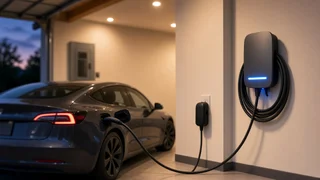
SCE Electrical Panel Upgrade for Home EV Charging
Adding a Level 2 EV charger often raises one question for Southern California Edison (SCE) customers: does the home's electrical panel need an upgrade first? Many homes do not. An upgrade is needed only when a load calculation shows the existing panel and service cannot safely carry the charger's continuous load on top of what the house already uses. When an upgrade is required, the work splits between a licensed electrician and your local permitting office on the home side, and SCE on the utility side. SCE is involved mainly when the electrical service itself must change, not every time a panel is replaced.
The Short Answer
SCE does not install home EV chargers or replace residential breaker panels. Those jobs belong to the homeowner's electrician. SCE's role begins when the project increases the home's service capacity, requires a new or relocated meter, or needs the utility to disconnect and reconnect power. In those cases the electrician or homeowner coordinates with SCE, and SCE may need to evaluate or upgrade its own equipment, such as the service drop, underground lateral or neighborhood transformer. Whether you need any of this depends on your home's existing service size, current electrical loads and the charging speed you want.
Panel Upgrade vs. Service Upgrade
People often say 'panel upgrade' when they mean several different jobs. The difference matters because it determines who does the work, whether SCE has to be involved, and how long the project takes.
Type of work | What changes | Typical SCE involvement; Adding a circuit only | A new 240-volt breaker and wiring for the charger in the existing panel | Usually none; Panel replacement at the same rating | A new breaker panel with more spaces or modern breakers, same service amperage | Often limited to a disconnect and reconnect if the meter must be pulled; Service upgrade | Higher service amperage, such as moving from a 100-amp to a 200-amp service, often with a new meter-main panel | SCE review and scheduling, plus possible work on utility-side equipment; Meter relocation or new meter panel | The meter socket or combination meter-main unit is moved or replaced | SCE approval of the meter location and equipment, and reconnection
Many Southern California houses use a combination meter-main panel. In that design the utility meter and the main breaker share one enclosure on the exterior wall. Replacing that unit almost always affects the meter, so SCE coordination is likely even when the service amperage stays the same.
How to Tell Whether Your Home Needs an Upgrade
The deciding factor is a load calculation, not the number printed on the main breaker alone. An electrician totals the home's existing and planned loads using the methods in the National Electrical Code (NEC), which California adopts through its own electrical code. The calculation shows whether the service has enough spare capacity for an EV charger.
Electrical code treats EV charging as a continuous load, so the charger's circuit must be sized at 125 percent of the charger's continuous current. A charger that draws 32 amps continuously, for example, needs a 40-amp circuit. This sizing rule is one reason a charger can push a smaller service past its limit.
Signs that an upgrade may be needed: The home has an older or lower-amperage service, such as 100 amps or less, and already runs large electric loads. The panel has no free breaker spaces, and tandem breakers or reorganizing cannot solve that. The home has, or will add, other major electric loads such as a heat pump, electric range, electric water heater, pool equipment or a second EV. The panel is a model with a known history of reliability concerns, is damaged, or shows signs of overheating. You want the highest charging speed your vehicle can accept, which calls for a larger circuit.
A home with a 200-amp service and mostly gas appliances often has room for a Level 2 charger without any service change. A smaller service in an all-electric home is a much more likely upgrade candidate. Only a site-specific load calculation answers the question for a particular house.
How the Upgrade Process Typically Works
Details vary by city, county and the condition of the property. The general sequence for an SCE service upgrade looks like this:
1) Assessment: A licensed electrician inspects the existing panel and service and performs a load calculation that includes the planned charger. 2) Design and equipment choice: The electrician specifies the new panel or meter-main unit and confirms it meets SCE's equipment and meter-location requirements. 3) Permit: The electrician pulls an electrical permit from the local building department. The permit comes from the city or county, not from SCE. 4) Utility coordination: For a service upgrade or meter change, the electrician submits the project to SCE. SCE reviews the request and determines whether its own equipment, such as the overhead drop, underground conductors or transformer, needs work. 5) Installation: The electrician installs the new equipment. SCE disconnects power for the changeover and reconnects it afterward, in some cases only after the local inspection is approved. 6) Inspection: The local building department inspects the work. 7) Charger installation: The EV charger circuit is installed, either as part of the same job or afterward.
Timelines are hard to predict. A simple circuit addition can be quick. A full service upgrade depends on permit processing, SCE's review and scheduling, and whether utility-side work is required. Homes with underground service, or neighborhoods where the transformer is near capacity, may take longer. Ask your electrician early what SCE coordination your specific job will need.
Alternatives That May Avoid a Full Upgrade
A service upgrade is not the only route to home charging. Depending on the load calculation and your driving habits, these options may make an upgrade unnecessary or postpone it.
Lower-amperage Level 2 charging: Many chargers can be set to a lower current. A smaller circuit may fit within existing capacity and still recharge a typical daily commute overnight. Level 1 charging: A standard 120-volt outlet adds range slowly, but it can be enough for drivers with short daily mileage. Load management devices: Some chargers and add-on devices monitor total household demand and reduce charging current automatically when other loads are high. Electrical code allows energy management systems to be considered in load calculations, subject to local approval. Circuit sharing or switching: Some devices let the charger share a circuit with another large appliance, such as a dryer, and run only one at a time. Smart panels: These panels can monitor and control individual circuits. In some cases they let a home add loads without increasing service size. Results depend on the product and on local inspector acceptance.
Each alternative trades some charging speed or flexibility for lower cost and less disruption. For a single EV with predictable daily driving, a managed or lower-amperage charger is often a practical choice. For households planning several electric appliances or more than one EV, a service upgrade may make more sense in the long run.
Costs, Rebates and Rate Plans
Panel and service upgrade costs vary widely. The main factors are the scope of work, equipment, local permit fees, wall or stucco repair, trenching for underground service, and whether SCE-side work is needed. Get itemized quotes from more than one licensed electrician, and ask each to state clearly which costs depend on SCE's review.
SCE has offered residential EV charging incentives at various times, and state, local and federal programs have also supported charger installation and panel work. Program availability, eligibility and amounts change, sometimes with little notice. Check SCE's current EV offerings and any local programs before you sign a contract, because some incentives require pre-approval or specific equipment.
Your electricity rate also affects the value of home charging. SCE offers time-of-use rate plans, including options designed for EV owners, that make electricity cheaper during off-peak hours. Scheduling charging for those hours, through the vehicle or the charger, can lower operating costs noticeably. Compare plans against your household's actual usage before switching.
Choosing the Right Next Step
Find your current service size on the main breaker, and note the major electric appliances in the home. Decide how much charging you need based on daily mileage, not the vehicle's maximum charging rate. Have a licensed electrician perform a load calculation and explain whether you need a new circuit, a panel replacement, a service upgrade or a load-management solution. If a service upgrade is recommended, ask how SCE coordination will be handled and what could affect the schedule. Review current SCE and local incentives and EV-oriented rate plans before work begins.
For many SCE customers, the answer is simpler than expected: a dedicated 240-volt circuit in the existing panel is enough. When it is not, knowing the difference between a panel replacement and a service upgrade makes it easier to compare quotes, plan around utility scheduling and choose the most cost-effective path to home charging.