Riding Side Saddle on a Motorcycle: What It Means and How It Differs From Riding Astride
The Short Answer
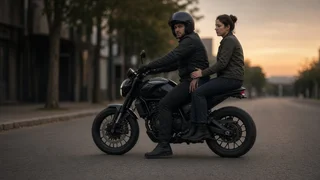
Riding side saddle on a motorcycle means a passenger sits sideways on the seat with both legs hanging off one side instead of straddling the bike. The practice is common in some parts of the world, especially on small motorcycles and scooters in South and Southeast Asia. In the US it is rare and generally discouraged. Motorcycle passenger seats, footpegs and handling assumptions are built around a passenger who sits astride, facing forward, with one foot on each side.
The main qualification is legal. Some US state vehicle codes say how a passenger must be seated, often requiring them to face forward with a leg on each side or to use footrests. Whether side saddle riding is specifically prohibited depends on the state, so check your state's motor vehicle code or rider handbook rather than assuming it is allowed.
What Side Saddle Riding Looks Like
In a typical side saddle position, the passenger sits on the rear section of the seat, angled roughly perpendicular to the direction of travel. Both legs dangle on the same side of the motorcycle, usually the left in countries where traffic keeps left, though this varies. The passenger usually holds the rider's waist, a grab rail, or the seat edge, and their feet may rest on one footpeg, a dedicated step, or nothing at all.
The term borrows from horse riding. Women historically rode horses side saddle while wearing long skirts, using specially designed saddles. Motorcycles have no equivalent purpose-built seat in mainstream production, which is a key reason the position works less well on two wheels.
Where and Why It Happens
Side saddle riding is mostly driven by clothing and culture rather than preference for the position itself. Long skirts, saris, sarongs and other traditional garments can make straddling a seat impractical or socially uncomfortable. In regions where small motorcycles and scooters are a main form of family transport, many passengers ride this way out of habit.
Manufacturers selling into those markets have adapted. Motorcycles sold in India, for example, are commonly fitted with a sari guard, a metal guard over the rear wheel that helps keep loose fabric from being drawn into the wheel or chain. US-market motorcycles generally lack this kind of hardware, because the design assumes an astride passenger.
Separately, the phrase sometimes refers to a freestyle stunt in which the rider moves both legs to one side while the bike is moving. That is a trained exhibition maneuver, not a way to carry a passenger, and it is outside the scope of normal road riding.
How Side Saddle Differs From Riding Astride
Factor | Astride passenger | Side saddle passenger; Body position | Faces forward, legs on both sides | Faces sideways, both legs on one side; Grip | Knees and thighs grip the seat or rider; feet brace on footpegs | No knee grip; relies mainly on hands; Weight distribution | Centered over the bike | Offset to one side; Movement in corners | Leans naturally with the bike | Tends to stay upright or shift unpredictably; Braking and acceleration | Can brace against footpegs and tank or rider | Slides or twists more easily on the seat; Foot and clothing clearance | Feet on pegs, away from wheel and exhaust | Feet and fabric closer to rear wheel, chain and exhaust; US bike design | Matches passenger seats, pegs and grab points | Not what most bikes are designed for
Effects on the Rider and Handling
A motorcycle steers and balances largely through lean. When a passenger sits astride and stays aligned with the rider, the combined mass leans as one unit. A side saddle passenger places their weight off-center and cannot move with the bike as easily, so the rider has to compensate.
Constant lateral imbalance: the rider may need to hold slight steering or body input just to keep the bike tracking straight, especially at low speed. Uneven cornering: turns toward the passenger's side and away from it can feel different, and a passenger who instinctively leans away from a turn makes the bike harder to steer. Low-speed instability: pulling away, stopping and slow maneuvering are harder when weight is offset and the passenger cannot brace with their feet. Mounting and dismounting: a passenger getting on or off from one side can tip a stationary bike if the rider is not ready. Added load on a smaller bike: lighter motorcycles and scooters are affected more by a shift in passenger weight than heavier touring machines.
Main Risks for the Passenger
Falling off: without knee grip or solid foot support, hard braking, a sudden swerve or a pothole can unseat a sideways passenger more easily. Entanglement: loose skirts, scarves or long garments near the rear wheel or chain can be pulled in. Burns: legs on one side may rest close to an exhaust pipe or muffler, depending on the bike's layout. Injury in a crash: a sideways body position offers less protection, and the passenger is less able to brace for impact. Reduced protective gear options: clothing chosen to make side saddle comfortable, such as long skirts, usually offers little abrasion protection.
Legal Considerations in the US
There is no single national rule on passenger seating position. Motorcycle passenger rules are set by each state and commonly cover items such as a proper passenger seat, passenger footrests, and in some states minimum passenger age or helmet use. Some states' wording describes the passenger sitting astride or facing forward; others simply require a designated seat and footrests. Because wording and enforcement differ, the reliable way to know whether side saddle riding is allowed where you live is to read your state's motor vehicle code or its motorcycle operator manual.
Even where a law does not mention side saddle riding directly, a passenger who cannot reach both footrests may not meet a footrest requirement. It is also worth asking your insurer how they treat a crash involving a passenger who was not seated as the motorcycle was designed.
If a Passenger Can't Ride Astride: Practical Alternatives
In most US situations, the better answer is to change the clothing or the vehicle rather than adapt the seating position.
Change clothing for the ride: riding pants, divided skirts or layering trousers under a skirt let the passenger sit astride; they can change on arrival. Use a sidecar: a sidecar gives a passenger a proper seat without straddling, and it removes the balance issue because the rig is a three-wheeled vehicle, though it handles very differently and needs practice. Consider a trike or three-wheeled motorcycle: many have a wider, more supportive passenger seat and do not depend on the passenger leaning. Choose a different vehicle for that trip: if a passenger regularly needs to travel in clothing that rules out straddling, a car or another form of transport may suit those trips better. Check seat and footpeg fit: some passengers avoid straddling because the seat feels too high or wide; a different passenger seat or adjustable pegs may make astride riding comfortable.
If Side Saddle Riding Happens Anyway
Where it is legal and the rider and passenger still choose it, typically for short, slow trips, a few basic principles reduce the risk without making the position safe in the way astride riding is.
Keep trips short and speeds low, and avoid highways and heavy traffic. Secure all loose fabric so nothing can reach the rear wheel, chain or belt. Keep the passenger's legs clear of the exhaust, and check where hot parts sit on that particular bike. Give the passenger a firm hand hold, such as a grab rail or the rider's waist, and agree that they will stay still rather than lean. Have the rider fully set and balanced before the passenger mounts or dismounts. Brake and accelerate smoothly and allow extra distance from other traffic. Wear a helmet and the most protective clothing practical, regardless of local helmet laws.
Bottom Line
Side saddle riding is a recognized way of carrying a passenger in some parts of the world, mainly because of clothing and local custom. On typical US motorcycles it works against how the bike is designed to carry a passenger: it offsets weight, removes the passenger's ability to grip and brace, and puts clothing and legs closer to moving and hot parts. Some states regulate passenger seating in ways that may rule it out. For most riders, the practical choice is to have the passenger ride astride in suitable clothing, or to use a sidecar, trike or other vehicle when that is not possible.