Reverse Osmosis Systems for Motorhome Drinking Water: What to Check Before You Buy
The Short Answer
A reverse osmosis system can give a motorhome noticeably cleaner, better-tasting drinking water, but it is not automatically the right choice for every coach. It works best for owners who often stay at campgrounds with water hookups, or who can fill a dedicated jug or small tank while connected. If you mostly camp off-grid, the water an RO unit sends to drain, its demand for steady pressure, and the space it takes up can outweigh the benefits. In that case a good multi-stage carbon filter, or an RO unit used only when hooked up, is often the more practical choice.
The deciding factors are how you camp, what water pressure and power your coach can supply, where the reject water will go, how much room you have under the galley sink, and whether you are prepared to protect the system from freezing and keep up with filter changes.
How Reverse Osmosis Works in Plain Terms
Reverse osmosis pushes water through a semi-permeable membrane, a thin layer with pores small enough to block most dissolved minerals, salts and many other contaminants. The cleaned water that passes through is called permeate or product water. The water that carries the rejected material away is called concentrate, brine or reject water, and it goes to a drain.
A typical system has several stages. A sediment pre-filter catches sand, rust and scale. One or more activated carbon pre-filters remove chlorine and improve taste and odor; this matters because chlorine can damage common thin-film membranes. The RO membrane does the main work. Many systems then add a carbon post-filter for taste, and some add a remineralization stage that puts back a small amount of calcium or magnesium, since RO water can taste flat to some people.
Water quality is often described by TDS, or total dissolved solids. An inexpensive handheld TDS meter lets you compare incoming water with product water, which is a simple way to tell when the membrane is wearing out. TDS does not measure everything, though, so a low reading is not proof that water is free of every contaminant.
Is RO a Good Fit for Your Motorhome?
RO tends to suit you if you:
Travel to areas where campground water tastes of minerals, sulfur or heavy chlorine; Spend most nights on full or partial hookups; Want a dedicated drinking-water tap instead of buying bottled water; Have space under the galley sink and a practical way to drain reject water; Are willing to follow a regular filter and membrane replacement schedule
RO is a weaker fit if you:
Boondock for long stretches and need to stretch your fresh tank and grey tank capacity; Have very limited cabinet space or a galley sink without room for an extra faucet; Camp in freezing conditions without a heated, enclosed plumbing area; Mainly want to remove chlorine taste and sediment, which simpler carbon filtration already handles
The most important trade-off for motorhome owners is waste. Conventional RO systems send part of the incoming water to drain to keep the membrane clean. On hookups this rarely matters. When you are running from the fresh tank, every gallon of reject water drains your supply and fills your grey tank at the same time, shortening how long you can stay put.
Types of RO Systems Used in Motorhomes
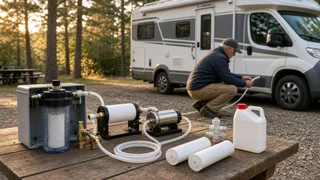
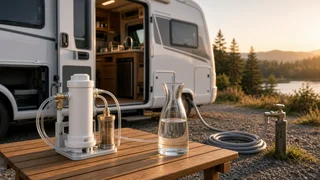
Type | How it works | Best for | Main trade-offs; Countertop or portable | Freestanding unit, often with its own reservoir and pump; may plug into 120V or run from 12V | Owners who want no permanent plumbing changes | Uses counter space; must be secured or stowed while driving; Under-sink tankless | Fills on demand through an internal booster pump; no storage tank | Compact galleys where a tank will not fit | Usually needs electrical power; flow depends on pump and membrane capacity; Under-sink with storage tank | Membrane fills a small pressurized tank that feeds a dedicated faucet | Owners with enough cabinet space who want water available without power | Tank takes room and adds weight when full; slower refill; External or hose-connected | Sits outside the coach and filters campground water before it reaches your tank or a container | Filling a fresh tank or jugs on hookups | Must be set up and packed away each stop; slow for large volumes
Whole-coach RO, where all water in the motorhome passes through a membrane, is uncommon because of the volume of reject water and the flow required. Most owners treat RO as drinking and cooking water only and use simpler filtration for showers, toilets and washing.
What to Check Before Buying
Water Pressure and Pump Compatibility
RO membranes need adequate, steady pressure to produce water efficiently. Low pressure means slower production and a higher share of water going to drain. Campground supply pressure varies widely, and when you run from the fresh tank, your coach's 12V water pump sets the pressure. Many residential RO systems are designed around household pressure, which some RV pumps may not match.
Check the pump rating listed in your coach's documentation and compare it with the operating pressure range the RO system specifies. If the system is rated for higher pressure than your coach supplies, look for a model with a built-in booster pump or budget for adding one. Also note that pump cycling can produce pulsing pressure; an accumulator tank, which some coaches already have, helps smooth it.
Power Requirements
Tank-style systems without a booster pump need no electricity. Tankless and boosted systems do. Check whether the unit runs on 12V DC directly or needs 120V AC. A 120V-only unit is fine on shore power or with an inverter, but when boondocking it draws from your house batteries through the inverter, so factor it into your energy use. A 12V model wired to the house system is usually simpler for motorhome use.
Waste Ratio and Drain Routing
Look at the stated ratio of product water to reject water, and remember that the figure is usually measured at specific test conditions, so real-world results at lower pressure can be worse. Systems with better efficiency or a permeate pump design send less to drain.
Plan where the reject line will connect. Under-sink systems normally tie into the sink drain above the P-trap with a drain saddle, so reject water goes to the grey tank. Make sure the connection is secure against road vibration and that your grey tank capacity can handle the extra volume on your typical trips.
Production Rate and Your Actual Use
Manufacturers often state production in gallons per day, which describes capacity under ideal conditions rather than the flow you see at the faucet. For a motorhome, think about how much drinking and cooking water your household actually uses and how quickly you need it. A tankless unit that fills a glass promptly may matter more to you than a high daily rating paired with a slow-filling storage tank.
Space, Mounting and Weight
Measure the cabinet under your galley sink, accounting for existing plumbing, the water pump if it sits nearby, and room to remove filter housings during changes. Filter housings need clearance below them to unscrew. A storage tank adds weight when full, which counts toward your cargo capacity, though for a small tank the effect is modest.
Everything must be fastened firmly. Units designed for homes are not built with vehicle motion in mind, so plan to use brackets, straps or a mounting plate screwed to a solid surface. Galley layouts, cabinet depths and plumbing routing vary by manufacturer, floorplan and model year, even within the same model line, so measure your own coach rather than relying on general fitment claims.
Fittings and Vibration Resistance
Most RO systems use push-to-connect tubing fittings. They are convenient but can loosen or weep under constant vibration. Look for fittings with locking clips, check them after the first few trips, and route tubing so it is supported and not rubbing on sharp edges. A small leak in a closed cabinet can cause floor damage before you notice it, so some owners add an inexpensive leak alarm.
Faucet and Countertop Fit
Under-sink systems usually feed a separate drinking-water faucet. Check whether your sink or counter has a spare hole, such as one used for a soap dispenser or sprayer. If not, you may need to drill one, which is a more permanent change on solid-surface counters. Some owners instead use a diverter or a faucet with a built-in filtered-water channel; confirm that it is compatible with your existing faucet connections.
Freeze Protection and Winterizing
Freezing can crack filter housings and damage the membrane. Membranes are also sensitive to the antifreeze used to winterize RV plumbing, so you should not pump RV antifreeze through an RO system. Before buying, check how the manufacturer recommends draining and storing the unit, whether the membrane can be removed and stored separately, and whether bypass valves make it easy to isolate the system when you winterize the rest of the coach.
Pre-Filtration for Varied Source Water
Because you fill from different sources as you travel, strong pre-filtration protects the membrane. Sediment filters handle grit and scale, while carbon removes chlorine. Some municipal systems use chloramine, which is harder to remove; catalytic carbon handles it more effectively than standard carbon. If you often camp where water is very hard, scale can build on the membrane faster, so expect to replace it sooner.
Certification
In the US, independent certification to NSF/ANSI Standard 58 is the main benchmark for residential reverse osmosis systems. Pre- and post-filters may carry certification to NSF/ANSI 42 for taste and odor or NSF/ANSI 53 for certain health-related contaminants. Certification applies to specific claims, so check which contaminants a given system is certified to reduce rather than assuming it covers everything.
Replacement Filters and Cost of Ownership
The purchase price is only part of the cost. Each stage has its own replacement interval, and the membrane lasts longer than the pre-filters but still wears out. Before choosing, find out how easy it is to buy replacement cartridges, whether the system uses standard-size housings that accept filters from several brands, or proprietary cartridges you can only buy from one source. Standard sizes are easier to find while traveling.
Remineralization and Taste
RO removes most minerals along with contaminants, which some people find makes water taste flat. A remineralization cartridge adds a small amount of minerals back for taste. It is optional; whether you want one is a matter of preference. Note that RO water can also be slightly more acidic before remineralization, which is one reason some systems include it.
Simpler Alternatives Worth Comparing
If RO feels like more system than you need, compare it with these options:
Inline hose filter: attaches to the campground supply hose and removes sediment and chlorine before water enters the coach; inexpensive and easy, but limited in what it removes; Canister carbon filter system: one or more housings at the inlet or under the sink; better taste and odor control without reject water; Under-sink carbon block filter: feeds a drinking faucet with no waste water and no power needed; UV sterilizer: targets bacteria and other microorganisms but does not remove dissolved minerals or chemicals, and needs power
Many owners combine a basic inlet filter for all coach water with RO only at the drinking faucet. This protects plumbing and appliances while keeping the RO system's water use limited to what you drink and cook with.
Buying Checklist
Decide how often you camp on hookups versus off-grid, since this shapes whether RO waste water is acceptable; Compare your water pump rating with the RO system's operating pressure range; plan for a booster pump if needed; Confirm whether the system needs power and whether it runs on 12V or 120V; Check the product-to-reject ratio and plan the drain connection to the grey tank; Measure cabinet space, including clearance to remove filter housings; Plan secure mounting and vibration-resistant fittings; Confirm faucet placement or a compatible alternative; Check draining, storage and bypass options for winterizing; Look for NSF/ANSI 58 certification and review which contaminants it covers; Check replacement filter availability, sizes and intervals before buying
Next Step
Start by looking at your own coach: note the water pump specification, measure the space under the galley sink, and check for a spare faucet hole. Then weigh how you camp. If you are mostly on hookups and have the space, an under-sink RO system with good pre-filtration and a booster pump if needed is a sensible choice. If you boondock often or space is tight, a countertop or external unit used only on hookups, or a quality carbon filtration setup, will likely serve you better with fewer compromises.