How to Replace an Engine Control Module Fuse
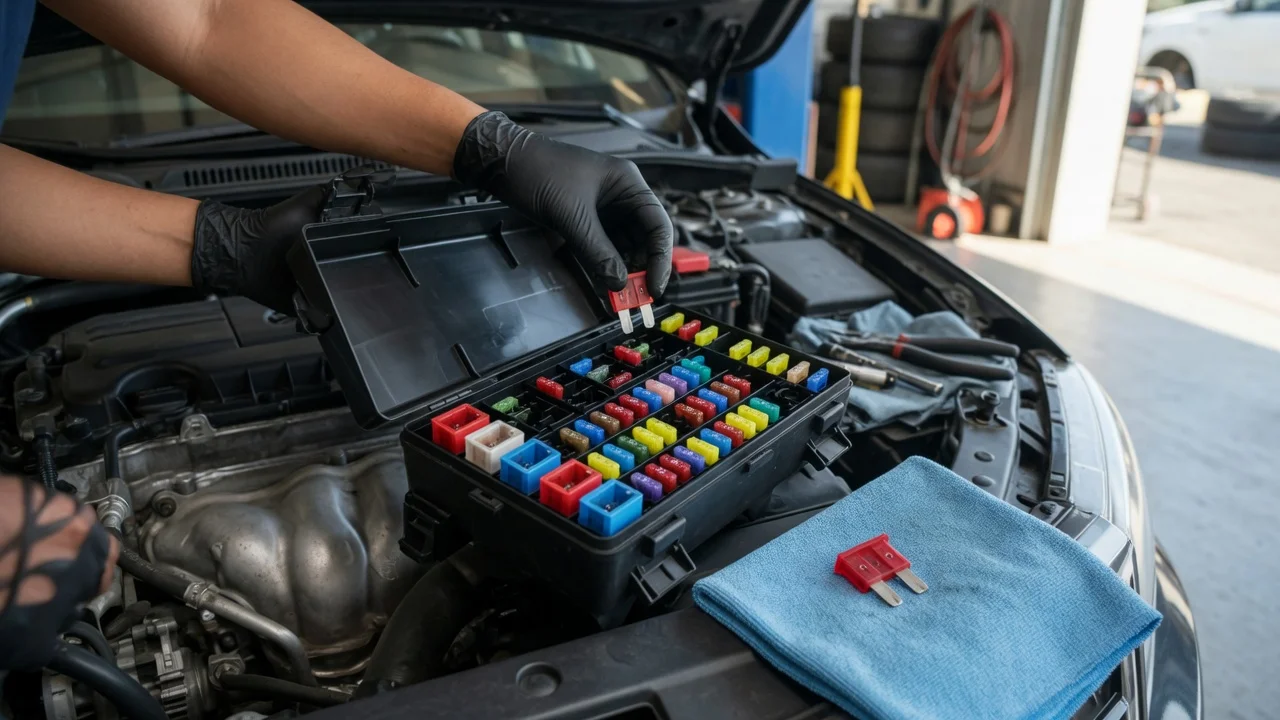
The Short Answer
Replacing an engine control module fuse is usually a simple job. Switch the ignition off, find the fuse that feeds the engine control module (ECM), pull it, and check whether its metal element is broken. If it is, fit a new fuse of exactly the same amperage rating and physical type. The ECM is the computer that manages fuel injection, ignition timing and other engine functions, and some manufacturers call it the powertrain control module (PCM).
One point matters more than the rest. A fuse blows to protect a circuit. If the new fuse blows again, the fault is in the wiring or a connected component, not in the fuse. Do not install a higher-rated fuse to stop it blowing, because that removes the protection the fuse provides.
What Depends on Your Vehicle
Several details change from one make, model year and powertrain to the next, so this guide does not state them:
Fuse location: the ECM fuse is often in the fuse and relay box under the hood. Some vehicles put it in an interior fuse panel or have more than one fuse feeding the module. Label: the fuse box diagram may mark it ECM, PCM, ECU, EFI, ENG or with a manufacturer-specific abbreviation. Amperage rating and fuse type: these are set by the manufacturer and must be confirmed for your specific vehicle. Related relays: some systems also use a main relay or EFI relay that powers the module.
The owner's manual or the diagram printed inside the fuse box cover is the reference for these details. If neither is available, a service manual for your exact model year and engine is the next place to look.
Step-by-Step Replacement
1) Turn the ignition off and remove the key, or switch off a push-button system. Leave the vehicle in park or in gear with the parking brake set. 2) Open the fuse box named in your owner's manual and use the diagram to find the ECM fuse. 3) Remove the fuse with the plastic puller often clipped inside the fuse box, or with needle-nose pliers. 4) Hold the fuse up to the light. A broken or melted metal strip means it has blown. A test light or multimeter can confirm continuity if it is hard to tell by eye. 5) Fit a replacement with the same amperage rating, shown by the number and color code on the fuse, and the same size and style. Press it fully into its slot. 6) Close the fuse box cover and start the engine to check that the symptom has cleared.
If the New Fuse Blows Again
A replacement that blows right away, or soon after, points to a short circuit or an overloaded circuit. Common causes include chafed wiring and a failing sensor, injector or other component that shares the circuit. A fault inside the module itself is also possible. Finding the cause usually means tracing the wiring and testing each component, ideally with the wiring diagram for your vehicle. If you are not comfortable doing electrical diagnosis, take the vehicle to a qualified technician.
Limits of This Guide
No vehicle-specific data was available for this guide, so it gives no fuse ratings, locations or labels for particular models. It also does not cover whether a blown ECM fuse explains a particular symptom, such as a no-start condition, because that depends on how your vehicle's circuits are laid out. Check those details against your own vehicle's documentation.