Replace a Brake Backing Plate or Dust Shield
The short answer
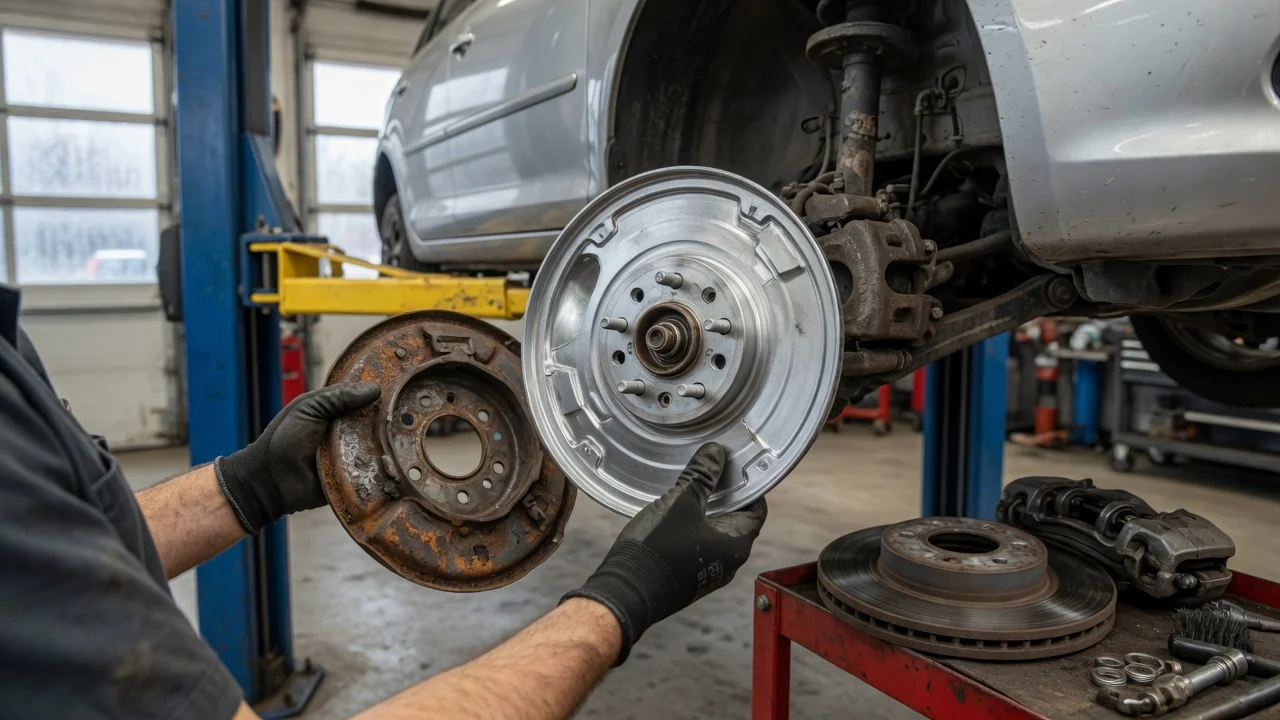
A brake dust shield or backing plate can be replaced, but the difficulty depends on which part your vehicle has and how it is mounted. On many disc-brake setups, the dust shield is a thin stamped-steel cover behind the rotor. Some bolt directly to the steering knuckle or axle and come off once the caliper and rotor are removed. Others are clamped between the hub bearing and the knuckle, so the hub has to come off too. On drum brakes, the backing plate is a structural part that carries the brake shoes, wheel cylinder and often the parking brake hardware. Replacing it means taking the drum brake apart, and on some axles it also means pulling the axle shaft.
Before you buy parts, find out which design your vehicle uses. The correct procedure, fasteners and torque values vary by make, model year, axle position and drivetrain. They are not covered here.
Dust shield vs. backing plate
The two terms are often used interchangeably, and some parts catalogs call both a back plate. They usually describe different parts with different jobs.
Part | Typical brake type | Main role | What replacement usually involves; Dust shield (also called splash shield) | Disc brakes | Keeps road debris and water off the inner rotor face; may help guide airflow | Remove the caliper and rotor; on some designs, also remove the hub or bearing assembly; Backing plate | Drum brakes | Structural mount for shoes, wheel cylinder and related hardware | Disassemble the drum brake; on some designs, remove the axle shaft or hub
Common reasons to replace one
Corrosion: thin dust shields can rust through or flake apart, especially where road salt is used. Bending: a shield knocked out of position can rub the rotor and make a scraping or grinding noise. Damage found during other brake, hub or bearing work: replacing the shield then often costs little extra labor because the parts are already off. On drum brakes, a corroded or worn backing plate: the shoes can stop sitting or sliding properly against the plate, which affects how the brake works.
A scraping noise does not always mean the shield needs replacing. If it is bent but still sound, carefully bending it back so it clears the rotor may be enough. If it is rusted through or cracked, replacement is the more reliable fix. That is a practical judgment rather than a manufacturer rule. If the shield is close to the rotor, inspect it rather than assume.
What determines how big the job is
Mounting method: a shield held by its own bolts is far simpler than one sandwiched behind a hub bearing. Axle position and drivetrain: front and rear, driven and non-driven, and solid-axle and independent designs can all differ. Drum or disc: drum backing plates involve brake shoes, springs, the wheel cylinder and usually a brake hydraulic connection. Disturbing that connection means bleeding the brakes afterward. Seized fasteners: on corroded vehicles, stuck hub bolts or a stuck hub can add significant time. Wheel-speed sensor routing: the sensor or its wiring may need to be unclipped or removed to free the hub or shield.
General sequence for a disc-brake dust shield
These are broad steps for orientation only. Follow the service information for your specific vehicle, including torque values and any one-time-use fasteners.
Safely raise and support the vehicle, then remove the wheel. Remove the caliper and support it so the brake hose is not stretched or kinked. Remove the caliper bracket if required, then the rotor. If the shield bolts on separately, remove its bolts and fit the new shield. If the shield sits behind the hub, remove the hub or bearing assembly as the service procedure directs, which may include the axle nut and wheel-speed sensor, then install the new shield and refit the hub. Reassemble, torque fasteners to the manufacturer's specification, and check that the shield does not touch the rotor.
Drum-brake backing plates
Replacing a drum-brake backing plate is closer to a full brake-assembly job than a simple cover swap. The shoes, springs, adjuster and wheel cylinder must be removed and moved to the new plate or replaced. Because the wheel cylinder connects to the hydraulic system, the brakes typically need bleeding afterward. On some rear axles, the plate is held by fasteners behind the axle flange, so the axle shaft has to come out. Whether that applies to a given vehicle depends on its axle design, which was not specified here.
Gaps in this guide
No vehicle-specific details were provided. This guide therefore does not include part numbers, torque specifications, labor times, part prices, or confirmation of which mounting design a particular model uses. Check those against the service manual or parts catalog for your exact model year, axle position and drivetrain before starting.