Renault VIN Codes: How to Read and Decode a Renault Vehicle Identification Number
A Renault VIN is a 17-character vehicle identification number that identifies one specific car. Like every modern VIN, it has three sections. The first three characters are the World Manufacturer Identifier (WMI), and VF1 is the code most associated with Renault cars built in France. Characters four through nine are the Vehicle Descriptor Section (VDS), which describes the model, body and often the engine or version. Characters ten through seventeen are the Vehicle Identifier Section (VIS), which ends in the car's individual serial number. Renault VINs do not always follow North American conventions. Cars built to US rules must use position 9 as a check digit and position 10 as a model year code. Most Renaults, however, were built for European and other markets, where those rules do not apply. On many Renault VINs, position 10 does not reliably give the model year, and position 9 is not a calculated check digit. Before reading any single character, find out which market the car was originally built for.
Where to Find the VIN on a Renault
The VIN appears in several places. Comparing them is the first step in confirming the car's identity. Exact locations vary by model and generation, so check more than one.
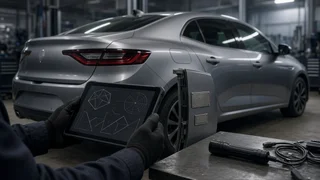
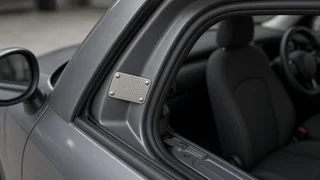
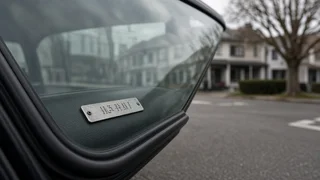
Manufacturer's identification plate: usually a riveted or adhesive plate on a door pillar or in the engine bay. Besides the VIN, it typically shows weight ratings and may carry other factory codes. Stamped into the body: many Renaults have the VIN stamped into a structural panel, often near the front bulkhead, the strut tower or under a floor cover. Windshield base: some models show the VIN through the lower edge of the windshield. Ownership documents: the title, registration or foreign registration certificate should list the same VIN. Service records and insurance papers: useful for cross-checking, but secondary to the physical markings.
Every location should show the identical 17 characters. If they differ, if the plate or body stamping appears altered, or if the documents don't match the car, resolve that before buying, registering or insuring it.
Renault VIN Structure at a Glance
Positions | Section | What it usually tells you on a Renault; 1–3 | World Manufacturer Identifier (WMI) | Manufacturer and region; VF1 is the common Renault passenger car code; 4–9 | Vehicle Descriptor Section (VDS) | Model or project family, body style, and often engine or version; position 9 is a check digit only on vehicles built to North American rules; 10 | Start of Vehicle Identifier Section | Model year on North American-spec vehicles; often not a dependable model year indicator on European-market Renaults; 11 | Vehicle Identifier Section | Frequently an assembly plant code; 12–17 | Vehicle Identifier Section | Sequential production or serial number
VINs do not use the letters I, O and Q, because they are easily confused with 1 and 0. If a VIN you've transcribed contains one of these letters, re-read the original.
Positions 1–3: Manufacturer Identifier
VF1 is the WMI most readers will see on a Renault car. The first character identifies the region and the second the country; V and F together point to France. Renault-group vehicles made under other brands or subsidiaries carry their own WMIs. Dacia models built in Romania, for example, use a different prefix. A car sold as a Renault in one country may also be built under a sister brand elsewhere. An unfamiliar prefix doesn't automatically mean a problem, but it should match the brand and plant the seller claims.
Positions 4–9: Model, Body and Version
This section carries most of the model information. Renault typically uses the first characters after VF1 to identify the model family, often tied to the company's internal project code. Renault refers to many generations internally by project codes such as X84 or X95. Enthusiast resources often use these codes alongside the VIN, because one model name can cover several distinct generations. The remaining VDS characters commonly distinguish body style, such as hatchback, estate or van, and may reflect the engine or version.
The exact meaning of each VDS character changes between models and generations. No single universal Renault chart covers every car. Treat any decoding table as specific to the model range it was written for.
Platform and Chassis Codes vs. the VIN
Three terms are easy to confuse. The VIN identifies one individual vehicle. A project or chassis code, such as the X-series codes, identifies a model generation. A platform code identifies the shared engineering base underneath, such as the CMF families developed within the Renault–Nissan–Mitsubishi alliance, which can sit beneath several different models.
The VIN can help you infer the project code, because the model characters in the VDS usually correspond to it. Platform codes generally aren't spelled out in the VIN; you confirm them from the model generation once you know it. The engine code is also separate. Renault engine codes typically follow a letter-number-letter pattern, with K9K being a widely recognized example. The engine code is usually found on the engine block or in parts and service data, not in the VIN.
Positions 10–17: Year, Plant and Serial Number
On vehicles built to North American standards, position 10 encodes the model year and position 11 the assembly plant. Many European-market Renaults leave position 10 without a dependable model year meaning; a character there may look like a year code without actually indicating the year. To confirm the year on such a car, use the registration document, the first-registration date or the production date from a dealer record rather than a generic year chart.
Position 11 is commonly used for the assembly plant on Renault VINs, but plant letters differ across eras. Only trust a plant decode from a source that covers the same model and period. The final six characters are the production serial number, and they make the VIN unique.
Trim, Paint and Factory Equipment Codes
The VIN alone rarely shows the trim level, paint color or full factory equipment list. Renault records these details in other places:
The manufacturer's plate or a separate label on many Renaults carries extra factory codes. Depending on the model, these may include a paint code and a trim or equipment-level code. A Renault dealer or authorized service center can usually look up the vehicle's factory build data from the VIN, covering the original market specification and the options fitted at the factory. Parts catalogs used by dealers and parts suppliers also use the VIN to identify the correct components for that exact build.
If the original specification matters, for example when checking a claimed option, ordering paint or confirming a rare version, ask for the factory build data instead of relying on an online VIN decoder.
Decoding a Renault VIN in the United States
Renault hasn't sold passenger cars in the US for decades, so most Renaults US readers encounter fall into two groups: older models sold during the American Motors partnership era, and privately imported vehicles, often brought in under the federal exemption for vehicles at least 25 years old. The two groups decode very differently.
US-market Renaults from the AMC era were built to US VIN rules. Their model year, check digit and plant positions follow North American conventions, and standard US decoders can usually read them. Imported European or other foreign-market Renaults were never built to US VIN rules. US decoders, including the federal NHTSA decoding tool, may return partial results, errors or misleading information for these cars. This doesn't mean the VIN is fake. For an imported car, the import paperwork and foreign registration records are usually the most reliable support for the car's identity and year, and US titling authorities may ask to see them.
Step-by-Step: How to Decode and Verify a Renault VIN
1) Find the VIN in at least two physical locations on the car and on the ownership documents. 2) Confirm it has exactly 17 characters and contains no I, O or Q. 3) Check that the first three characters match a Renault-group manufacturer code, such as VF1 for French-built Renault cars. 4) Find out whether the car was built for the North American market or another market. This decides whether positions 9 and 10 follow US rules. 5) Read the model characters in positions 4–9 and match them to the model generation or project code using a source specific to that model. 6) Interpret position 10 as a model year only if the car is North American-spec. Otherwise, confirm the year from registration or production records. 7) Interpret position 11 as a plant code only with a reference for the same model and era. 8) Check the manufacturer's plate for additional factory codes, such as paint or equipment level. 9) For trim, factory equipment and original market specification, ask a Renault dealer or authorized service center to look up the build data from the VIN. 10) Make sure every source agrees. If anything conflicts, such as a mismatched VIN, unexplained repairs around the stamping or documents that don't fit the car, have it professionally inspected before going further.
Limits of Online Renault VIN Decoders
Free online decoders are useful for a quick first look, but they work from generalized tables. They can mislabel the model year, plant or engine on Renaults built outside North America, and they rarely show trim or option details reliably. Use them to narrow down the model, then confirm anything important, such as year, specification or originality, from the car's documents and factory build data.