Decode a Renault VIN
The short answer
A Renault VIN (vehicle identification number) is a 17-character code that follows the same international structure used by most carmakers. Its first three characters identify the manufacturer, the middle six describe the vehicle, and the last eight identify the individual car. A free online decoder can usually confirm that a VIN belongs to a Renault and give a broad outline of the vehicle. Detailed information, such as exact model, engine, trim and build date, often requires Renault's own records or a dealer, because Renault's internal codes are not fully published and vary by model and era.
There is one qualification that matters for US readers. Renault has not sold passenger cars through its own US network for decades, so most Renaults in the United States are older cars or private imports. Decoders built around US-market data may therefore return incomplete results, or none at all, for a European-market Renault VIN.
How a Renault VIN is structured
Modern VINs follow the ISO 3779 standard, which divides the 17 characters into three sections. The letters I, O and Q are not used, which avoids confusion with the numbers 1 and 0.
Positions | Section | What it generally identifies; 1–3 | World Manufacturer Identifier (WMI) | Country and manufacturer; 4–9 | Vehicle Descriptor Section (VDS) | Manufacturer-defined vehicle attributes, such as model, body type or engine; 10–17 | Vehicle Identifier Section (VIS) | The specific vehicle, often including plant and serial number
Positions 1–3: manufacturer
VF1 is the manufacturer prefix most commonly associated with Renault passenger cars built in France. Renault-group vehicles built elsewhere, or sold under related brands, may use different prefixes. A VIN that does not start with VF1 is not automatically suspect, but it is worth checking against the car's documents and badging.
Positions 4–9: vehicle description
This section uses Renault's internal coding for the vehicle family, body style and other attributes. The meaning of these characters depends on the model and generation, and no verified code table was available for this guide. Treat any decoder output for these positions as a starting point rather than a confirmed specification.
Positions 10–17: the individual vehicle
The final section identifies the specific car and normally ends in a serial number. Under North American rules, position 10 encodes the model year and position 9 is a check digit calculated from the other characters to catch typing errors. European regulations do not require either, so on many European-market Renaults position 9 is not a check digit and position 10 may not indicate the model year reliably. A US-oriented decoder that applies North American rules to a European VIN can report a wrong year or flag the VIN as invalid even when it is genuine.
Where to find the VIN on a Renault
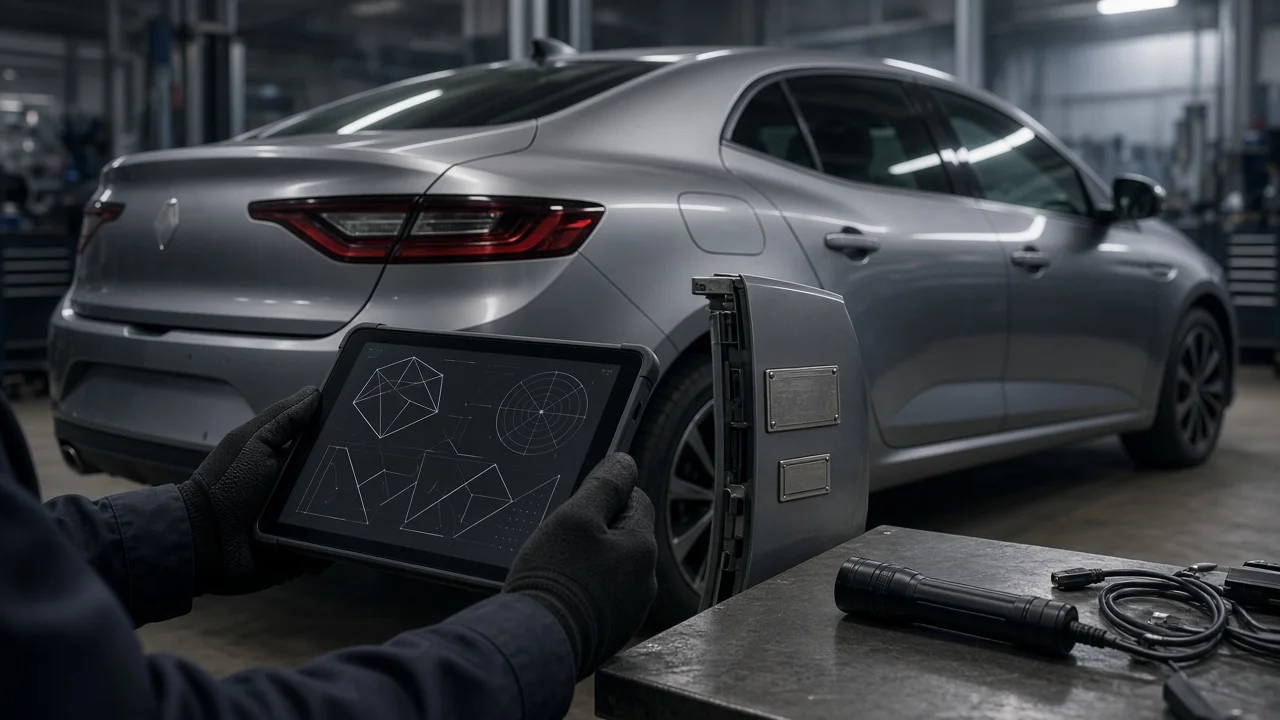
On a plate or label, commonly in the door-pillar area or the engine bay; Stamped into the body structure, with the exact location varying by model; Often visible through the base of the windshield on newer models; On registration, title and import documents
The VIN should match in every location and on every document. A mismatch, or signs that a plate or stamping has been altered, is a reason to stop and investigate before buying.
What an online VIN check can and cannot tell you
Online tools fall into two broad groups. Decoders interpret the characters of the VIN itself. History or report services look up records linked to that VIN, such as title brands, accidents or recalls. Each has limits.
Decoders usually confirm the manufacturer and sometimes the model family, but they may misread Renault-specific codes or the model year. US history and recall databases rely on records from US-market vehicles, so an imported Renault may have little or no history there. Records from the car's original country, such as previous registrations or service history, are generally held in that country's systems and may not appear in US-based reports. A clean report does not prove a car is problem-free; it only means no records were found.
Getting a reliable result
Copy the VIN carefully from the car itself, not only from paperwork or a listing. Run it through more than one decoder and treat disagreements as a prompt for further checks. For exact specification and build details, ask a Renault dealer or the brand's customer service in the car's original market. For an imported Renault, request the export, import and compliance paperwork and confirm the VIN on each. Use the VIN together with a physical inspection, not as a substitute for one.
Gaps in this guide
No verified Renault code tables, model-specific decoding examples or details of particular online services were available for this article. Position-by-position meanings beyond the standard structure, and any claim about a specific Renault model, should be confirmed with Renault or an authorized dealer.