Identify an Engine by Vehicle VIN
The Short Answer
For most vehicles sold in the US from the 1981 model year onward, you can identify the factory-installed engine from the 17-character Vehicle Identification Number (VIN). Federal rules require the VIN's Vehicle Descriptor Section, characters 4 through 8, to encode the vehicle's attributes. For passenger cars, multipurpose passenger vehicles and trucks, those attributes include engine type. Each manufacturer decides which character, or combination of characters, carries the engine information. You therefore need a decoder or the manufacturer's VIN chart to read it reliably.
There are two qualifications. First, the VIN shows the engine the vehicle was built with, not necessarily the engine installed today. If the engine has been swapped, the VIN will not show it. Second, vehicles built before the 1981 model year used non-standardized VIN formats that varied by manufacturer, so the method below may not apply to them.
The search phrase "check engine VIN" is also not related to the check engine warning light. A VIN decode identifies the vehicle and its configuration. It does not read fault codes, which require an OBD-II scan tool.
How the 17-Character VIN Is Organized
Characters 1–3: World Manufacturer Identifier (WMI), which identifies the manufacturer and region. Characters 4–8: Vehicle Descriptor Section (VDS), which encodes attributes such as model, body type, restraint system and engine type. Character 9: Check digit, calculated from the other characters to detect transcription errors. Character 10: Model year code. Character 11: Assembly plant code. Characters 12–17: Production sequence (serial) number.
Several manufacturers, including many domestic US brands, have commonly used the eighth character as the engine code. This is a convention, not a universal rule. Other manufacturers encode the engine elsewhere in the VDS or combine it with other attributes, and assignments can change between model years. Treat any single-character shortcut as a starting point, and confirm it against documentation for the specific make and model year.
Where to Find the VIN
Lower driver's side corner of the dashboard, visible through the windshield from outside the vehicle. Label on the driver's side door jamb or door edge, often on the same sticker that lists tire pressures or the manufacture date. Vehicle title and registration documents. Insurance card or policy documents. Some service and repair records.
Compare the VIN on the vehicle against the VIN on the paperwork. If they do not match, decode the number that is physically on the vehicle and investigate the discrepancy before relying on either one.
How to Decode the Engine From the VIN
Copy all 17 characters exactly. The letters I, O and Q are not used in standard VINs, so a character that looks like O is a zero. Enter the VIN into a decoder. NHTSA offers a free public VIN decoder built on manufacturer-submitted data. Many parts retailers and vehicle history services also provide decoders. Check the result for engine displacement, cylinder count, fuel type and, where available, the manufacturer's engine code. If the decoder returns several possible engines or none, use the manufacturer's VIN decoding chart for that model year, or ask a dealer service department to look up the build data.
Decoder results depend on the data the manufacturer supplied. For some vehicles, a decoder returns only displacement and cylinder count. Others return a specific engine code. Before ordering engine-specific parts, confirm the decoded engine with a second source.
Confirming the Engine on the Vehicle Itself
Several items on the vehicle can corroborate a VIN decode or reveal an engine change. Their locations vary by make, model and engine, so check the service documentation for the specific vehicle configuration.
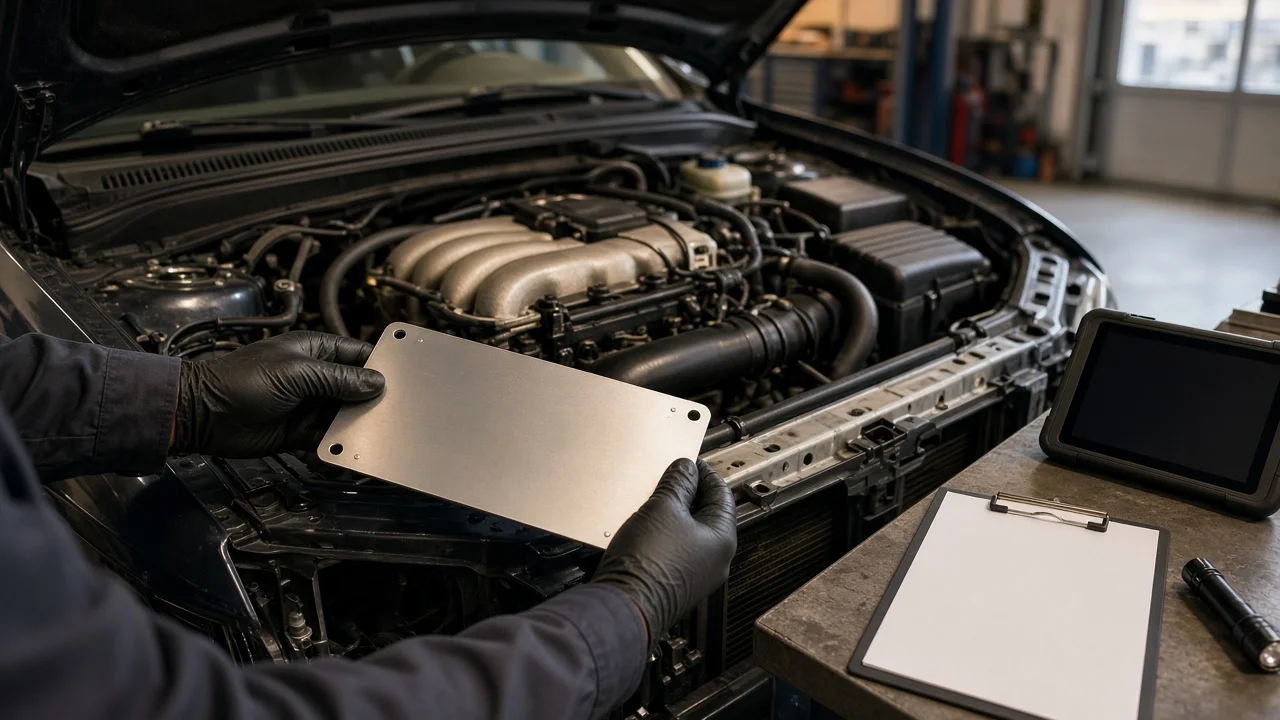
Vehicle Emission Control Information label: usually under the hood. It typically lists engine displacement and an engine family identifier for emissions certification. Engine code or serial number stamped or cast on the engine block, or printed on a tag or label attached to the engine. The position differs widely between engines. Partial VIN stamping: some manufacturers stamp all or part of the VIN on the engine block. This can help show whether the engine is original to the vehicle.
Easily Confused Identifiers
VIN vs. engine serial number: the VIN identifies the whole vehicle. An engine serial number identifies an individual engine and is separate from the VIN. Engine code vs. engine family number: an engine code identifies an engine design or variant. The engine family number on the emissions label is a certification grouping and may cover more than one engine variant. VIN engine character vs. displacement: a single VIN character stands for an engine as defined in the manufacturer's chart. It is not a displacement figure, and the same character can mean different engines across brands or model years.
Limitations and Gaps
This guide covers the general VIN structure for vehicles sold in the US from the 1981 model year onward. It does not include manufacturer-specific engine code tables, because no make- or model-specific documentation was provided. For a definitive answer, use the manufacturer's VIN decoding information for the exact model year, or the factory build record. If the vehicle may have had an engine replacement, physically inspect the engine identification markings as well.