How to Find Vehicle Specifications by VIN
A Vehicle Identification Number (VIN) can tell you a lot about a car, truck or SUV: who built it, the model year, the plant where it was assembled, and usually the model, body style, engine and restraint system. It is not a full build sheet, though. Options packages, paint color, trim details and changes made after the vehicle left the factory often do not show up in a basic decode. This guide covers what a VIN lookup can and cannot tell you, how to find the number on a vehicle, and how to read its structure.
The Short Answer: What a VIN Lookup Gives You
In the United States, vehicles built for the 1981 model year and later use a standardized 17-character VIN. When you enter that number into a VIN decoder, the decoder reads the manufacturer's coded fields and returns the specifications those fields represent. How much detail you get depends on how much the manufacturer encodes and on how complete the decoder's database is.
Usually available from a VIN decode: • Manufacturer and country or region of origin; • Make and model; • Model year; • Body style or vehicle type (passenger car, truck, multipurpose vehicle, etc.); • Engine type or displacement, often with fuel type; • Restraint system details such as airbag configuration; • Assembly plant; • Sometimes series, trim level, drive type or transmission, depending on the manufacturer
Often missing or unreliable from a VIN alone: • Individual options and packages; • Exterior and interior colors; • Exact trim on brands that don't encode it; • Aftermarket modifications, engine swaps or other changes made after production; • Condition, mileage, accident or ownership history (these come from separate history and title databases, not from decoding the VIN itself)
If you need an exact equipment list, look at the original window sticker (the Monroney label) or a manufacturer build sheet. Some manufacturers and dealers can retrieve these by VIN. A basic decode is best for confirming identity: checking that a vehicle really is the year, model and engine the seller claims.
Where to Find the VIN
Exact label placement varies by manufacturer and vehicle type, but these are the most common places on vehicles sold in the US:
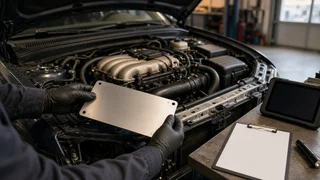
• Lower corner of the dashboard on the driver's side, readable from outside through the windshield; • Driver's door jamb or door edge, on the certification label (this label usually also lists the manufacture date and weight ratings); • Vehicle title and registration documents; • Insurance card or policy documents; • Service and repair records; • On some vehicles, stamped on the frame, the engine block, or a firewall plate under the hood
Compare the VIN on the dashboard with the one on the door label and on the title. They should match exactly. If they don't, or if a label looks tampered with, stop and investigate before buying, because mismatched VINs can point to replaced parts, rebuilt vehicles or fraud.
How to Read the 17 Characters
A modern VIN is divided into three sections. Knowing the layout helps you sanity-check a decoder's output and spot a mistyped number.
Position: 1 2 3 | 4 5 6 7 8 | 9 | 10 | 11 | 12 13 14 15 16 17; Section: W M I | V D S | C | YR | PL | Production sequence; WMI = World Manufacturer Identifier; VDS = Vehicle Descriptor Section; C = Check digit; YR = Model year; PL = Assembly plant
Positions | Name | What it identifies; 1–3 | World Manufacturer Identifier (WMI) | Country or region and manufacturer; the third character often indicates vehicle type or division; 4–8 | Vehicle Descriptor Section (VDS) | Manufacturer-defined attributes such as model, series, body style, engine and restraint system; 9 | Check digit | A calculated value used to catch transcription errors in vehicles built for North America; 10 | Model year | A letter or number code for the model year; 11 | Plant code | The factory where the vehicle was assembled; 12–17 | Vehicle Identifier Section (sequence) | The individual vehicle's production serial number
The VDS (positions 4 through 8) holds most of the specification information, but each manufacturer defines its own codes. The same character can mean different things for different brands, or even for different model years from the same brand. That is why you need a decoder with manufacturer-specific data. You cannot interpret these positions with a universal chart.
Decoding the Model Year Character
The 10th character is the one people most often want to read by hand. The code uses letters and numbers in a cycle that repeats every 30 years, so the same character can stand for two different years three decades apart. The rest of the VIN and the vehicle itself tell you which one applies. The letters I, O, Q, U and Z and the number 0 are not used as year codes. Recent cycle values:
Code | Model year | Code | Model year; Y | 2000 | E | 2014; 1 | 2001 | F | 2015; 2 | 2002 | G | 2016; 3 | 2003 | H | 2017; 4 | 2004 | J | 2018; 5 | 2005 | K | 2019; 6 | 2006 | L | 2020; 7 | 2007 | M | 2021; 8 | 2008 | N | 2022; 9 | 2009 | P | 2023; A | 2010 | R | 2024; B | 2011 | S | 2025; C | 2012 | T | 2026; D | 2013 | V | 2027
Model year is not the same as the build date. A vehicle can be built in one calendar year and sold as the next model year. If the exact production month matters, check the door-jamb certification label.
Telling Look-Alike Characters Apart
Standard VINs never use the letters I, O or Q, because they are too easy to confuse with 1 and 0. If you think you see one of those letters, it is almost certainly the number 1 or 0. Other common misreads include 5 and S, 8 and B, and 2 and Z. If a decoder rejects a VIN or returns a vehicle that clearly doesn't match, re-read the number at the source before assuming the vehicle is mislabeled.
Free Ways to Look Up Specs by VIN
Free VIN decoding is widely available, and for basic specifications a free tool is often all you need.
• NHTSA's VIN decoder (part of its Product Information Catalog and Vehicle Listing, or vPIC): A free government tool that decodes the data manufacturers submit to the agency. It is good for make, model, year, body class, engine and safety equipment fields, but it won't give you options or color. • NHTSA's recall lookup: Not a spec decoder, but entering a VIN shows open safety recalls for that specific vehicle, which is worth checking during any purchase. • Manufacturer owner portals and dealers: Depending on the brand, you may be able to view original equipment or request a window sticker reprint by VIN. Availability and cost vary. • Commercial decoders and history-report services: Many offer a free basic decode and charge for history reports covering title brands, reported accidents and odometer records. Paid reports add history, not necessarily more specifications. • NICB VINCheck: A free tool that checks for theft and total-loss records. It is useful for due diligence but is not a source of specifications.
Decoders sometimes disagree, especially on trim and engine variants, because they rely on different databases. If the details matter, such as ordering parts or confirming a specific engine, cross-check the decode against the door label, the engine bay, and the window sticker or build records.
When a VIN Decode Won't Work as Expected
• Pre-1981 vehicles: Older VINs weren't standardized. They vary in length and format by manufacturer, and modern decoders often can't read them. Classic-vehicle references and marque clubs are usually better resources. • Vehicles built for other markets: Imports and gray-market vehicles may follow regional VIN conventions. For example, the model-year and check-digit positions are not used the same way everywhere, so US-oriented decoders may return incomplete or wrong results. • Very new models: A decoder's database may lag behind the latest model year. • Low-volume, kit and specialty builders: Small manufacturers may have limited data in public decoders. • Modified vehicles: The VIN records how the vehicle left the factory, not its current configuration.
Using a VIN Lookup Well
Treat a VIN decode as the vehicle's factory identity. It is the most reliable way to confirm the make, model, year, plant and core powertrain, and to catch a listing that misstates any of them. For the full picture, combine it with a window sticker or build sheet for equipment, a recall check for safety campaigns, a history report for title and accident records, and an in-person inspection for the vehicle's actual condition and any changes since it was built.