Ram Factory Integrated Trailer Brake Controller: What Owners Should Know
The essential answer
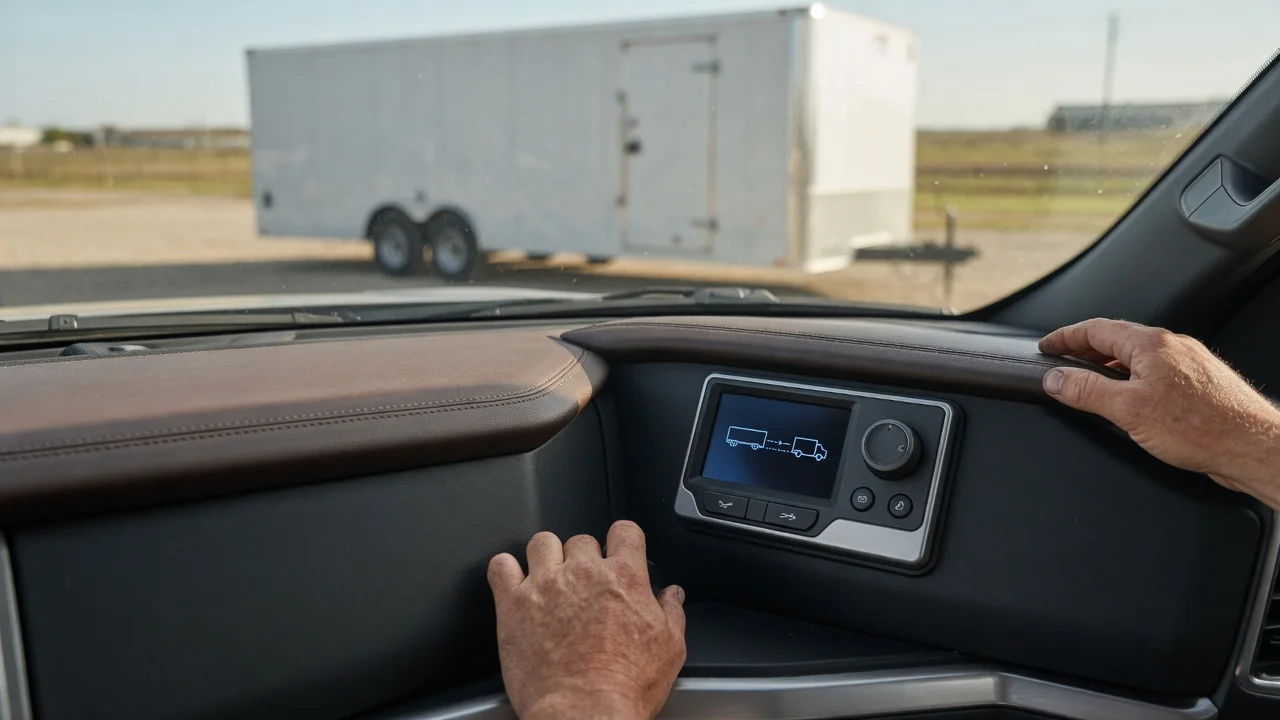
The Ram factory integrated trailer brake controller is an OEM module that lets the truck's electronic stability, transmission and dashboard systems communicate with electric trailer brakes. It allows gain adjustment, manual trailer brake application and trailer brake output display through the instrument cluster. The feature is not present on every Ram truck, and for many 1500, 2500 and 3500 models the factory controller is a dealer-installed or Mopar accessory rather than a standard line-fit item. The core qualification is that the Ram integrated controller works only when the correct module is installed, the sales code is enabled in the vehicle configuration, and the trailer connector provides the proper brake output signal.
What the Ram controller actually controls
The integrated trailer brake controller sends a proportional voltage signal to the trailer brake magnets based on deceleration and the gain setting selected by the driver. It also supports manual application through the dash controls. Because the function is integrated, the truck can share data such as vehicle speed, brake pedal position and stability control intervention. On factory-equipped models, trailer brake output and gain are typically shown in the cluster display, and the manual slide or squeeze control on the center stack allows testing trailer brakes without using the tow vehicle brake pedal.
Factory equipped versus Mopar accessory
Some Ram trucks leave the assembly line with the integrated trailer brake controller already installed. Others have the wiring and mounting location but no module. In those cases, the Mopar integrated trailer brake controller is sold as an accessory kit. The kit is not just a switch panel; it includes the control module and requires programming. Enabling the feature is done through the vehicle's configuration, often using a dealer tool. Installing the hardware without enabling the sales code will not produce a functional integrated system.
Model year and trim differences
Availability varies by model year, trim and packaging. A 2019 Ram 1500 with a trailer-tow group may or may not include the controller depending on the option combination. Ram 2500 and Ram 3500 trucks are more likely to have the integrated controller as standard or as part of a heavy-duty towing package, but base or fleet trims can still omit it. The only reliable way to determine whether a specific truck has the factory controller is to inspect the dash control location and verify the equipment through the build sheet or vehicle configuration.
Identifying the factory controls
The Ram integrated trailer brake controller is normally located on the lower center stack or near the trailer-related switches. The control includes gain adjustment buttons and a manual brake lever or squeeze control. If the location has a blank cover, the module is absent. Some models may route the controls into the touchscreen, but the physical switch module remains the common identification point. A truck with a seven-pin trailer connector does not automatically have an integrated brake controller; the connector can be present without the controller module.
Why integration matters for towing behavior
An integrated controller can be more predictable than a generic aftermarket unit because it uses actual vehicle deceleration signals rather than an inertial sensor or time-delay estimate. The Ram system can also coordinate trailer brake output with stability control events when the proper configuration is active. However, the practical benefit depends on correct gain setup, proper trailer brake adjustment and a compatible trailer wiring circuit. The integrated controller does not correct a poorly loaded trailer or undersized brake wiring.
Installation and programming
For a Ram that lacks the module, the Mopar integrated controller is generally sold as a kit for the applicable model year. Installation includes replacing the blank panel with the control module and making the electrical connection to the existing body harness. After installation, dealer-level programming is required to add the sales code and configure the module. Without that step, the truck may not recognize the controller, and the trailer brake output may remain inactive. Some independent shops have tools that can perform the enable procedure, but not all OBD scan tools can do it.
Common troubleshooting points
When an integrated controller does not operate, check whether the truck actually has the module and whether the sales code is present in the configuration. If the system is active but the trailer brakes feel weak, the gain is often set too low or the trailer brake shoes or magnets need service. A trailer disconnected warning can appear even when the connector is attached if ground continuity or the trailer brake circuit is marginal. Because the Ram system uses the factory wiring path, a damaged seven-pin connector or corroded trailer-side plug affects operation before any controller setting does.
When an aftermarket controller is the practical choice
If the cost of the Mopar module plus dealer programming is not justified for occasional towing, a quality aftermarket proportional controller can be installed using an under-dash harness. The Ram may still provide a factory brake controller connector under the dash even when the integrated module is absent. That allows a plug-in aftermarket installation without cutting wires. The trade-off is the loss of cluster integration and the potential for a less seamless look. For frequent heavy towing, the factory integrated route is generally the more cohesive solution on supported Ram trucks.
What to verify before buying or towing
Check the physical dash control, the window sticker or build sheet, and whether the trailer brake output is shown in the cluster during manual application. Confirm the truck has the seven-pin connector with a functional brake output pin. If purchasing a used Ram 1500, 2500 or 3500 advertised as having a trailer brake controller, verify that the integrated module is present rather than assuming from the tow package name. If the module is missing, treat the truck as needing a hardware and programming retrofit.