Pittsburgh Brake Bleeder Kit: Vacuum Pump vs. Pneumatic Auto-Refill, and What to Check Before Buying
If you are looking at a Pittsburgh brake bleeder kit, you are usually choosing between two tools: the hand-operated brake bleeder and vacuum pump kit, and the pneumatic brake fluid bleeder with an auto-refill bottle. Both let one person pull old brake fluid and air out through the bleeder screws without a helper pumping the pedal. The short answer: the hand pump kit suits occasional bleeding and doubles as a vacuum tester, while the pneumatic version suits full fluid flushes and frequent use, but only if you have an air compressor that can keep up with it. Two conditions change that answer: vehicles whose ABS unit needs a scan-tool bleed procedure, and bleeder screws that leak air around their threads, which can make any vacuum bleeder look like it is failing.
What each Pittsburgh bleeder kit does
Pittsburgh is the house tool brand sold through Harbor Freight, and its bleeding tools follow designs common across the industry. Model numbers, kit contents and packaging change over time, so check the current listing and the box contents rather than relying on an older description.
Hand brake bleeder and vacuum pump kit
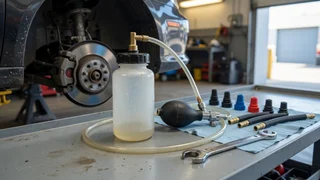
This kit is built around a handheld pump with a trigger-style handle and usually a vacuum gauge. You connect clear tubing from the pump to a catch jar, then from the jar to the caliper or wheel cylinder bleeder screw using one of the included adapters. Squeezing the handle creates vacuum in the jar; when you crack the bleeder screw open, fluid and air are drawn out into the jar instead of into the pump. Because it is a general-purpose vacuum pump, the same tool can test vacuum-operated components, check for vacuum leaks in hoses and actuators, or help with other fluid-extraction tasks, which is part of its appeal for home mechanics.
Pneumatic brake fluid bleeder with auto-refill
The pneumatic version uses shop air passing through a venturi to create continuous vacuum, so there is no hand pumping. Fluid is drawn into a collection container attached to the tool. The auto-refill part is a separate bottle of fresh brake fluid that sits inverted on the master cylinder reservoir and tops it up as the level drops. That matters because letting the reservoir run dry during bleeding pulls air into the master cylinder, which turns a simple job into a much longer one. For a complete flush, where you push a large volume of fluid through every corner, continuous vacuum plus automatic refill is a meaningful time saver.
Side-by-side comparison
Factor | Hand vacuum pump kit | Pneumatic bleeder with auto-refill; Power source | Your hand | Air compressor; Vacuum delivery | Intermittent; you re-pump as it drops | Continuous while air flows; Reservoir management | You watch and top up manually | Refill bottle tops up the reservoir; Best suited to | Single-corner bleeds, occasional use, vacuum diagnostics | Full fluid flushes, multiple vehicles, frequent use; Other uses | Vacuum testing, small fluid extraction | Mainly brake and clutch hydraulic bleeding; Noise and setup | Quiet, portable, quick to set up | Compressor noise, air hose, more setup; Main drawback | Hand fatigue on long flushes | Requires adequate compressor capacity
Which one fits your situation
Choose the hand pump kit if you bleed brakes occasionally, for example after replacing a caliper or a single brake hose, if you do not own a compressor, or if you also want a vacuum gauge for diagnosing engine or HVAC vacuum problems. It is also the easier tool to take to a driveway or a car parked away from your garage.
Choose the pneumatic auto-refill bleeder if you regularly flush brake fluid on one or more vehicles, already own a compressor, and value not having to keep an eye on the reservoir. The refill feature is the main reason many people pick it over a hand pump, especially on vehicles with small master cylinder reservoirs that empty quickly.
If you only open the hydraulic system rarely, neither tool is strictly necessary; the two-person pedal method works on most vehicles. The value of either kit is doing the job alone and doing it more cleanly.
What to check before buying
Compressor capacity (pneumatic version): venturi tools consume air continuously. Compare the air requirement printed on the listing or packaging with your compressor's rated output; an undersized compressor will cycle constantly and the vacuum will be weak. Adapter coverage: confirm the kit includes adapters or tapered fittings that seal on the bleeder screws on your vehicles. Bleeder screw sizes vary by make, model year and caliper design, and a loose fit lets air in at the tip. Tubing quality and length: tubing should be clear so you can see bubbles, long enough to reach from the wheel to where the tool sits, and resistant to brake fluid. Refill bottle fit (auto-refill version): the bottle and its adapter need to sit securely on your master cylinder reservoir opening. Reservoir neck shapes differ, so check whether the included adapter suits your vehicles or whether you will need to hold or prop it. Collection capacity: a larger catch container means fewer interruptions during a full flush. Seals and replacement parts: pump seals and check valves wear over time, especially when exposed to brake fluid. Find out whether the store or brand offers replacement parts or warranty coverage before you buy. Return policy: because fitment questions are common, a straightforward return or exchange option reduces the risk if an adapter or bottle does not suit your vehicle.
Vehicle-specific factors that affect the result
Brake fluid type: most vehicles use glycol-based DOT 3, DOT 4 or DOT 5.1 fluid; a smaller number use silicone-based DOT 5. These families must not be mixed. Use the fluid specified on your reservoir cap or in your owner's manual, and keep a tool that has handled one type away from the other unless it is thoroughly cleaned. Glycol fluid also damages paint, so protect body panels around the reservoir and wheels.
ABS and electronic brake systems: on many vehicles, a standard bleed at the four corners is enough. On others, especially if air reached the ABS hydraulic unit, the manufacturer procedure calls for a scan tool to cycle the ABS valves. A vacuum bleeder cannot do that step. Check the procedure for your specific model year and trim before you start, particularly if the master cylinder or ABS unit was replaced or ran dry.
Bleed sequence and clutch systems: the order in which you bleed each corner depends on the vehicle's hydraulic split, so follow the sequence for your model rather than a generic rule. Many manual-transmission vehicles share the brake reservoir with the hydraulic clutch, and the same tools can often bleed the clutch slave cylinder if an adapter fits.
Why vacuum bleeders sometimes seem not to work
The most common complaint with any vacuum bleeder is a constant stream of small bubbles that never stops. Often that air is not coming from the brake system at all. When the bleeder screw is opened, vacuum can draw air in around its threads and into the tubing, so the bubbles keep appearing even after the system itself is clear. Signs of this are tiny, steady bubbles that do not taper off, combined with a firm pedal afterward.
Practical fixes include opening the bleeder screw only slightly, sealing the threads with thread tape or a suitable sealing compound on the bleeder screw threads (not the tapered seat), or using bleeder screws designed with a built-in thread sealant or check valve. Judge success by pedal feel and by whether the fluid coming out has changed from old, darker fluid to clean fluid, not by bubbles alone.
How bleeding fits into other brake work
A routine swap of brake pads and brake rotors does not normally require bleeding, because the hydraulic system stays closed. You still need to watch the reservoir level when pushing caliper pistons back, since old fluid is forced upward. Bleeding becomes necessary when you open the system, such as replacing a caliper, hose, line or master cylinder, or when the brake fluid is due for replacement under your vehicle's maintenance schedule. Brake fluid absorbs moisture over time, which lowers its boiling point and can contribute to internal corrosion, so periodic flushing is maintenance rather than a repair.
If you are already doing pad and rotor work, it is a good time to check pad friction material against the manufacturer's wear limits, inspect rotors for minimum thickness, and look over hoses and calipers for leaks. A bleeder kit addresses fluid and air; it does not correct a soft pedal caused by worn parts, a failing master cylinder or a leaking caliper seal.
Using either kit effectively
Start with the master cylinder reservoir full, and keep it from dropping too low throughout the job. Fit the adapter snugly on the bleeder screw and use a wrench that fits the screw properly to avoid rounding it. Create vacuum first, then open the bleeder screw a small amount; close it before releasing vacuum or removing the tube. Keep fluid out of the pump body on the hand kit; the catch jar exists to stop fluid reaching the pump mechanism. Clean the tool after use according to the instructions, keep caps on fresh fluid, and never reuse fluid you have drained. After bleeding, check pedal feel with the engine off and running, verify the reservoir level, and test the brakes at low speed before normal driving.
When another method makes more sense
A pressure bleeder, which pushes fluid in at the reservoir rather than pulling it out at the wheels, avoids the thread-leak problem entirely and is popular with people who flush fluid often, though it requires a reservoir adapter that fits your vehicle. Gravity bleeding is slow but simple on some vehicles. The two-person pedal method needs no tool beyond a wrench, tubing and a bottle. If your vehicle requires a scan-tool ABS bleed and you do not have a compatible tool, the practical next step may be to do the corner bleed yourself and have a shop complete the ABS procedure, or have the whole job done professionally.
Next step
Decide first whether you have a compressor that can support a venturi tool, then confirm the bleed procedure for your vehicle, including the fluid type and any ABS requirement. With those two answers, the choice is usually clear: the hand vacuum pump kit for occasional jobs and diagnostics, or the pneumatic auto-refill bleeder for frequent full flushes. Before buying, check that the adapters and refill bottle suit your bleeder screws and reservoir.