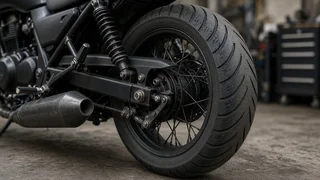
Motorcycle Wheel Runout Tolerance

A motorcycle wheel that wobbles or shakes usually points to runout—a deviation from a true circular path as the rim and tire rotate. Motorcycle wheel runout tolerance is the permitted range for that lateral and radial deviation before handling, tire wear, and bearing life suffer. Riders researching this measurement often need to connect the service specification with what they feel at the handlebar or see at the axle. Because wheel construction, drive system, and engine configuration vary, the correct tolerance depends on model identification and the equipment used to measure it.
Essential answer
Motorcycle wheel runout tolerance describes how much a rim may move side to side or up and down while spinning before it is considered out of specification. Lateral runout measures wobble across the wheel’s width, while radial runout measures the rim’s roundness relative to the axle. The allowed range is usually small, often expressed in thousandths of an inch or hundredths of a millimeter, and it exists because no production wheel is perfectly true. A tolerance gives technicians a repeatable target rather than relying on how the wheel feels when rotated by hand.
The subject covers cast, forged, spoked, and tubeless wheels because each construction reacts differently to impact, spoke tension, and mounting stress. A drive system such as chain, belt, or shaft can influence how rear-wheel movement appears during measurement, and engine configuration affects the vibration a rider may confuse with runout. Riding controls transmit subtle rim deviations through the bars and pegs, so what feels like a loose component may actually be runout. Equipment compatibility matters because a dial indicator mounted incorrectly can create a false reading that looks like an out-of-true rim.