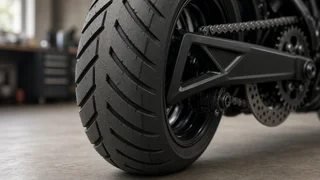
Motorcycle Tire Feathering
Motorcycle tire feathering describes an uneven wear pattern that develops when tread blocks wear at an angle, creating a saw-tooth or scalloped profile around the circumference. Riders often notice the condition through increased road noise, vibration, or a rough feel when running a hand along the tread. Understanding why feathering occurs helps separate normal tire behavior from incorrect inflation pressure, suspension settings, or load conditions that may need attention before the tire reaches the end of its useful life.
Essential answer
Feathering on a motorcycle tire is a tread wear condition in which the leading or trailing edge of each tread block becomes more worn than the opposite edge. This creates a stepped profile that can be felt as a saw-tooth texture when brushing a hand across the tire in one direction. The pattern is most noticeable on the rear tire under acceleration or on the front tire when braking loads are frequent, and it can be accompanied by humming or howling noises at moderate speeds.
The condition does not automatically mean the tire is unsafe, but it changes how the contact patch interacts with the road. The severity and location of feathering can point toward common influences such as sustained straight-line riding, tire size and load index choices, inflation pressure, or suspension damping. Because motorcycle tires use comparatively soft compounds and rounded profiles, feathering may progress more visibly than on automotive tires, making regular tread depth inspection a practical way to track the pattern.