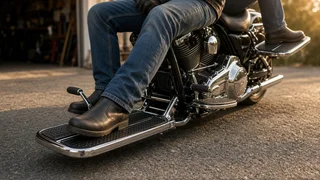
Motorcycle Foot Peg Extensions for More Legroom

The Short Answer
Yes, a foot peg extension can give you more legroom. These are usually called peg lowering brackets or relocation kits, and they mount between the bike's original peg bracket and the peg itself. They move your feet lower, further back, or forward, which opens up the knee angle and can ease cramping on longer rides.
Three conditions change that answer:
Fitment is model-specific. A kit made for one model, model year or trim may not bolt onto another, even within the same family. Lowering the pegs reduces cornering clearance. On a bike ridden hard through bends, that trade-off may outweigh the comfort gain. Moving the pegs without moving the shifter and rear brake pedal can make both controls awkward or unsafe to reach. A suitable kit either keeps the controls in proportion or includes a way to adjust them.
How Peg Extensions Create Legroom
Legroom on a motorcycle depends on the relationship between three points: the seat, the footpegs and the handlebars, often called the rider triangle. Taller riders, or riders with stiff knees or hips, often find the stock knee bend too tight. Lowering the pegs increases the distance from seat to foot. Moving them rearward or forward changes the leg angle without necessarily adding length.
The direction of the offset matters as much as the amount. Straight-down kits add the most leg extension. Down-and-back kits keep a sportier, weight-over-the-pegs posture. Forward offsets suit cruisers and relaxed touring positions, but they shift more weight onto your lower back and seat.
Types of Peg Extensions and Alternatives
Option | What it does | Best suited to | Main trade-off; Rider peg lowering brackets | Move the main pegs down and/or back from the stock mount | Sport, standard and adventure bikes with cramped knee angles | Less ground clearance; shifter and brake may need adjusting; Forward controls | Relocate pegs, shifter and brake pedal forward as a set | Cruisers | More involved install; changes riding posture substantially; Highway pegs | Add a second resting position, usually on crash bars or frame mounts | Long highway stints on cruisers and tourers | Feet are away from the controls when using them; Passenger peg lowering brackets | Lower or reposition pillion pegs | Taller or less flexible passengers | May contact exhaust, saddlebags or side stand; Taller seat | Raises the rider rather than moving the pegs | Riders who can still reach the ground comfortably | Higher seat height makes stops harder for shorter legs
If you mainly want to stretch occasionally on long straight roads, highway pegs may solve the problem without changing your normal riding position. If the cramping is constant, relocating the main pegs addresses it more directly.
What to Check Before Buying
Exact Fitment
Confirm the kit lists your specific make, model, model year and, where relevant, trim and market. Peg mounts, rear-set designs and exhaust routing can change between generations or between US and other-market versions. Where a listing names only the model without a year range, ask the seller before ordering.
Control Geometry
Check whether the kit relocates or extends the shift lever and rear brake pedal, or whether those controls stay in the stock position. If only the peg moves, your toe may sit above or behind the lever, forcing you to lift your foot to shift or brake. Look for kits that include a lever extension, an adjustable shift linkage, or a design that leaves the controls within the bike's adjustment range.
Ground Clearance
Lower pegs touch down sooner in corners. If your bike already scrapes peg feelers, which are small sacrificial tips under the pegs, a lowering kit will make that happen at shallower lean angles. Kits that move the peg back as well as down can lose less clearance than straight-down designs. Manufacturers do not always publish clearance figures, and none were available for this article, so compare the stated offset against how you ride.
Interference With Other Parts
Check for possible contact with the exhaust, heat shields, side stand, center stand, brake master cylinder, frame sliders and luggage mounts. This is especially relevant for passenger peg kits, where saddlebags and mufflers sit close to the pillion mounts.
Construction and Hardware
Most brackets are machined aluminum or steel. Either can work; what matters more is that the bracket is rigid enough not to flex under braking or standing load, and that the kit includes correctly sized, longer bolts rated for the job. Kits that reuse stock bolts are sometimes too short once a spacer is added.
Compatibility With Your Existing Pegs
Some kits accept the original pegs; others require their own. If you have already fitted wider or aftermarket pegs, confirm they will mount to the new bracket.
Passenger Accommodation
Passengers often have less legroom than the rider because pillion seats sit higher and pillion pegs are mounted higher still. Passenger peg lowering brackets work on the same principle as rider kits and can make longer two-up rides more tolerable. Check heat clearance from the exhaust carefully, since a passenger's foot or boot may end up closer to the muffler. Passenger footrest requirements vary by state, so keep functioning passenger pegs fitted whenever you carry a pillion.
Installation Points
Follow the kit instructions and the bike's service manual torque values; do not guess fastener torque. Use thread locker only where the instructions call for it. After fitting, adjust the shift lever and brake pedal so each can be operated without lifting your foot off the peg. Confirm the rear brake light switch still activates when the pedal is pressed, since moving the pedal can change switch timing. Check the side stand folds and deploys without hitting the new bracket. Recheck bolt tightness after the first ride.
If the kit relocates brake components or requires bleeding a hydraulic line, as some forward-control setups do, consider professional installation unless you are comfortable with brake work.
Information Gaps
No confirmed product data, prices, offset measurements or model-specific fitment lists were available for this article. Treat the checks above as a framework, and verify offsets, included hardware and compatibility against the manufacturer's listing for your specific bike before buying. Fitting a peg kit may also affect warranty coverage on related parts, so check your warranty terms if the bike is still covered.