Mercury V10 engine oil capacity
What a Mercury V10 holds
There is no single oil-capacity figure for every engine sold as a Mercury V10. The amount the crankcase takes is set by the specific engine family, displacement, oil-pan design and whether the published fill includes a new filter. Using the wrong volume is a common cause of overfill, aeration and low-pressure warnings on these engines.
Under the Mercury name, the V10 that owners usually mean is the Mercury Marine 5.7-liter V10 four-stroke outboard, sold in the Verado line in the mid-350 to 450 horsepower class from the 2022 model year onward. Mercury passenger cars and SUVs did not use a factory V10, so an automotive search for “Mercury V10 oil capacity” often collides with Ford’s 6.8-liter Triton V10, a related-brand truck and van engine that is a different powerplant with its own pan and filter specification.
Which engine the question actually refers to
Confirm the engine before you buy oil or set a drain interval. The marine V10 is identified on the outboard’s serial-number plate and in the model designation as a 5.7-liter V10 Verado. It is a 20-valve, dual-overhead-cam four-stroke with a wet sump and a spin-on filter, used on boats rather than in Mercury-branded road vehicles.
If the vehicle is a Ford Super Duty truck, E-Series van, Excursion or a motorhome chassis with a 6.8-liter gasoline V10, that is the Ford Triton 6.8-liter engine, not a Mercury car engine. Its oil capacity, filter part number and viscosity chart live in the Ford owner’s manual and workshop specification for that model year. Mixing those two fill figures will overfill one engine and underfill the other.
Why published fills differ
Factory capacity is stated as a wet-sump refill with a new filter unless the manual prints a separate “without filter” line. The first fill on a dry or rebuilt engine is larger because galleries, the cooler and the filter housing were empty. After a routine drain, residual oil stays in the block, so the refill is the published service fill, not the dry-engine total.
A documented specification, a parts-counter estimate and an online forum number are not the same class of evidence. Only the capacity printed for your model year and serial range in the Mercury or Ford service literature is the specification. Aftermarket lists often omit whether the filter is included, which is enough to put the level above the full mark.
How to set the correct level on your engine
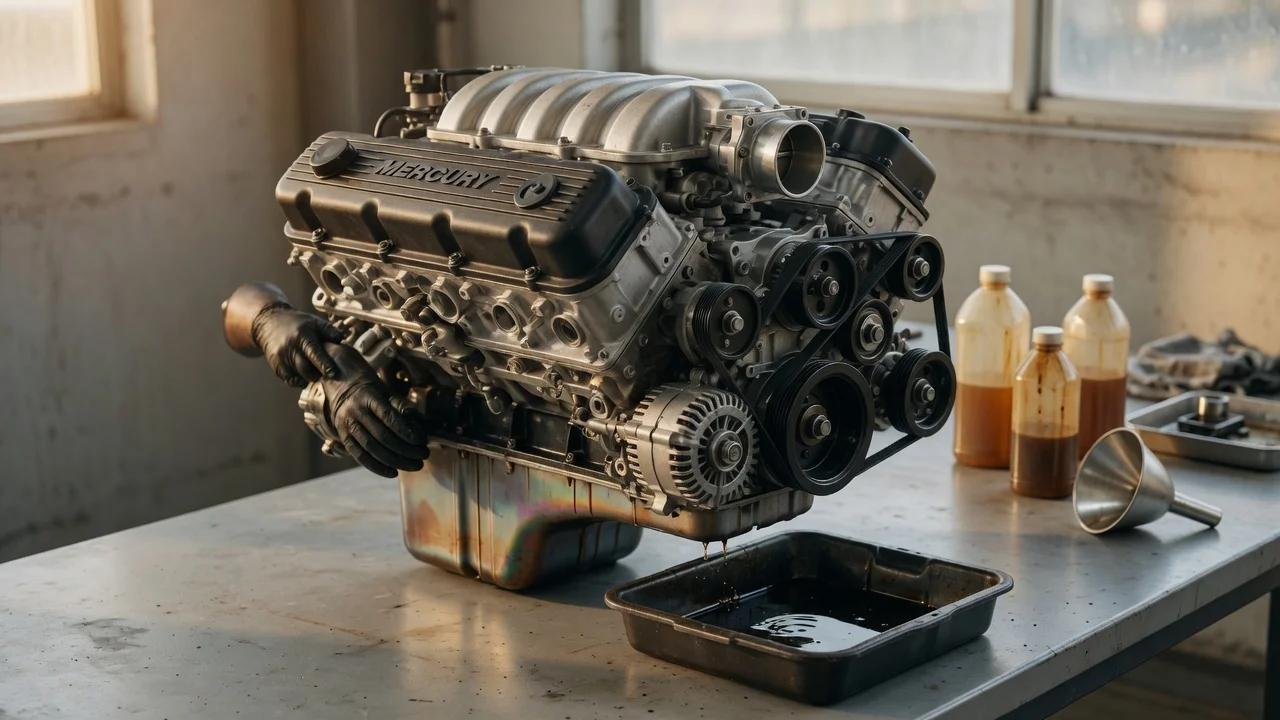
Identify the engine from the serial plate, not from a sales brochure or a generic V10 search. Note model year, horsepower rating and whether it is a Verado outboard or a Ford 6.8-liter road engine. Use the oil type and capacity table in the owner’s manual or service guide that matches that serial range. Marine V10s call for NMMA FC-W four-stroke oil in the viscosity Mercury lists for the ambient range; the Ford 6.8-liter uses the Ford specification printed for that year. Change the filter with the oil. Fill to a volume slightly below the published service fill, start the engine, let oil reach the galleries and cooler, then shut down and wait for drain-back. Check the dipstick or sight indication on a level hull or a level vehicle. Add in small amounts until the level sits between the add and full marks. Do not use the filler neck as a “until it spills” gauge.
Overfill on a high-output V10 can aerate the oil, raise crankcase pressure and push oil past seals. Underfill starves the pickup at heel, trim or steep drive angles on a boat, and during hard cornering or grades on a truck. The dipstick after a complete drain-back is the working check; the manual figure is only the starting quantity.
What this article cannot pin to a single number
A quart-and-liter table for every Mercury V10 variant is not included here because capacity is serial- and application-specific, and a universal number would be misleading. The 5.7-liter Verado V10 and the Ford 6.8-liter Triton V10 do not share a pan, filter or refill volume. If you need a purchase quantity today, read the capacity line in the manual that matches your serial number, buy that volume plus a matching filter, and finish the job on the dipstick rather than by emptying every bottle into the filler.