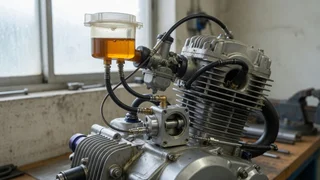
Mercury 2-stroke lower unit oil
A Mercury 2-stroke outboard depends on the lower unit oil to protect its driveshaft, propshaft, and gear set under constant load. Choosing the correct marine gear lubricant matters because these gears endure shock, moisture exposure, and wide temperature swings. The right product resists water intrusion, protects yellow metals, and maintains film strength. Without a suitable fill, wear accelerates and water contamination can turn lubricant into a milky emulsion, compromising shift quality and long-term durability.
Essential answer
Mercury 2-stroke lower unit oil is a marine-specific gear lubricant intended for the gearcase of a two-stroke outboard. It is generally an extreme-pressure 80W-90 or 85W-90 formulation, often sold as premium or high-performance gear lube. Unlike common automotive differential fluid, it is engineered to tolerate the continuous possibility of water entry through worn propshaft seals or fishing-line damage. The additive package normally includes emulsifiers that hold limited water in suspension, plus corrosion inhibitors that protect bronze bushings and other soft metals inside the case.
The real difference from generic gear oil is its behavior when water enters the housing. The emulsifier chemistry prevents the water from separating into a free layer that can rust gears quickly, instead creating a stable mixture that keeps some lubrication present. Mercury’s earlier outboards favored an amber oil, while later premium fluids tend to be green or blue. Color alone is not identification; the actual requirement is a marine lower-unit formulation rather than an ordinary GL-5 automotive product that may lack the correct water-handling and yellow-metal protections.