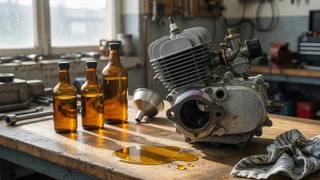
Choose BRP 2-stroke oil
Choosing BRP 2-stroke oil means matching the lubricant specification to your specific Rotax engine, injection system, and riding conditions. The right product protects power valves, resists deposit formation, and maintains clean combustion under heat and load. Before buying, confirm the manufacturer approval or equivalent performance category for your model, then verify fill quantity and service interval from your owner’s manual. A correct level check and consistent product choice reduce wear and help the exhaust system and internal surfaces stay cleaner longer.
The direct answer
For most BRP and Rotax applications, the direct answer is to select a quality synthetic or synthetic-blend 2-stroke oil that meets the performance category stated for your specific engine and oil delivery method. BRP-branded formulations are designed around the thermal loads, injector flow, and power valve behavior of their two-stroke lineup. If you are running an older engine with a different pump calibration, the same modern low-ash product may still be appropriate, but the manual’s guidance should take priority over habit.
A low-ash or ashless synthetic is often the safest starting point because it tends to leave less combustion residue around pistons and exhaust ports. That matters when an injection system is feeding oil continuously and you cannot easily switch chemistry mid-tank. Before buying a non-BRP substitute, read the bottle for the stated JASO or API two-stroke performance class and any manufacturer approval language. An oil that merely says “for snowmobiles” or “premix” may not satisfy a Rotax injection requirement.
Choosing and buying
When shopping, first identify the equipment precisely. The oil requirement for a Sea-Doo watercraft, a Ski-Doo snowmobile, and a Can-Am off-road vehicle can differ because piston acceleration, cooling, and exhaust temperatures are not identical. Look for compatibility language that names your engine family or the relevant Rotax performance specification. Avoid choosing solely by price; a cheaper oil with the wrong deposit-control chemistry can increase power valve sticking and ring groove carbon over time.
Check the fill quantity you actually need before buying a large container. A watercraft reservoir may hold less than a snowmobile system, and an older carbureted model may consume oil at a different rate than an E-TEC or direct-injection design. Use the level check procedure in the manual, not just the translucent tank marks, because vehicle angle and recent operation can change the reading. Tipping the machine or running the tank empty can be more than an inconvenience on an injected engine.
Comparing alternatives
If you compare a BRP-branded oil with an aftermarket equivalent, focus on the declared two-stroke service categories and the intended injection environment. A synthetic blend may work adequately for moderate loads, while a full synthetic often offers better film strength during sustained high-rpm operation. The trade-off is usually cost and availability, not a simple better-or-worse ranking. The best choice is the oil that matches the engine’s heat range and is available consistently enough to keep the reservoir full.
For mixed-fleet owners, a single product that covers both water and snow equipment can be convenient, but only if the listed approvals cover both engine families. Do not assume an oil approved for one Rotax model automatically carries approval for another with a different exhaust valve arrangement or injection mapping. If you switch products, avoid mixing large amounts of dissimilar oils in the tank. A gradual change is easier on the system than a sudden change in viscosity and additive chemistry.