Mercury 40 hp 4-stroke engine oil
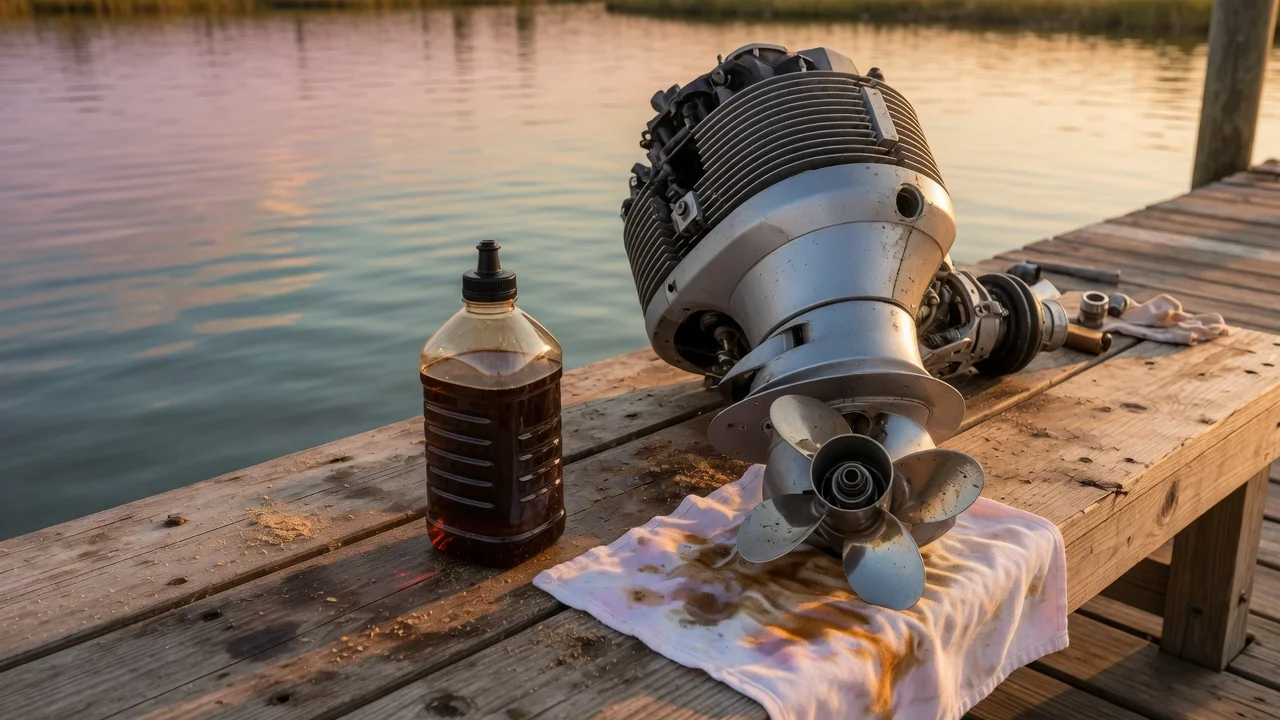
What oil a Mercury 40 hp four-stroke uses
A Mercury 40 hp four-stroke outboard is specified for NMMA FC-W certified 4-stroke marine engine oil, not ordinary automotive motor oil and not 2-stroke mix oil. Mercury’s own 4-stroke outboard oil in SAE 10W-30 is the usual factory fill and service recommendation for this power class in temperate conditions; many later Mercury 4-stroke manuals also list SAE 25W-40 FC-W for warmer operation. The owner’s manual for the exact model year and serial number is the controlling document for viscosity, capacity, and filter.
Scope and what changes the answer
This guidance applies to Mercury Marine 40 horsepower four-stroke outboards (carbureted and EFI FourStroke families). It does not apply to Mercury 40 hp two-strokes, which use TC-W3 2-stroke oil mixed with fuel or injected separately; to MerCruiser sterndrives; or to automotive engines. Within the 40 hp four-stroke line, oil grade, sump capacity, and filter part number still vary by generation, serial range, and market, so a claim that is true for one 40 FourStroke can be wrong for another.
Why FC-W marine oil is required
FC-W is the National Marine Manufacturers Association category for four-stroke watercraft oils. It adds rust and corrosion protection, shear stability, and water-tolerance tests that passenger-car API oils are not required to meet. Outboards sit idle in humid, salt-laden air and can ingest moisture; an automotive 10W-30 that meets API SN or SP can still leave the lower unit and powerhead under-protected against corrosion. Mercury-branded 4-stroke oil is formulated to that FC-W standard; other brands are acceptable when they carry a current FC-W mark at the viscosity the manual lists.
Viscosity: 10W-30 and 25W-40
Mercury four-stroke literature commonly pairs SAE 10W-30 FC-W with cooler starting and a wide operating band, and SAE 25W-40 FC-W with higher ambient temperatures. Both grades are marine 4-stroke oils, not interchangeable with 2-stroke oil. If the engine will see cold starts near or below freezing, 10W-30 is the grade most Mercury 40 hp four-stroke charts point to. If the boat lives in consistently warm water and the manual lists 25W-40, that heavier grade is the intended choice. Do not blend viscosities to “split the difference,” and do not substitute a 5W-30 or 15W-40 automotive oil unless that exact grade is printed in the applicable Mercury chart.
Use NMMA FC-W (or FC-W Catalyst) 4-stroke marine oil at the SAE grade the serial-specific manual lists. Prefer Mercury 4-Stroke Outboard Oil when matching factory service, or an equivalent FC-W oil in the same viscosity. Match oil to climate using the manual’s temperature chart, typically 10W-30 for cooler starts and 25W-40 where listed for warmer use. Change the oil and the spin-on filter together; run the engine to operating temperature before draining so the sump empties cleanly. Confirm capacity on the dipstick after a running fill; published quart or litre figures differ by 40 hp generation and are not interchangeable.
What not to pour in
Do not use TC-W3 2-stroke oil in the crankcase. Do not use gear lube (the lower unit uses a separate SAE 80W-90 or 75W-90 marine gear lubricant). Automotive oils without an FC-W rating, motorcycle wet-clutch oils, and “high-mileage” car oils are outside the specification. Straight-weight oils and racing oils that omit rust inhibitors are also outside the spec. If the engine has a catalytic converter (some later EFI four-strokes), the manual may require FC-W Catalyst; a non-catalyst FC-W oil can be the wrong product on those serial numbers.
Capacity, filter, and service interval
Sump capacity for Mercury 40 hp four-strokes is model-dependent and is not a single number across the family. Typical 40 hp three-cylinder FourStroke engines hold on the order of a few litres with a filter change, but the only supported figure is the one printed for that serial range. Overfilling can aerate oil and raise crankcase pressure; underfilling starves the cam and journals. Fill, run, shut down, wait a few minutes, then read the dipstick with the engine in the attitude the manual specifies (usually vertical or on the trailer in the running position).
Mercury’s published four-stroke service schedule commonly calls for an oil and filter change after the first break-in period (often around 20 hours or 3 months on new engines) and then at regular hourly or seasonal intervals thereafter. Exact hours, months, and filter part numbers are serial-specific; treat any round number from a forum or a generic 40 hp chart as unverified until it matches the manual or a Mercury parts lookup for that engine.
How to choose and what to do next
Read the oil specification page in the owner’s manual for the engine’s serial number. Buy FC-W 4-stroke oil in the listed SAE grade, plus the matching Mercury or equivalent spin-on filter. If the manual is missing, the serial number on the transom bracket or midsection identifies the correct chart through a Mercury dealer. Check the lower-unit gear lube separately; it is a different product and a different service. After the change, confirm the dipstick level, look for leaks at the filter and drain, and keep a record of hours and viscosity used so the next service stays on the same spec.
Gaps to confirm before you buy
This article does not assign a single oil capacity, filter part number, or change interval to every Mercury 40 hp four-stroke, because those values change with generation and serial range and were not supplied as a single documented spec here. Catalyst versus non-catalyst FC-W, and whether 10W-30 or 25W-40 is listed for a given climate, must be taken from the engine’s own chart. If the boat is used in commercial, extreme-idle, or heavily silted water, follow any shortened interval in that same manual rather than a generic recreational schedule.