Air-cooled 2-stroke engine oil
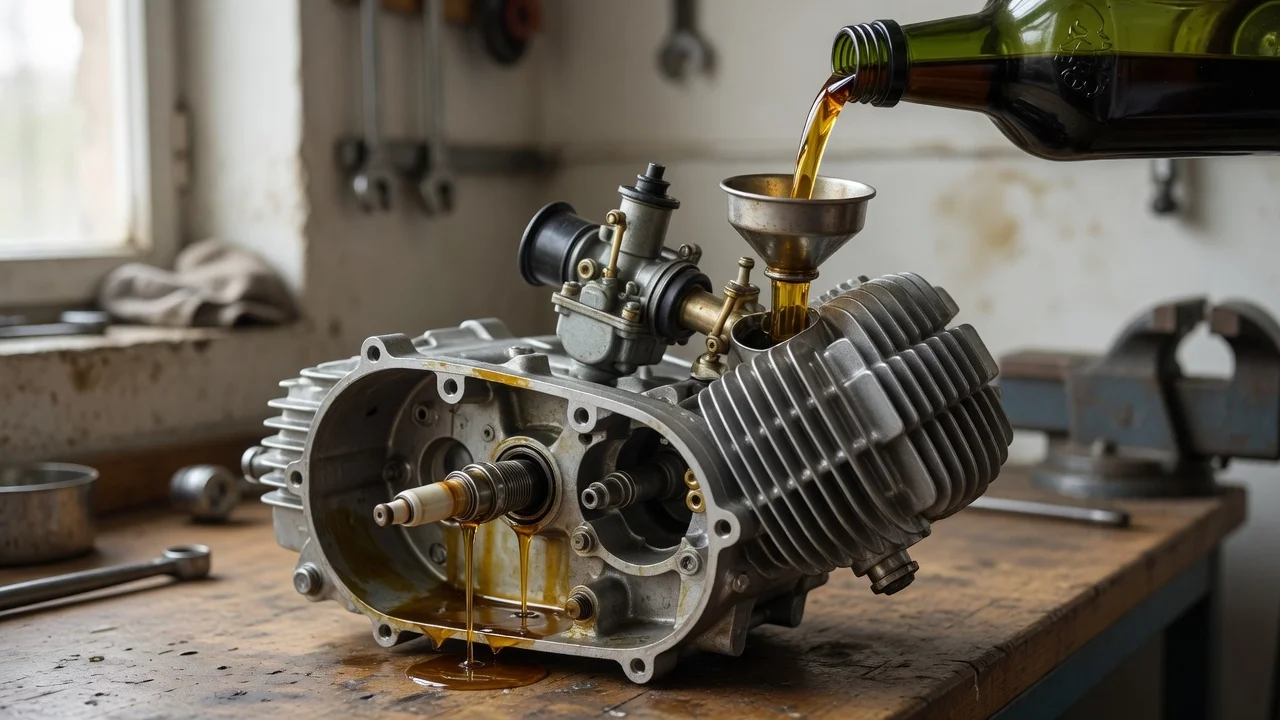
The short answer
An air-cooled two-stroke engine needs a dedicated two-stroke oil that meets the standard named in its owner's manual. Most manuals specify a JASO rating (FC or FD), an ISO rating (EGC or EGD), or the older API TC rating. Do not use four-stroke motor oil. Avoid oil rated only NMMA TC-W3 unless the manufacturer allows it, because that oil is designed for water-cooled outboard engines.
Three things can change this answer. The first is what the manufacturer specifies for your model year and market. The second is whether the engine uses premix (oil blended into the fuel) or oil injection (a separate tank and pump). The third is the fuel-to-oil ratio the manual calls for. If the manual names a rating or ratio, follow it over any general guidance, including this article.
Why air cooling matters for oil choice
A two-stroke engine has no oil sump. Oil travels through the engine with the fuel, lubricates the crankshaft bearings, cylinder wall and piston rings, and is then burned. That means the oil must lubricate well and also burn cleanly.
Air-cooled engines shed heat through cooling fins rather than a liquid coolant circuit. Their cylinder temperatures generally run higher and vary more with load, speed and ambient conditions. Oil for these engines needs to keep protecting at those temperatures. It also needs to resist the carbon deposits and ring sticking that heat encourages.
Outboard engines are cooled by the water they run in, so they operate cooler. TC-W3 oil is formulated for that environment. It does not necessarily provide the high-temperature protection an air-cooled engine needs. Some oils carry both an air-cooled rating and TC-W3, and those are fine. The concern is oil that carries only the water-cooled rating.
Reading the ratings on the bottle
Rating | What it indicates | Fit for air-cooled engines; JASO FB | Older Japanese standard covering basic lubrication and detergency | Acceptable only if the manual names it; superseded by FC and FD; JASO FC | Adds low-smoke and higher detergency requirements | Common minimum for modern air-cooled engines; JASO FD | Builds on FC with stronger detergency for cleaner pistons | Meets or exceeds FC; suitable wherever FC is specified; ISO-L-EGC | International grade based on JASO FC, with an added piston cleanliness test | Comparable to FC; ISO-L-EGD | International grade based on JASO FD, with an added piston cleanliness test | Comparable to FD; API TC | Older North American standard for high-performance air-cooled two-strokes | Acceptable if the manual names it; NMMA TC-W3 (only) | Formulated for water-cooled outboard engines | Not recommended unless the manufacturer approves it
In general, an oil meeting a higher grade in the same family can replace a lower one. For example, FD can be used where FC is specified. The reverse is not true. If the manual lists a specific manufacturer-branded oil, a third-party oil with the same rating is usually acceptable. Check the warranty terms if the vehicle or equipment is still covered.
Mineral, semi-synthetic or synthetic
Any base type meets the requirement as long as it carries the rating your manual specifies. Synthetic and semi-synthetic two-stroke oils are commonly marketed as producing less smoke and fewer deposits. They are often recommended for high-revving or hard-working engines. No comparative test data was supplied for this article, so specific brands or formulations cannot be ranked here. Treat the rating, not the base-oil label, as the deciding factor.
Premix versus oil injection
Premix engines need you to blend oil into the fuel before filling the tank. The ratio is written as fuel to oil. For example, 50:1 means fifty parts fuel to one part oil. Add the oil to fuel in a clean container and mix it thoroughly before fuelling.
Oil-injected engines meter oil from a separate tank, so you fill that tank with straight two-stroke oil. Injection pumps need oil that flows easily, especially in cold weather. Some oils are labelled for premix only and are not suitable for injection systems. Check the container for injector or autolube compatibility before using it in an oil-injected engine.
Getting the ratio right
Use the ratio given in the owner's manual for your specific engine. Ratios vary between manufacturers, models and sometimes model years. Some manuals also give a different ratio for running-in a new or rebuilt engine.
Adding extra oil is not automatically safer. Too much oil can foul spark plugs, increase smoke, and build carbon in the exhaust port and on the piston. Too little oil risks inadequate lubrication and piston seizure. Some oils are sold as suitable for a range of ratios. Even so, the engine manufacturer's figure should take priority over the oil label.
Mixed fuel and storage
Petrol degrades over time, and fuel mixed with two-stroke oil is no exception. Mix only as much as you expect to use in a reasonable period, and store it in a sealed, labelled container. If an engine will sit unused for an extended time, follow the manual's storage procedure. That may involve draining the fuel or using a stabiliser. The supplied material gave no specific shelf-life figures, so check the oil and fuel manufacturers' guidance for exact periods.
What this article could not confirm
No model-specific specifications were supplied. This article therefore cannot state the required rating or ratio for any particular motorcycle, scooter, moped or other air-cooled two-stroke engine. Requirements can differ by model year, market and engine variant, so the same model name sold in different regions or years may carry different recommendations. Use your owner's manual, the manufacturer's service information, or a dealer for the exact specification.
Quick checklist before you buy
Confirm the oil rating and fuel-to-oil ratio in the owner's manual for your exact model year and market. Choose a two-stroke oil labelled for air-cooled engines that meets or exceeds that rating, such as JASO FC or FD, ISO-L-EGC or EGD, or API TC. Avoid oil rated only NMMA TC-W3 unless the manufacturer approves it, and never use four-stroke motor oil. For oil-injected engines, check that the oil is labelled as suitable for injection systems. Mix premix fuel at the specified ratio in a clean container, and only in quantities you will use reasonably soon.