Maruti 800 Engine Oil: Grades, Capacity and Change Intervals
Direct answer
The most commonly recommended engine oil for a Maruti 800 is a 20W-40 mineral oil meeting an API SE, SF or SG service classification, depending on the car's age and the climate where it is driven. Many owners in moderate and warm conditions use 20W-40, while 15W-40 is also an acceptable option in some colder regions. The final choice should follow the grade given in the owner's manual for your specific model year and engine condition.
Why the grade matters
The Maruti 800 uses a small-displacement, naturally aspirated petrol engine that was designed when older mineral oil technology was standard. The viscosity grade affects cold-start flow and high-temperature protection. A 20W-40 grade works well across typical Indian and warm-climate operating temperatures, while a 15W-40 grade can make cold starts easier in cooler weather without losing high-temperature film strength.
Engine oil capacity
The Maruti 800 engine oil capacity is approximately 3.0 to 3.5 litres including the oil filter, depending on the generation and whether the sump is drained completely. A 3-litre container is often slightly short when the filter is also replaced. It is safer to buy a 4-litre container, fill to the dipstick marks, and keep the remainder for top-ups.
Recommended oil specification
Condition | Recommended grade; Normal warm climate, older engine | 20W-40 mineral; Cooler climate or easier cold starts | 15W-40 mineral; High-mileage engine with minor leaks | 20W-40 mineral with seal conditioner if specified; Severe operating conditions | Follow manual interval, do not simply choose thicker oil
Most Maruti 800 owner manuals specify an API SE, SF or SG oil. These older API categories are not always printed on modern oil containers, but many 20W-40 mineral oils still carry API SF or SG approval. Avoid using an oil rated only for diesel engines unless the container clearly states petrol-engine compatibility.
Change interval
A typical oil and filter change interval for a Maruti 800 is every 5,000 km or 6 months, whichever comes first, during normal use. For heavy city running, frequent short trips or dusty conditions, the oil should be changed closer to every 3,000 to 4,000 km. Long idling and stop-and-go traffic count as harder conditions than steady highway driving.
Checking the oil level
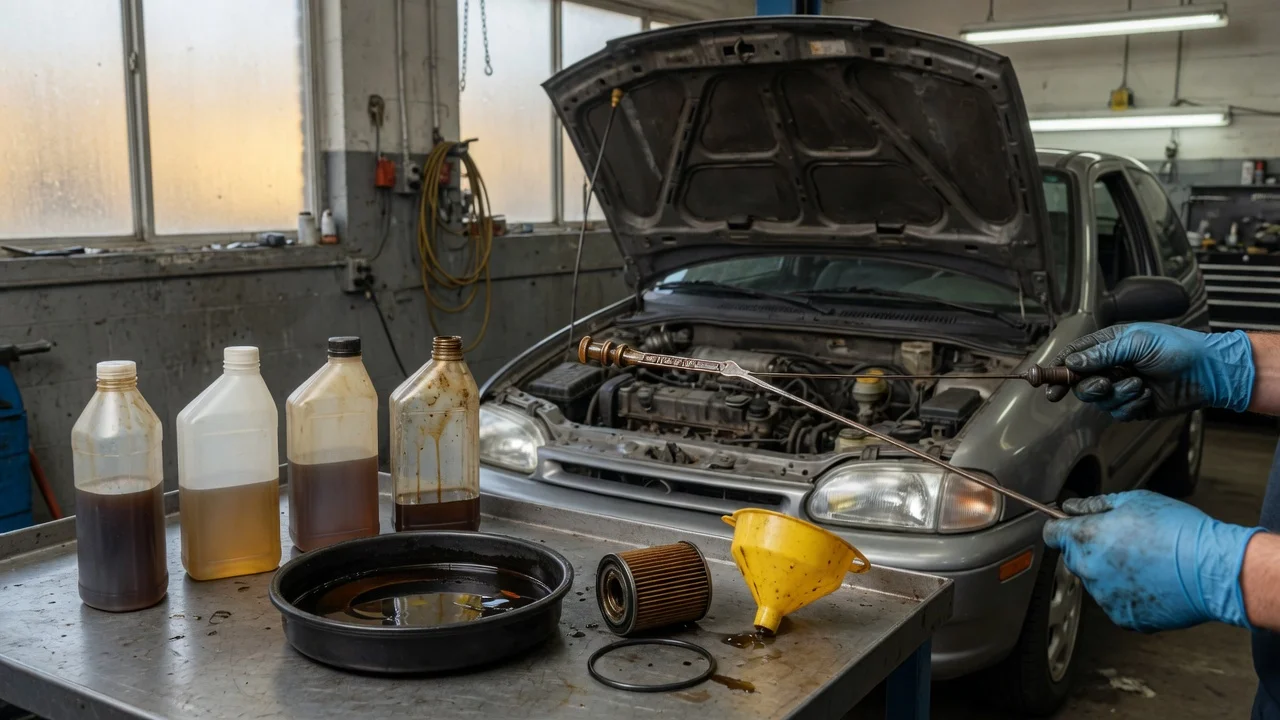
Check the oil with the car parked on level ground and the engine off for a few minutes. Pull the dipstick, wipe it clean, reinsert it fully, then remove it again. The oil film should sit between the minimum and maximum marks. On a Maruti 800, the distance between the min and max marks is usually close to 1 litre, so a reading near minimum needs immediate topping up.
Choosing between mineral and synthetic
Mineral oil is the conventional choice for the Maruti 800 and is adequate for the engine's modest output and older sealing materials. Fully synthetic oil is not necessary and may expose minor seepage in an old engine, although a high-quality semi-synthetic can offer slightly better high-temperature stability. The most important factor is using the correct viscosity and changing it on schedule.
Things to check before buying
Confirm the viscosity grade recommended for your model year. Check that the oil carries a petrol-engine API rating such as SF, SG or a later backward-compatible rating. Buy enough oil for the capacity plus a top-up bottle. Replace the oil filter at the same time; an old filter shortens the new oil's life. Avoid mixing very different oil brands or bases unless you have no alternative.
Material uncertainty
Exact oil capacity and grade can vary between Maruti 800 generations, carburettor and fuel-injected versions, and regional owner manuals. The figures here are typical rather than universal. Where the manual is available, its printed specification should override general guidance. If the engine has been rebuilt or modified, oil choice may also differ from the factory recommendation.