How Keyless Relay Theft Works and How to Protect Your Car
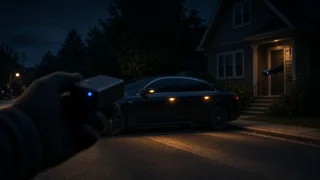
Remote key fob car theft usually means a relay attack. Thieves use two radio devices to pass the signal between your key fob and your car, so the car behaves as if the key is right beside it. This only works on vehicles with passive keyless entry and start, where you can unlock the doors and press the start button while the fob stays in your pocket. The most effective protection combines several layers. Block or disable the fob's signal when you aren't using it, add a visible mechanical deterrent, and make the car harder to drive away or keep. If your car needs a button press on the fob to unlock, or a physical key in the ignition to start, the classic relay attack generally does not apply. Other theft methods still can.
What "keyless" means and why it matters
Most modern fobs have a remote button that sends a coded unlock command. A passive keyless entry and start system goes further. The car regularly transmits a short-range wake-up signal, and when a fob in range hears it, the fob answers automatically. If the car accepts the answer, it unlocks when you touch the handle and allows the engine to start with a button press. That automatic, hands-free exchange is what thieves stealing key fob signals exploit. The exploit works because the system assumes the key is nearby whenever a valid reply arrives.
How a relay attack works, step by step
1) Two people work together. One stands near the car with a device that picks up the car's wake-up signal. The other gets close to where the key is kept, such as near a front door, a window or a person in a public place. 2) The first device forwards the car's signal to the second device, which rebroadcasts it close to the fob. 3) The fob hears what looks like its own car nearby and sends its normal response. 4) The second device carries that response back to the first, which transmits it at the car. 5) The car receives a genuine, correctly coded reply and unlocks. The thief gets in and presses the start button, and the relayed exchange repeats to authorize the start. 6) The car is driven away. Many vehicles will not shut off a running engine just because the key is no longer detected, because stalling in traffic would be dangerous. Some show a warning instead.
The thieves never break the fob's encryption. They extend the distance over which a real conversation between the key and the car can happen. That is why the method is often loosely called signal boosting, or key fob signal amplification. The fob's signal is not really made stronger. It is captured and passed along, so the car is fooled about how close the key is.
What this means in everyday use
There is often little or no sign of forced entry, so a relay theft can look as if the owner left the car unlocked. Keys left near an entrance, on a hallway table or in a coat by the door are easier to reach than keys kept deep inside the home. The attack can happen in parking lots or other public places as well as at home, if someone can get near the person carrying the fob. It usually takes only a short time, so an alarm or camera that alerts you after the car is moving may not stop it. Vehicles differ. Some newer systems measure the timing or distance of the fob's reply, or use motion sensors in the fob, and these make relay attacks much harder. You often can't tell which approach your car uses without checking with the manufacturer or a dealer.
Is your car exposed? Quick checks
Start by confirming whether the vehicle has passive keyless features. These observations tell you whether the relay risk applies. They don't tell you how resistant your particular system is.
With the fob in your pocket, touch or pull the door handle without pressing any button. If the car unlocks, it has passive entry. Sit in the car with the fob in your pocket and check whether a start button works without inserting a key. If it does, it has passive start. If you must press the fob's unlock button and turn a key in an ignition barrel, the standard relay attack generally does not apply. Check the owner's manual or the vehicle settings menu for options related to keyless or passive entry. Some vehicles let you switch passive unlocking off. Ask a dealer whether your fob has a sleep mode, a motion sensor that stops it from responding while still, or newer distance-measuring technology. Availability depends on make, model year and market.
How to protect your car: a layered plan
No single product makes a car theft-proof. Treat each measure as one layer. Cutting off the signal stops the relay itself. Physical and electronic deterrents slow down a thief who gets in anyway. Recovery tools help if the car is taken.
Step 1: Stop the fob from talking when you aren't using it
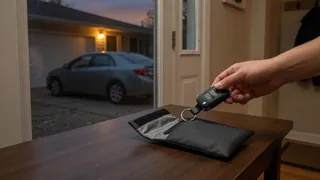
Store keys in a signal-blocking pouch or box, often sold as a Faraday pouch, whenever they're not in use. Spare keys need this too, since a spare in a drawer can be relayed just like the main key. If your vehicle or fob offers a sleep mode or a way to disable passive entry, consider using it. You will then unlock with the fob button, which removes the hands-free exchange that thieves rely on. Keep keys away from external doors, windows and walls that face where the car is parked. Distance alone isn't reliable protection, but it reduces exposure. In public, keep the fob in a blocking pouch when you're away from the car for a long time.
Step 2: Test your blocking pouch or box
Shielding quality varies between products, and pouches wear out with repeated folding. Verify yours instead of assuming it works.
1) Lock the car. Put the fob fully inside the pouch or box and close it completely, following its instructions. 2) Stand right next to the car holding the closed pouch, and pull the door handle. 3) If the car stays locked, the pouch is blocking the passive signal. If it unlocks, the pouch isn't shielding properly or wasn't sealed correctly. Re-seal it and test again, or replace it. 4) Repeat the test from time to time, especially if the pouch looks worn, creased or torn.
Step 3: Add a visible mechanical deterrent
A mechanical deterrent doesn't depend on radio signals, so it still works if the electronics are fooled. Common options include steering wheel locks, pedal locks and gear-lever locks. These devices add time and effort, and their visibility can encourage thieves to move on. Determined thieves can defeat them, so think of them as a delay. When choosing one, check vehicle compatibility with your steering wheel shape, airbag cover and pedal layout. Follow the product's instructions on installation position so the locking mechanism engages firmly and doesn't interfere with airbags or controls. Always remove it completely before driving.
Step 4: Strengthen electronic access control
Ask whether a software update is available for your vehicle's keyless or immobilizer system. Manufacturers sometimes change how these systems behave. Consider an aftermarket immobilizer that needs an extra step to start the engine, such as a code entered through existing buttons or a separate authorization tag. Have it installed by a qualified installer, because it involves the vehicle's wiring and starting system. Thieves sometimes plug into the onboard diagnostic port to program new keys. An OBD port lock or a relocated port can help on vehicles where this is a known risk. If you rely on a manufacturer app, secure the account with a strong unique password and two-factor authentication where offered.
Step 5: Make the car harder to reach and easier to recover
Park in a locked garage when you can, or in a well-lit spot visible from the home. Physical barriers such as lockable driveway posts or gates can block a quick getaway. A tracking device, ideally professionally installed and hidden, improves the chances of recovery. It won't prevent the theft. Motion-activated lighting and cameras can deter some attempts and record evidence, though they may not stop a fast theft.
A note on electrical isolation
Some owners consider battery disconnect switches or hidden cut-off switches to electrically isolate a circuit the car needs to run. These can work, but they may affect alarm function, stored settings and onboard electronics, and some modern vehicles respond poorly to interrupted power. Any modification to starting or fuel circuits should be done by a qualified professional familiar with your vehicle. It may also affect your warranty or insurance, so check before going ahead.
Comparing the main protection options
Measure | What it addresses | Limits; Signal-blocking pouch or box | Stops the fob from answering a relayed signal | Only works when the key is inside and sealed; quality varies, so test it; Disabling passive entry or fob sleep mode | Removes the hands-free exchange entirely | Not available on every vehicle; less convenient; Steering wheel, pedal or gear lock | Slows a thief who gets in | Can be defeated with time and tools; must be removed before driving; Aftermarket immobilizer | Adds an extra authorization step to start | Needs professional installation; cost and compatibility vary; OBD port lock | Makes key programming through the diagnostic port harder | Doesn't address relay attacks directly; Garage, barriers and lighting | Limit access and add visibility | Depend on your property and parking situation; Tracker | Helps recovery after theft | Doesn't prevent the theft; some can be found or jammed
Other keyless-era theft methods to know about
Relay attacks are only one way of stealing cars with key fob technology. Thieves have also programmed blank keys through the diagnostic port, and in some cases accessed vehicle wiring from outside to send commands directly to the car's network. A signal-blocking pouch doesn't stop these methods. That is why mechanical deterrents, port protection, manufacturer updates and secure parking remain useful even if you protect your fob perfectly.
If you suspect an attempt or a theft
Finding your car unlocked when you're sure you locked it, or noticing items moved inside, could mean a relay attempt. It could also be a fob that didn't register the lock command, a door that wasn't fully closed, or another fault, so treat it as a reason to tighten your precautions, not as proof. If the car is stolen, report it to the police promptly and contact your insurer. If you have a tracker or connected app, share the location information with the police and do not try to recover the vehicle yourself. Afterward, ask a dealer whether remaining keys should be reprogrammed and any unknown keys removed from the vehicle's memory.
Bottom line
Keyless relay theft works by extending the conversation between your fob and your car. It doesn't break the security code. If your car unlocks and starts without a button press or key, keep every fob in a tested signal-blocking pouch or switch off passive entry if your vehicle allows it. Then add a visible mechanical deterrent, consider electronic access control upgrades from a qualified installer, and park somewhere secure. Each layer covers gaps the others leave.