Choosing a Faraday Bag to Prevent Keyless Car Theft
The short answer
A good Faraday bag can stop relay theft of a car with passive keyless entry, but only while the key fob is fully sealed inside it. Relay theft is when thieves capture and extend your fob's signal so the car thinks the key is nearby. The bag works by blocking the radio signals the car and fob use to talk to each other. If the bag is worn, poorly made, left open, or the key is outside it, it gives no protection. It also does nothing against theft methods that bypass the key entirely. So test the bag on your own car before trusting it, and treat it as one layer of security, not the only one.
How relay theft works and why a bag helps
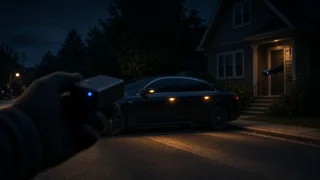
With passive keyless entry, the car sends out a short-range wake-up signal. When your fob is close enough to hear it, the fob replies and the car unlocks or allows the engine to start. In a relay attack, one thief holds a device near your home, often close to the front door or wherever keys are kept. A second thief stands by the car with another device. The two devices pass the signals back and forth, so the car responds as if the fob were standing beside it.
A Faraday bag is a pouch lined with conductive material, usually metallized fabric. It blocks radio signals going in and out. If the fob cannot hear the car's wake-up signal, it never replies, and there is nothing for thieves to relay.
Check whether your car actually needs one
Relay theft only matters if your car unlocks or starts without you pressing a button on the fob. Look for a door handle you can grab to unlock, or a push-button start that works with the fob in your pocket. If you have to press the fob to unlock and insert or turn a key to start, relay attacks are generally not the risk you are facing.
Keyless systems differ between manufacturers, model years, markets and even trims, so check the specifics for your car. Some fobs go to sleep after being still for a while, which limits relay attacks when the key is left untouched. Some newer systems measure the distance to the fob more precisely, using ultra-wideband (UWB) radio, which makes simple relaying much harder. Some vehicles let you switch off passive entry in the settings menu or with a button sequence on the fob. Your owner's manual or a dealer can tell you which of these apply to your car. If your fob already has a sleep mode or your car uses distance measurement, a bag adds less protection, though it can still be a sensible backup.
If you use your phone as a car key, the phone may talk to the car over Bluetooth, UWB or NFC. A bag that blocks your fob will usually block these too, but you will lose calls and messages while the phone is inside. Most people secure the physical fob in a bag and manage phone-key settings separately.
What to check before buying a Faraday bag
Signal coverage: Car fobs typically use a low-frequency wake-up signal and a higher-frequency reply, and some newer systems also use UWB or Bluetooth. Look for a bag described as blocking key fob signals specifically, not just phone or Wi-Fi signals. Be wary of vague claims like "blocks all signals" or "military grade" with no detail behind them. Closure design: The opening is the weakest point. Roll-top closures and double fold-over flaps, where the shielding overlaps when closed, tend to seal more reliably than a single flap. A closure that is awkward to use will eventually get left half-open. Layers and construction: More than one layer of shielding fabric gives some margin as the material wears. Check that seams are tight and the shielding wraps around the edges with no visible gaps. Durability: The metallized fabric can crack or wear thin from repeated folding, especially near the fold line and closure. A tough outer shell, such as heavy nylon or leather, protects the lining. Assume any bag will eventually need replacing. Size and capacity: Make sure it fits your fob, attached keys and any keyring comfortably, without straining the closure. If your household has several keyless cars or keeps a spare fob, either buy a larger pouch or a bag for each key. Everyday convenience: A small pouch that clips to a keyring travels with you. A larger box or tray suits a fixed spot at home. Pick whichever you will actually use every time. Return policy: Because you can only confirm a bag works by testing it on your own car, buy from a seller who accepts returns if it fails.
Test the bag on your own car
Testing takes a minute and is the only reliable way to know the bag works with your specific key and car. Put the fob in the bag and close it exactly as you will in daily use. Stand right beside the car, holding the bag, and pull the door handle. If your car allows it, sit inside, with the bag next to you, and try the start button. With a working bag, the car should not unlock or start. Then take the fob out and confirm the car responds normally, so you know the test was fair.
A common shortcut is to put a phone in the bag and call it. That shows the bag blocks phone signals, but phones and car fobs use different frequencies, so it does not prove the bag stops your fob. Always test with the car itself.
Repeat the test every so often, particularly once the bag starts showing wear or after it has been crushed, washed or caught in a door. A bag that passed when new can fail quietly later.
Faraday bag or another option?
Option | Strengths | Trade-offs | Best for; Faraday pouch | Portable, works at home and away, inexpensive | Only protects while sealed; wears out; easy to forget | Carrying the key daily and storing it overnight; Faraday box or lined tray | Easy to drop keys into; holds several fobs; less wear from folding | Stays in one place; lid must close fully | A household with several keyless cars or a fixed key spot; Fob sleep mode or disabling passive entry | No extra product; always on once set | Not available on every car; may reduce convenience | Owners whose car supports it; Improvised metal tins or appliances | Already at hand | Lids often leave gaps and results vary; appliances get opened or used | Not recommended unless tested with your car every time; Physical and electronic add-ons, such as a steering lock, OBD port lock, aftermarket immobilizer or tracker | Protect against theft methods a bag cannot stop | Extra cost, some need professional installation | Higher-risk cars and areas, as a layer on top of a bag
For most owners, the practical choice is a pouch for daily carrying, plus a box at home if several keys need storing. If your car lets you turn off passive entry or has a fob sleep feature, using that alongside a bag gives you protection that does not depend on a single habit.
Costs to keep in mind
The bag itself is usually the smallest part of the cost. Plan for one bag per keyless fob, including spares, since an unprotected spare in a drawer near the front door can still be relayed. Plan also for replacing bags as they wear. If you add physical or electronic security, compare the total including any installation, and ask your insurer whether certain devices affect your premium.
What a Faraday bag will not protect against
A bag addresses one theft method: relaying the fob's signal. Thieves may instead connect to the car's diagnostic (OBD) port to program a new key, tap into the car's internal wiring network, which is known as CAN injection, or simply tow the vehicle. A bag has no effect on any of these. If your model is often stolen, ask your dealer whether software updates are available for your car's keyless or immobilizer system, and consider a visible steering lock, an OBD port lock or a tracking device as additional layers.
Quick buying checklist
Confirm your car has passive keyless entry or start, and whether the fob has a sleep mode or passive entry can be switched off. Choose a bag that specifically claims to block car key fob signals. Prefer a roll-top or double fold-over closure with multiple shielding layers. Check it fits all your keys without straining the closure. Buy enough bags for every keyless fob, spares included. Buy from a seller with a usable return policy. Test the bag at your car on day one, and retest regularly. Make sealing the key a fixed habit, especially at home overnight. Add other security layers if your car is a common theft target.