Kawasaki Z400 Oil Capacity: How Much Oil the Parallel-Twin Needs

The Short Answer
The modern Kawasaki Z400 uses a 399 cc parallel-twin engine. For a routine oil and filter change it takes roughly two liters, which is about two US quarts. The exact figure depends on whether you replace the filter during the change. The owner's manual for your model year has the authoritative numbers. In practice, the correct fill is the amount that puts the level between the upper and lower marks on the oil level window once the engine has run and settled.
Treat any single number, including the approximate one above, as a starting point rather than a target. Add oil gradually and confirm the level through the inspection window.
Which Z400 This Applies To
Several different motorcycles have carried the Z400 name, so it matters which one you own.
Modern Z400 (US market from the 2019 model year): the naked sibling of the Ninja 400. Both use the same liquid-cooled 399 cc parallel twin, so they share the same oil capacity and oil specification. This guide covers this bike. Vintage Z400 / KZ400 (1970s): an unrelated air-cooled design with its own capacity and service requirements. Figures for the modern bike do not apply. Z250 and Z300: these earlier small Z models use different engines, so their capacities should not be assumed to match the Z400. Z500: in many markets, including the US, Kawasaki has replaced the Z400 with a larger-displacement Z500. The two engines are closely related, but you should not assume the oil capacity is identical. Check the Z500's own manual.
Why the Capacity Figure Changes
Motorcycle manuals usually list more than one oil capacity, because the amount the engine accepts depends on how much old oil is still inside it.
Situation | What happens | Effect on refill amount; Oil drained, filter not replaced | The old filter and its housing stay full of oil | Smallest refill; Oil drained, filter replaced | The new filter is dry and absorbs oil on first start | Slightly more than without a filter change; Engine completely dry (after a rebuild) | Every passage, the cooler circuit if fitted, and the sump are empty | Largest figure; not relevant to normal servicing
Draining time also matters. An engine left to drip for a long time, or drained while warm, gives up more oil than one drained quickly or cold. That is one reason the sight window is more reliable than a measured pour.
Checking the Level Correctly
The Z400 has no dipstick. It uses an oil level inspection window, a small round sight glass on the right side of the engine near the clutch cover, with upper and lower level marks around it. Follow these steps for an accurate reading:
Hold the bike upright on level ground. A paddock stand or a helper works well, because the side stand tilts the bike and makes the level read low. If the engine has just been filled or run, idle it briefly, then shut it off and wait a few minutes so oil can drain back to the sump. Read the level in the window. It should sit between the upper and lower marks. If it is low, add small amounts through the filler cap and recheck after each addition. Avoid topping up to the very top of the window as a habit.
Overfilling and Underfilling
Running low on oil reduces lubrication and cooling margin for the bearings, cam surfaces and transmission. On this type of engine the oil lubricates the gearbox as well as the engine. Overfilling is less obvious but also undesirable. Excess oil can be churned by moving parts, which can cause aeration (air mixed into the oil) and push oil into the crankcase breather system. If you have overfilled noticeably, drain a little out rather than riding on it.
Oil Type
Kawasaki typically specifies a 10W-40 four-stroke motorcycle oil for this engine. The oil should meet a current API service category and carry a JASO MA-family rating. The JASO MA rating matters because the Z400 has a wet clutch that runs in the same oil as the engine. Many passenger-car oils carry friction modifiers that can make a wet clutch slip, which is why a motorcycle-specific JASO MA, MA1 or MA2 oil is the usual recommendation. Confirm the exact viscosity and approvals for your climate and model year in the owner's manual.
Practical Tips for an Oil Change
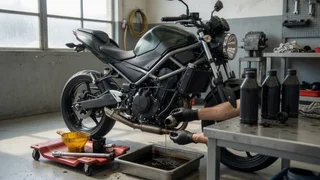
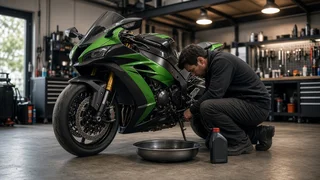
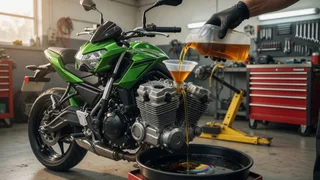
Buy a little more oil than the nominal capacity. Oil is often sold in one-liter or one-quart bottles, and a partial spare bottle is useful for later top-ups. Use a new crush washer on the drain plug if the manual calls for one, and tighten the plug to the specified torque rather than by feel. Lightly oil the new filter's rubber seal before installing it so it seats evenly. Pour slightly less than the expected amount, run the engine briefly, check for leaks around the plug and filter, then bring the level up to the window marks. Recheck the level after the first ride, because a fresh filter can absorb a little more oil once it fully primes.
Bottom Line
The modern Z400 takes roughly two liters, or about two US quarts, for a typical oil and filter change. It needs slightly less if the filter is not replaced. Because the manual's figures vary with the service performed, the dependable method is to fill gradually with a JASO MA-rated 10W-40 motorcycle oil and stop when the level sits between the marks on the inspection window with the bike upright. Owners of the vintage KZ400 or the newer Z500 should use the figures for their own engines.