Kawasaki ZX-10R Engine Oil Capacity: How Much Oil It Takes and How to Get the Level Right
Riders who search for the ZX-10R engine oil capacity usually want one number before an oil change. Kawasaki does not publish one universal figure. The quantity depends on the generation of the bike and on what you are doing: a routine drain, a drain with a new filter, or a refill of a completely dry engine after a rebuild. This guide explains how those figures differ, what kind of oil the engine expects, and how to confirm the level once the oil is in.
The Short Answer
For recent ZX-10R generations, the commonly published figure for an oil-and-filter change is a little under four liters, or roughly four US quarts. Treat that as an approximate guide, not a confirmed specification for your bike. The exact fill quantity for your model year is printed in the owner's manual and the service manual. Use that figure, and use the sight glass to confirm the final level rather than relying on a measured pour alone.
Two qualifications change the answer. First, the ZX-10R has gone through several generations since its introduction, with substantial engine revisions along the way, so capacity can differ between them. Second, any single model year has more than one capacity figure depending on the job.
Why There Are Several Capacity Figures
Kawasaki service data for sport bikes typically lists oil capacity for three situations. The differences come from oil that stays in the engine after draining and from the volume of the filter itself.
Situation | What it means | Relative quantity; Oil change, filter not replaced | Oil drained from the sump; the old filter and some oil in galleries and passages remain | Lowest; Oil and filter change | Sump drained and filter replaced, so the new filter must also be filled | Slightly more; Dry engine | Engine fully rebuilt or assembled with no residual oil | Highest
Most home servicing falls into the middle row, because replacing the filter at each oil change is common practice. The dry-engine figure applies to engine builders and should not be poured into a bike after a normal drain, because residual oil is still inside.
Identifying Your Model Year and Variant
Before you look up the capacity, confirm exactly which bike you have. This matters most with used motorcycles, where the model year listed in an advertisement is not always accurate.
Check the vehicle identification number (VIN) stamped on the steering head and shown on the registration. The tenth character encodes the model year. Note the model code shown in the owner's manual or on the frame labels. Kawasaki uses these codes to separate generations and market versions. Confirm the variant. Standard ZX-10R models, ABS versions and the homologation-focused ZX-10RR share a family name, but you should check service data for the specific version rather than assuming identical figures. If the engine has been swapped or rebuilt, the engine number may not match the frame's model year. In that case, follow the data for the engine actually fitted.
Lubricant Specification
Capacity is only half of the oil question. The ZX-10R, like most Japanese sport bikes, uses a wet clutch that runs in the same oil as the engine and gearbox. That makes the lubricant specification as important as the quantity.
Use a four-stroke motorcycle oil rated to the JASO MA standard (MA, MA1 or MA2). This rating indicates the oil is suitable for wet clutches. Avoid car engine oils labeled as energy-conserving or resource-conserving. Their friction modifiers can make a wet clutch slip. Kawasaki has generally recommended a 10W-40 viscosity for its sport bikes, often with alternative grades for different climates. Confirm the viscosity and API service category listed for your model year. Where the manual lists a manufacturer-approved or branded oil, that is a recommendation, not a requirement. Any oil meeting the listed specification satisfies it.
How to Check the Oil Level Correctly
The ZX-10R uses an oil level inspection window, a sight glass on the lower part of the crankcase, rather than a dipstick. A level check is only meaningful when the bike is in the right position and the oil has had time to drain back into the sump.
Warm the engine briefly if it is cold, then switch it off. Wait a few minutes so oil can drain down from the cylinder head and passages. Hold the bike upright, either with a helper or on a paddock stand. A reading taken on the sidestand will be wrong because the bike is leaning. Read the level in the window. It should sit between the upper and lower marks.
Refilling Without Overfilling
Even with the correct published figure, small amounts of oil left in the engine and differences in filter design mean the measured quantity will not always land exactly on the mark. A cautious approach avoids that problem.
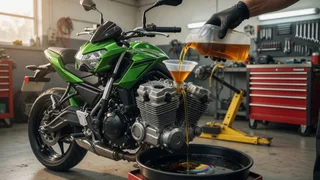
Add somewhat less than the listed quantity first. Start the engine and let it idle briefly so the new filter and oil passages fill, then check for leaks around the drain plug and filter. Shut the engine off, wait, hold the bike upright and read the sight glass. Top up in small amounts until the level sits between the marks.
Both errors carry risks. Too much oil can aerate as the crankshaft churns through it, raise crankcase pressure, and push oil into the breather and airbox. Too little reduces the reserve available to the oil pump, which matters on a bike capable of hard acceleration, braking and high cornering loads that move oil around the sump.
Service Interval Considerations
Kawasaki publishes oil and filter change intervals in the maintenance schedule for each model year, usually expressed as both distance and time, whichever comes first. Follow the schedule for your bike rather than a generic figure. Riders who do frequent track days, sustained high-rpm riding or many short trips may choose to change oil sooner than the standard schedule, because these conditions are harder on oil than steady road use. Whatever the interval, check the level regularly between changes, since oil consumption varies with how the bike is ridden.
Bottom Line
Expect a ZX-10R oil-and-filter change to need a little under four liters on recent generations, but take the exact fill quantity from the manual for your model year and job type. Use a JASO MA-rated motorcycle oil in the specified viscosity, add slightly less than the listed figure, and let the sight glass, read with the bike upright, decide the final top-up.