JT Strong Arm Jack Stabilizer: What It Does and What to Check Before Buying
The short answer
A JT Strong Arm jack stabilizer is a bracing kit, not a jack. It adds angled support arms between your trailer frame and the stabilizer jacks you already have, so the jacks resist side-to-side and fore-and-aft movement better once they are deployed. If your camper shakes when people walk around inside, or rocks when the wind picks up, bracing of this kind targets that problem directly. It does not level the trailer, lift weight, or replace jacks that are bent, undersized or worn out.
Whether it suits you depends mainly on three things: the type of jacks on your trailer, the frame layout where the brackets would mount, and whether your current jacks are sound enough to be worth bracing. If any of those is a poor match, the kit will either not fit or will not deliver the improvement you expect.
How JT Strong Arm stabilizer jacks reduce movement
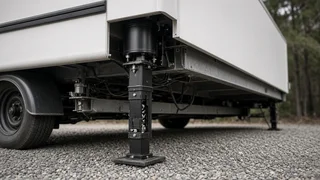
Most travel trailer and fifth wheel stabilizer jacks are tall, narrow scissor or post designs. They hold the frame up at a single support point, but they flex easily when pushed sideways because nothing triangulates them. A small amount of flex at each corner adds up to noticeable bounce inside the coach.
Bracing systems such as the JT Strong Arm add diagonal members that tie the lower part of each jack back to the frame. That creates a triangle, which is far stiffer than a single vertical leg. The jacks still carry the load; the arms mainly stop them from swaying or racking. The result is usually described by owners as a firmer, less bouncy feel rather than a perfectly rigid one, since tires, suspension and ground conditions still allow some movement.
What it does not do
It is not a leveling system. Level the trailer first with blocks, ramps or a powered leveling system, then deploy and brace the stabilizers. It does not lift the trailer. Using stabilizer jacks, braced or not, to raise the coach can overload them and is generally discouraged by jack makers. It does not fix soft or uneven ground. If a jack pad sinks, the bracing sinks with it. It does not stop all motion. Movement through the tires and suspension remains; wheel chocks or tire locking chocks address that separately.
What to check before you buy
Jack type and kit match
Kits are made for specific jack styles, and a set intended for scissor jacks is not the same as one for fifth wheel landing gear or front tongue jacks. Identify exactly what is on your trailer, including whether it is manual or powered, before choosing a kit. Confirm with the seller or the current product listing which jack types and configurations the kit covers, since compatibility can change between product versions.
Frame layout and stabilizer mounting
The brackets attach to the trailer frame, so there must be usable frame rail at the right distance from each jack. Look underneath for obstructions such as holding tanks, enclosed underbellies, crossmembers, wiring runs, propane lines or suspension hangers. Measure the space available rather than assuming it matches a typical trailer. Also check how the brackets fasten. Some mounting methods clamp to the frame while others may involve drilling, and drilling into a chassis can raise questions with the trailer manufacturer, so review that before committing.
Condition and load rating of your existing jacks
Bracing improves a healthy jack; it cannot rescue a damaged one. Check each jack for bent arms, worn pivots, stripped screws and loose mounting bolts. Note the load rating of your jacks and compare it with the weight they actually see. Stabilizer jacks are meant to steady a trailer that is already resting on its wheels, so their ratings are usually modest. If your jacks are undersized or worn, replacing them may come before, or instead of, adding a bracing kit.
Ground clearance and storage
When you travel, the arms are typically stowed or retracted. Check that nothing will hang low enough to catch on driveway transitions, campsite ruts or rough access roads. Consider how quickly the arms can be attached and removed, because a system that is tedious to set up tends to stay unused.
Ground stability at your typical campsites
A stiffer jack transfers more force into the ground, so the pad underneath matters. On gravel, grass or sand, use wide jack pads or blocks to spread the load. If you often camp on soft ground, factor pads into the purchase alongside the bracing kit.
Quick comparison: bracing kit versus other options
Option | Main job | Good fit when | Limits; Jack bracing kit (such as JT Strong Arm) | Stiffens existing stabilizer jacks against sway | Jacks are sound but the coach still bounces or rocks | Needs compatible jacks and frame space; does not level or lift; Upgraded or additional stabilizer jacks | More or stronger support points | Existing jacks are weak, damaged or too few | Installation work; still flex without bracing; Wheel chocks or tire locking chocks | Limit movement through the tires | Fore-and-aft rocking comes from the wheels | Do not address jack flex; Powered leveling system | Levels and supports the coach | You want automated leveling and setup | Higher cost and installation complexity; Jack pads or blocks | Spread load on soft ground | Jacks sink or shift on gravel, grass or sand | Do not add stiffness on their own
Installation and use
Follow the manufacturer instructions for bracket placement, fastener torque and arm adjustment, because the geometry affects how much the bracing helps. In normal use, the order is: level the trailer, chock the wheels, lower the stabilizer jacks until they are snug rather than carrying significant weight, then attach and adjust the arms. Reverse the sequence before moving, and make a habit of confirming the arms are stowed and the jacks fully retracted before towing.
If you are not comfortable working under the trailer or modifying the frame, an RV service shop can assess fit and handle installation. Ask them to confirm there is clear mounting space before ordering parts.
Is it worth buying?
A JT Strong Arm jack stabilizer is worth considering if your trailer's jacks are in good condition, the kit matches your jack type, and you have clean frame space for the brackets. In that situation it addresses the most common cause of interior bounce at a campsite. If your jacks are weak, your frame is crowded, or your main complaint is wheel-related rocking or difficulty leveling, look first at jack replacement, chocks or a leveling solution, and treat bracing as a later upgrade.