UDT2 Hydraulic Oil and John Deere Equipment: What to Check Before You Buy
The short answer
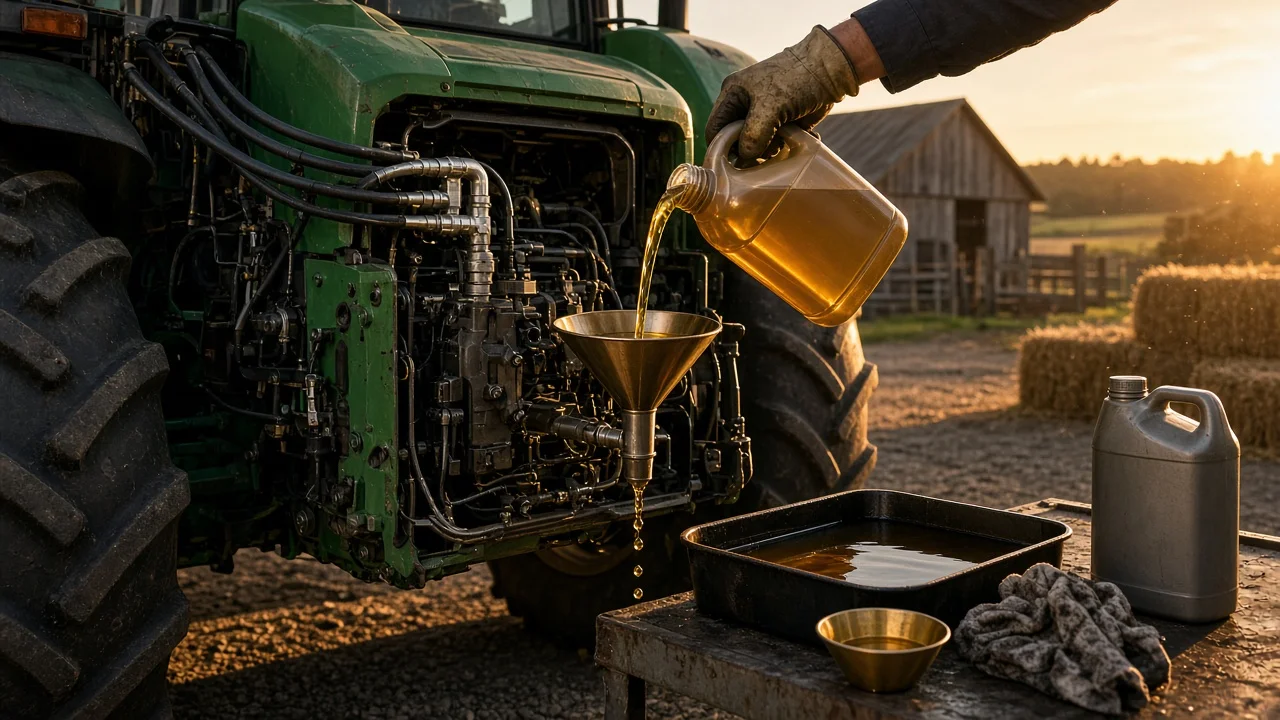
UDT2 is not the name of a John Deere fluid. It is most commonly associated with Kubota's Super UDT2 hydraulic transmission fluid. John Deere's own hydraulic and transmission oil is sold under the Hy-Gard name, with standard and low-viscosity versions tied to John Deere's internal specifications (JDM J20C for standard Hy-Gard and JDM J20D for the low-viscosity version). For a John Deere tractor or other Deere machine, buy a fluid that matches the specification in your operator's manual: genuine Hy-Gard, or an alternative whose label explicitly claims the required John Deere specification.
One condition changes this answer. If your machine is not a John Deere, or the manual for your specific model lists a different fluid, follow the manual. Fluid requirements can vary by model, serial number range, region and the components that share the oil supply.
Why UDT2 and John Deere get searched together
Both fluids belong to the same broad category: universal tractor transmission oil, often shortened to UTTO. A UTTO is a single oil designed to serve the transmission, the hydraulic system, the final drives and oil-immersed (wet) brakes, and sometimes the power take-off clutch, all from one shared reservoir. Many owners run more than one brand of tractor, or buy a used machine without its paperwork, so it is natural to ask whether one brand's fluid can stand in for another's.
Being in the same category does not make two fluids interchangeable. Each equipment maker sets its own performance targets for friction behavior, wear protection, viscosity and seal compatibility. A fluid built to one maker's specification may or may not meet another's. The only reliable test is what the product label claims and what your manual requires.
Identify the machine before you shop
Fluid choice starts with knowing exactly what equipment you are servicing. Record these details before you buy:
Model number, read from the machine itself rather than from memory or a listing. Serial number or product identification number, since requirements can change between production ranges of the same model. Which compartments share the fluid: transmission, hydraulics, wet brakes, PTO, front axle or a hydrostatic drive. Your climate and working conditions, because some manuals specify a low-viscosity fluid for cold-weather operation. The fluid currently in the machine, if known, particularly on a used tractor.
The operator's manual or service literature for that model and serial range is the authority on the lubricant specification. If you no longer have the manual, a dealer parts counter can usually look up the requirement from the serial number.
How to read a fluid label
Aftermarket transmission and hydraulic fluids describe their compatibility in different ways, and the wording carries real weight. Learn to tell these claims apart:
Label wording | What it generally means | How much to rely on it; Genuine OEM product (for example, John Deere Hy-Gard) | Made or sold by the equipment manufacturer to its own specification | Highest confidence for that brand's equipment; Manufacturer approval or licensed to a named specification | The oil maker states the product has been approved against that specification | Strong, if the exact specification code matches your manual; "Meets" or "meets the requirements of" a named specification | The oil maker claims performance equivalent to the specification, without formal approval | Reasonable from a reputable brand; confirm the exact code; "Recommended for use in" or "suitable for" a brand | A general marketing claim that may not reference a specification | Weak; look for a specific specification code; Generic "tractor hydraulic fluid" or "303" fluid | Often references an obsolete specification or none at all | Avoid for equipment that calls for a current specification
The "303" label deserves a word of caution. It refers to an old, long-obsolete fluid designation. Products sold under that label are not evidence of meeting any current manufacturer requirement, and low-cost fluids in this category have a mixed reputation among equipment owners.
Standard versus low-viscosity fluid
John Deere offers both standard Hy-Gard and Low Viscosity Hy-Gard, and other brands make similar splits. The lower-viscosity version is generally specified where cold-weather flow matters, or where particular transmissions and hydraulic systems call for it. Do not swap one for the other on assumption. Check whether your manual lists one fluid for all conditions or gives temperature-based options.
Can you use Kubota UDT2 in a John Deere, or Hy-Gard in a Kubota?
Some owners do, and some aftermarket fluids claim both specifications on the same label. That is the practical route if you run a mixed fleet and want to stock a single fluid. Buying one brand's genuine fluid and putting it in another brand's machine is different. Unless the label explicitly claims the specification your manual lists, you are relying on an assumption.
Wet brakes and wet clutches are where a mismatch most often shows up. They depend on the fluid's friction characteristics, and a poorly matched oil can contribute to brake chatter or noise, clutch engagement problems, or faster wear. If warranty coverage matters to you, using a fluid that does not meet the stated specification can also complicate a claim.
Mixing fluids during top-ups
Small top-ups with a different product that meets the same specification are generally less of a concern than mixing fluids built to different specifications. If you are unsure what is already in the system, or you want to switch brands for good, the cleaner approach is a full drain and refill with a new filter, following the procedure in your manual.
Fill quantity, level checks and service intervals
These three details vary by model, and they are the most common places owners guess wrong.
Fill quantity: use the capacity listed in your manual for that model and configuration. Shared-sump tractors can hold far more oil than owners expect, so check the figure before deciding how many containers to buy. Level check: follow the manual's procedure. Many machines need to sit on level ground with implements lowered and the engine either off or idling, depending on design. Checking with a loader raised or a three-point hitch lifted can give a misleading reading. Service interval: the manual sets hours-based intervals for fluid and filter changes, and they may be shortened for severe or dusty conditions. Filters are usually changed on their own schedule, which can be more frequent than full fluid changes. Condition checks: milky or foamy oil can point to water contamination, and a burnt smell or dark, gritty fluid suggests the oil needs attention sooner than the schedule says.
Buying checklist
Confirm the model and serial number, and find the lubricant specification in the manual. Decide between genuine OEM fluid and an aftermarket fluid that names the exact specification code. Check whether you need the standard or low-viscosity version for your climate and machine. Work out the total fill quantity and buy enough for a full change, plus a little for top-ups. Buy the correct filter at the same time if a change is due. Compare price per gallon across container sizes, since bulk containers often cost less per unit for larger machines. Be wary of unbranded fluids or vague "universal" claims with no specification code.
Bottom line
If you searched for UDT2 hydraulic oil to service a John Deere, what you most likely need is John Deere Hy-Gard or an equivalent that clearly claims the John Deere specification your manual lists. UDT2 is primarily a Kubota designation. Let the manual for your model and serial number decide, and choose products by specification code rather than by brand association or generic labeling.