How to restore an AGM battery
The short answer
An AGM (absorbent glass mat) battery is a sealed lead-acid battery. Its electrolyte is held in glass-fibre mats instead of sloshing freely, and pressure valves keep it closed. Restoring one usually means slowly and fully recharging it with a charger that has a dedicated AGM setting. That reverses mild sulfation, which is the build-up of lead sulfate crystals on the plates that happens when a battery sits partly or fully discharged.
Restoration only works when the battery is undamaged and the problem is discharge or light sulfation. It cannot repair a shorted or dead cell, internal plate damage, dried-out mats, a swollen case or general old-age wear. Unlike some older flooded batteries, an AGM battery is not designed to be opened or topped up with water, so there is no internal repair you can do. If the battery fails the checks at the end of this guide after a proper charge, replace it.
Before you start: is the battery worth trying to recover?
Do not attempt restoration, and do not connect a charger, if any of the following apply:
The case is bulging, swollen, cracked or leaking. The battery is hot without having been charged, or it hisses. There is a rotten-egg or sulfur smell, which points to overcharging or internal failure. The terminals are damaged or loose in the case. The battery has frozen. A deeply discharged lead-acid battery can freeze, and a frozen battery should not be charged.
In any of these cases, take the battery out of service and hand it in for recycling through a battery retailer or local waste facility. Lead-acid batteries should not go in household waste. Separate disposal rules apply in many jurisdictions, so check the rules where you live.
Age matters too. A battery that is several years old and has slowly lost starting power is more likely worn out than sulfated. A battery of reasonable age that went flat because the vehicle sat unused, a light was left on, or a parasitic drain discharged it is the best candidate for recovery. A parasitic drain is something that draws current while the vehicle is off.
Equipment you will need
A smart (multi-stage) battery charger with an AGM mode. A charger with an optional reconditioning or desulfation mode is useful, but use that mode only if the battery maker allows it. A digital multimeter for measuring voltage. Safety glasses and acid-resistant gloves. A well-ventilated work area away from sparks, flames and smoking. Baking soda solution and a wire brush or terminal cleaner for corrosion. The correct tools to disconnect and, if needed, remove the battery. The vehicle owner's manual and the battery label or data sheet, which give the correct charging voltages and any in-vehicle charging instructions.
Avoid old-style unregulated or "trickle" chargers that lack an AGM setting. AGM batteries are sensitive to overvoltage. Sustained charging above the maker's specified voltage can dry out the electrolyte for good and ruin the battery.
Step-by-step: recovering a discharged or sulfated AGM battery
1) Check the vehicle requirements first
Read the owner's manual before disconnecting anything. Many modern vehicles have specific instructions for the following:
Vehicles with start-stop systems. Vehicles with a battery monitoring sensor on the negative terminal. Vehicles with the battery under a seat or in the boot (trunk). Vehicles that specify designated jump or charging points under the bonnet.
Some vehicles can be charged in place at these points. Others need the battery disconnected. Requirements vary by make, model year and equipment, and this guide cannot cover every configuration. Follow the manufacturer's procedure for your vehicle.
2) Disconnect safely
If you are disconnecting the battery, switch the ignition and all accessories off. Remove the negative terminal first, then the positive. When reconnecting, attach the positive first and the negative last. Do not let tools bridge the two terminals. If the battery sits inside the cabin or boot, it may have a vent tube. Refit the tube correctly when you reinstall the battery so any gas is routed outside.
3) Inspect and clean
Check the case again for the warning signs listed above. Clean any corrosion off the terminals and cable clamps with a baking soda solution and a brush, then dry them. Do not remove the top cover, pry the valves open or add water or any additive. Some online guides recommend opening AGM batteries to add distilled water or Epsom salt. This is not a manufacturer-supported procedure. It can damage the battery, release acid and void any warranty.
4) Measure the resting voltage
Set the multimeter to DC volts and measure across the terminals. This reading tells you where you are starting from. A healthy 12-volt lead-acid battery has six cells. A reading roughly one cell's worth below normal, around 10.5 volts after resting, often points to a shorted cell, and charging will not fix that. Exact state-of-charge figures differ between battery makers, and AGM batteries usually rest slightly higher than flooded batteries. Use the values on your battery's label or data sheet rather than generic charts.
If the voltage is very low, some smart chargers will not detect the battery and will refuse to start. Certain chargers have a manual or "force" mode for deeply discharged batteries. Use it only as the charger's instructions describe, stay nearby and stop if the battery gets warm.
5) Charge slowly on the AGM setting
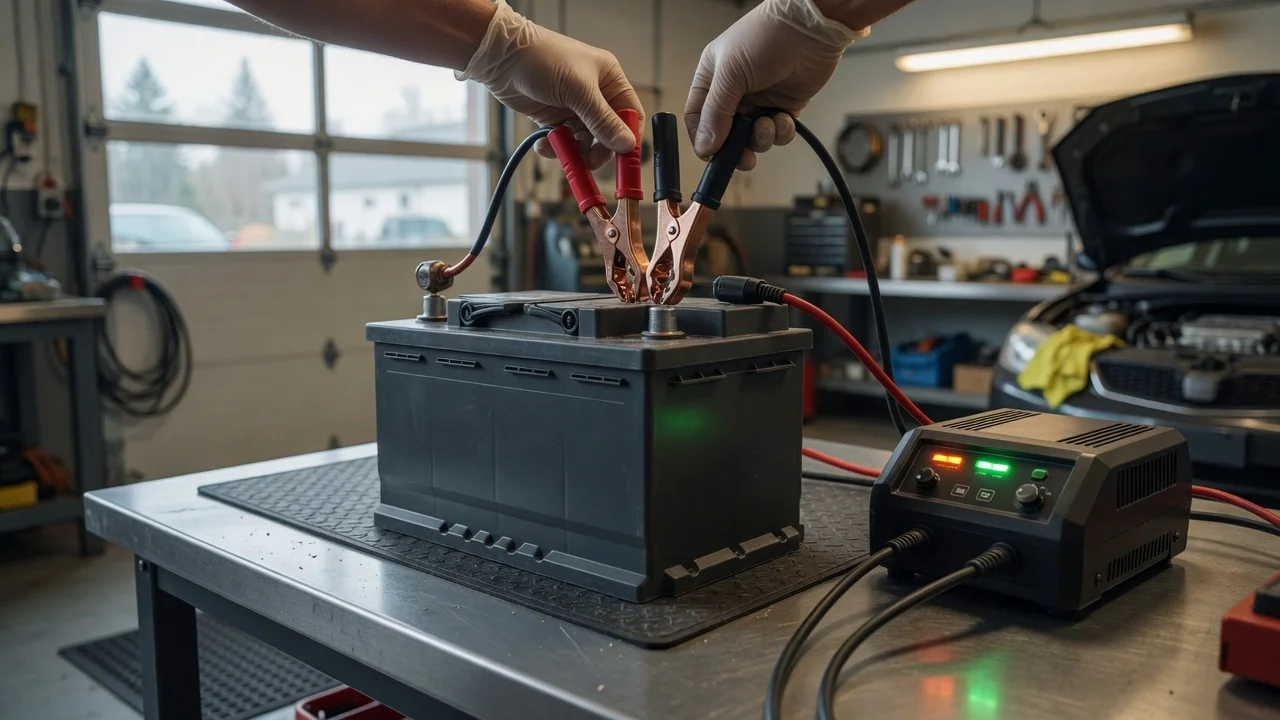
Connect the charger's positive clamp to the positive terminal and the negative clamp to the negative terminal, or to the vehicle's designated earth point if you are charging in place. Do this before switching the charger on. Select AGM mode and let the charger run its full cycle until it shows the battery is fully charged or has switched to maintenance (float) mode. A deeply discharged battery can take many hours. Lower charge currents are gentler on a recovering battery.
Check the battery from time to time during charging. Stop at once and disconnect the charger, switching it off first, if any of the following happens:
The case becomes hot to the touch. The case starts to swell. You hear hissing. You smell sulfur.
6) Optional: run a reconditioning cycle
If the battery still performs poorly after a full normal charge and the charger has a reconditioning or desulfation mode, you can try one cycle. Do so only if the battery maker's guidance allows it for AGM batteries. These modes briefly raise the voltage or apply pulses to break down sulfate crystals. Results vary, and how well they work depends on how long the battery sat discharged. Repeating the cycle on a battery that shows no improvement is unlikely to help and adds the risk of overcharging.
7) Let it rest, then test
Disconnect the charger and leave the battery to rest so the surface charge can dissipate. Twelve to twenty-four hours is a common practice. Then measure the resting voltage again and compare it with the full-charge figure on the battery's data sheet.
How to tell whether the restoration worked
A good voltage reading alone does not prove the battery is healthy. A sulfated or worn battery can show a normal voltage with no load and still be unable to deliver starting current. Confirm the result with these checks:
Resting voltage: after the rest period, it should match the maker's full-charge value. Retention: leave the battery disconnected for several days and measure again. A rapid drop suggests internal self-discharge or a failing cell. Load or conductance test: a battery tester checks whether the battery can still deliver its rated cold cranking amps (CCA). Many parts retailers and workshops offer this test. Real use: the engine should crank strongly, and the battery should not go flat again with normal driving.
If the battery fails the load test, cannot hold its charge or keeps going flat, replace it. Fit an AGM battery of the specification listed for your vehicle. Vehicles designed for AGM, especially those with start-stop systems, generally should not be downgraded to a standard flooded battery.
When to use a qualified technician
The vehicle requires battery registration or coding after a battery is replaced or disconnected, which is common on some vehicles with intelligent battery management. Without it, the charging system may undercharge or overcharge the new battery. The battery is hard to reach or sits inside the cabin, and removing it means disturbing trim, seats or vent lines. The battery keeps discharging. This may point to a parasitic drain or a charging-system fault, such as an alternator problem, which needs proper diagnosis. The vehicle is a hybrid or electric vehicle. Its 12-volt auxiliary battery may have its own procedures, and the high-voltage system must be left to trained technicians.
Preventing the problem from coming back
Most AGM batteries that need recovery have been left discharged. If a vehicle will sit unused for long periods, connect an AGM-compatible battery maintainer, or follow the manual's storage advice for disconnecting the battery. Fix the cause of any unexplained flat battery, such as a parasitic drain, short trips that never fully recharge it, or a charging fault. Without that, restoring the battery only delays the next failure.
Limits of this guide
This guide covers the general procedure for 12-volt automotive AGM batteries. It does not give exact voltages, charge currents or timings for specific batteries or vehicles, because these vary by manufacturer, battery size and vehicle equipment. Always confirm figures and safety steps against your battery's data sheet, your charger's instructions and your vehicle's owner's manual.