How to Inspect Steering Linkage for Play and Damage
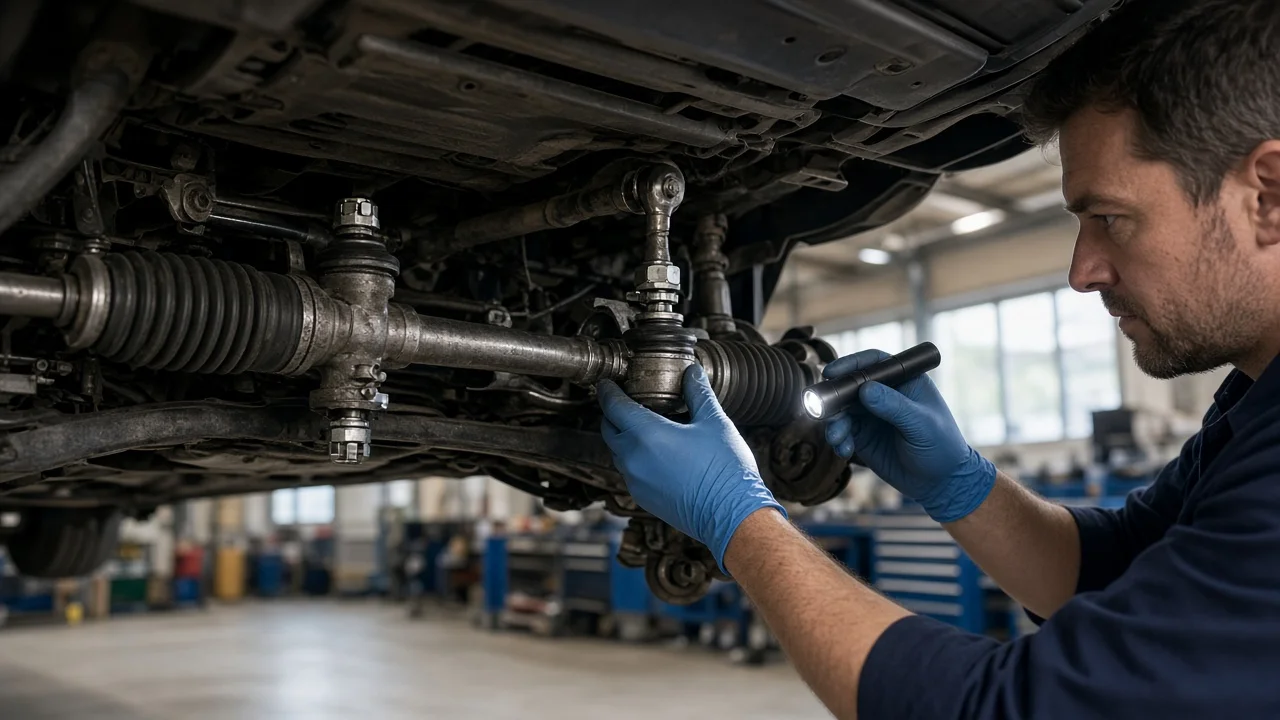
Loose or damaged steering linkage turns small movements of the steering wheel into vague, delayed or noisy responses at the front wheels. A worthwhile steering linkage inspection involves more than shaking a tire. You need a clear record of the symptoms, safe vehicle support and a method for separating joint play in the linkage from worn wheel bearings, ball joints or loose mounting points. The steps below follow that order so each finding means something before any part is replaced.
Establish the symptoms
Start by writing down exactly when the problem appears. Useful details include wander or constant small corrections at highway speed, a clunk or knock when turning the wheel at parking speed, free play before the front wheels respond, a steering wheel that sits off center when driving straight, and shimmy that appears at a particular speed. Note whether the symptom changes with braking, with turning in one direction, over bumps or only when the vehicle is loaded.
Then record associated signs and recent changes. Look at the front tires for feathered or unusually worn inner or outer edges, which often accompany a toe change. Think back to any pothole or curb strike, new tires or wheels, an alignment, suspension or steering repairs, and any lift or lowering kit that altered ride height. A recent event that lines up with the onset of symptoms is one of the strongest clues you can bring to the inspection or to a technician.
Distinguish plausible causes
The linkage itself has several wear points. On rack-and-pinion systems these are the outer tie rod ends and the inner tie rod joints hidden under the rack boots. Parallelogram systems on many trucks and older vehicles add a pitman arm, idler arm, center link and adjusting sleeves, while many solid front axles use a drag link and tie rod. Wear shows up as play inside a joint, while impact damage tends to show up as a bent rod, an off-center steering wheel or sudden tire wear.
Several other faults produce similar complaints. A worn wheel bearing also lets the tire rock, but the movement usually appears in more than one direction. Worn ball joints tend to show most movement when the tire is rocked top to bottom. Worn steering gear or rack mounting bushings let the whole unit shift on its mounting points, and a worn intermediate shaft joint adds free play at the steering wheel without any looseness at the wheels. Tire defects and alignment errors can cause pull or wander with no play at all. A clunk that you can feel through the steering wheel and that follows steering input points toward the linkage or steering shaft, whereas a steady pull with tight, consistent steering points toward alignment or tires.
Checks in a useful order
Begin with observations that need no lifting. Park on level ground with the parking brake set and the wheels straight. Look at each tie rod end, boot and joint for torn rubber, grease leakage, heavy corrosion, bent rods, missing cotter pins, loose adjusting sleeve clamps and fluid leaks around the steering gear or rack. Check the gear or rack mounting points and brackets for cracks, shifted bushings or fresh witness marks.
Next do a dry-park check with the vehicle's weight on the tires. A helper rocks the steering wheel back and forth through a small arc, just enough to move the front wheels, while you watch and feel each joint in turn, working outward from the steering gear. Any lost motion where one side of a joint moves before the other is a finding worth noting. For inner tie rods, grip the joint through the boot and feel for knocking. Whether the engine should run for power-assisted systems depends on the vehicle's service procedure.
Raised checks come last and require proper vehicle support: lift only at the specified lift points, place rated jack stands at the specified support points on firm, level ground, and never work under a vehicle held only by a jack. Depending on suspension design, some joints must be checked with the suspension loaded and others unloaded, so follow the model-specific procedure. Rock each front tire at the three and nine o'clock positions while a helper watches the linkage. Measuring idler arm or joint movement against an allowable limit, using a dial indicator or pry-bar procedure, needs the manufacturer's specification and is best left to a qualified technician if you do not have it.
Interpret the findings
Movement you can see or feel inside a specific joint, such as a stud shifting in its socket or a knock under your hand, establishes that the joint has play. When rocking the tire side to side, repeat the test with a helper holding the brake pedal down. If the movement disappears with the brake applied, wheel bearing play is more likely. If it remains and you can see it at a tie rod end or inner joint, the linkage is the stronger suspect.
Some findings still need confirmation before parts are replaced. A torn boot without play means the joint is exposed to dirt and water, not that it has failed yet. Slight movement in certain components, especially idler arms, may fall within the manufacturer's limit, and only that specification can decide. A bent tie rod or newly off-center steering wheel after an impact calls for checking the knuckle, control arms and mounting points as well, since more than one part may have taken the hit.
Plan the repair as a complete job. Replacing a tie rod or similar component changes toe, so a wheel alignment is needed afterward, and ride height should be checked before alignment on any vehicle with modified or sagging suspension. Tightening values and the fastener specification for each nut, including whether new cotter pins or self-locking nuts are required, must come from service information for the specific vehicle.
Urgency and next action
Some findings mean the vehicle should not be driven. Stop using it and arrange a tow if you find a joint visibly separating, a missing or loose nut or cotter pin, a bent linkage component after an impact, steering that binds, sticks or fails to return, a sudden large increase in free play, or a clunk accompanied by a change in where the wheels point. There is no reliable way to estimate how far a vehicle with these signs can safely travel.
For any repair visit, bring your symptom record together with the inspection results: which joint moved, whether it showed during the dry-park or raised check, and whether holding the brake changed it. Add tire wear observations, recent impacts or repairs, any ride height modification and the vehicle's year, make, model and drivetrain so the correct parts and specifications can be used. If you found only boot damage or minor play, schedule a professional inspection soon rather than waiting for the symptoms to grow worse.