How to Choose Where to Stop for an EV Charge and Meal
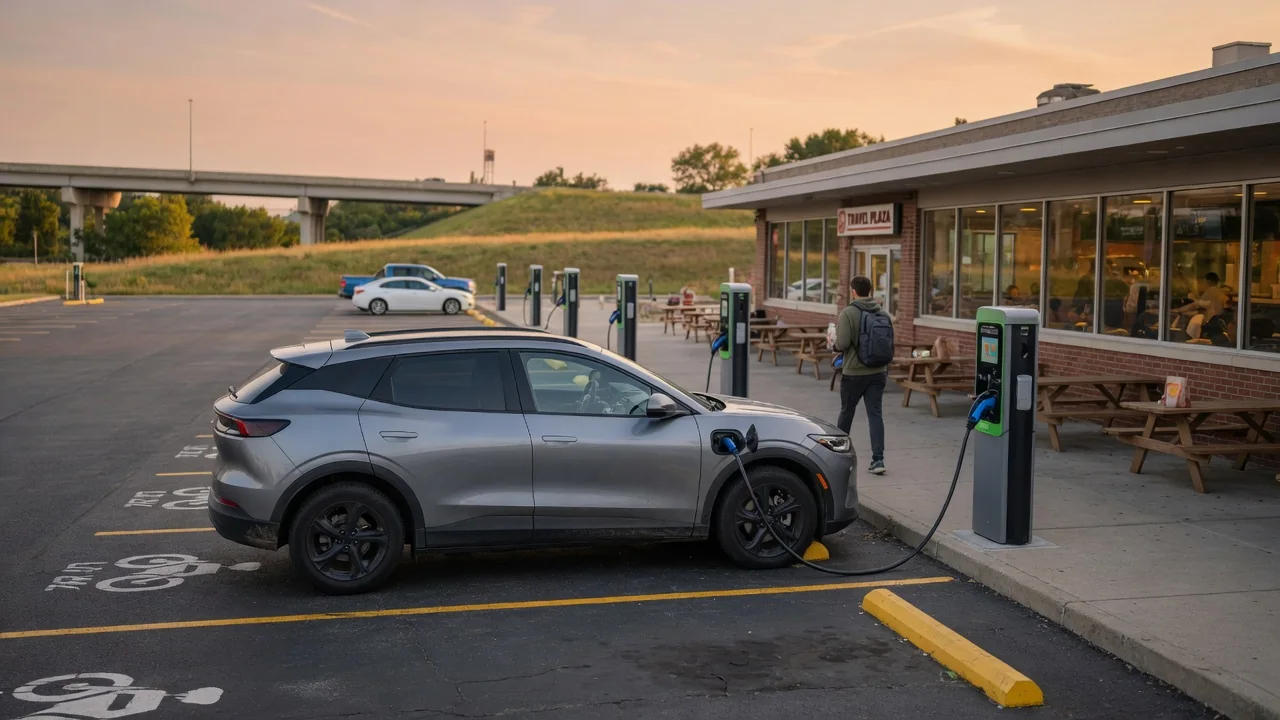
Combining a charging session with a meal is one of the most efficient ways to handle an EV road trip, because the time you would spend waiting for the battery becomes time you would spend eating anyway. Making it work depends on more than finding a charger next to a restaurant. A good EV trip charging meal stop lines up how long the car needs to charge, what is within walking distance, and what you will do if the plan falls apart on arrival.
Charging Time
The first question is how long the car will actually need to stay plugged in, and the answer is rarely just the charger's advertised power. A DC fast charger lists its maximum output, but the vehicle decides how much power it will accept at any moment. That acceptance follows a charging curve that is generally fastest when the battery is at a low state of charge and slows progressively as it fills. Many EVs taper noticeably as they approach the upper part of the battery, which is why road-trip planning often favors several shorter top-ups over one long session to nearly full. The exact shape of the curve varies by vehicle, so the owner's manual and the car's own trip planner are the best references for your specific model.
Battery temperature also matters. A cold battery typically accepts less power until it warms up, and many vehicles can precondition the battery when a fast charger is set as the navigation destination. If your car offers this feature, routing to the stop through the built-in navigation rather than a phone app may shorten the session. Arriving with a lower, but still comfortable, state of charge usually means the car spends more of its time in the faster part of the curve.
Once you have a rough estimate, compare it with the kind of meal you want. A quick counter-service stop and a sit-down restaurant with table service fill very different amounts of time. The ideal match is a meal that ends at about the same time the car reaches the charge you need for the next leg. If the meal will run much longer than the charge, a different stop, or a lighter meal here and a longer break later, may fit the route better.
Amenities
A charger that is technically near a restaurant is not always convenient. Check the actual walking route between the stalls and the entrance: distance, sidewalks, crossings of busy roads, and lighting if you will arrive after dark. Some charging sites sit at the far edge of a large parking lot or behind a building, which can turn a short-looking distance on a map into a longer walk, especially with children, pets or limited mobility.
Opening hours deserve attention, because charging sites often operate around the clock while nearby businesses do not. A stop that works well at lunchtime may have nothing open late in the evening or early in the morning. Restrooms, seating, shade or indoor space, and the ability to order ahead all affect how comfortable the wait feels. If you are towing or driving a larger vehicle, look for stall layouts that allow pull-through access or enough room to maneuver, since many stalls are designed only for nose-in or back-in parking.
Also consider how you will monitor the car while you eat. Many vehicles and charging apps can send notifications about charging progress, which helps you return before the session ends. That matters because some networks charge idle fees when a car stays connected after charging finishes, and a car left in a stall also blocks the next driver. A table with a view of the lot is a convenience, not a requirement, as long as you have a reliable way to track the session.
Backup
Even a well-chosen stop can fail on arrival. Chargers can be out of service, limited in output or fully occupied, and a site with only one or two stalls leaves little room for error. When choosing where to stop, favor locations with several stalls, and check recent status information or user reports in the charging network's app or a charging map before committing. These reports are useful but not guaranteed to be current, so treat them as a guide rather than a promise.
The most important backup is a second charging option within comfortable reach of the first. Plan to arrive at your chosen stop with enough remaining range to continue to an alternate site if needed, ideally on a different network so a single outage or payment problem does not affect both. Having more than one way to pay, such as the relevant apps installed and a payment card ready, reduces the chance of being stuck at a working charger you cannot activate. If your vehicle relies on an adapter for certain connectors, confirm it is in the car before you leave.
A slower Level 2 charger near a restaurant can also serve as a fallback, especially during a long sit-down meal. It adds far less range per hour than a fast charger, but it may provide enough distance to reach the next fast-charging site. Knowing where these options are before you need them is much easier than searching for them on a low battery.
Practical Implications and Limits
In practice, deciding how to choose where to stop for an EV charge and meal is a balance rather than a formula. The best charging site on a route may have poor food options, and the best restaurant may sit next to a single slow charger. Most drivers end up deciding which matters more on a given leg: minimizing total trip time, eating well, or keeping the stop simple and predictable. Being clear about that priority makes the choice easier and reduces second-guessing on the road.
There are limits to how precisely any of this can be planned. Charging estimates from navigation systems and apps are approximations that depend on temperature, speed, elevation, payload and battery condition, and real sessions can differ from the forecast. Restaurant wait times are equally unpredictable at busy hours, and station information can lag behind real conditions. A plan built with some slack, such as a slightly higher arrival charge and an identified alternate, tolerates these variations better than one optimized to the minute.
Behavior also varies between vehicles. Preconditioning, charge-limit settings, connector types and the way a car reports estimated charging time are specific to each model and software version, so general guidance can only go so far. Before a long trip, review the charging section of your owner's manual and try the relevant features on a short drive. That preparation turns a meal stop into a routine part of the journey rather than a source of uncertainty.