Why Does an EV Charge Session Have Idle Time?
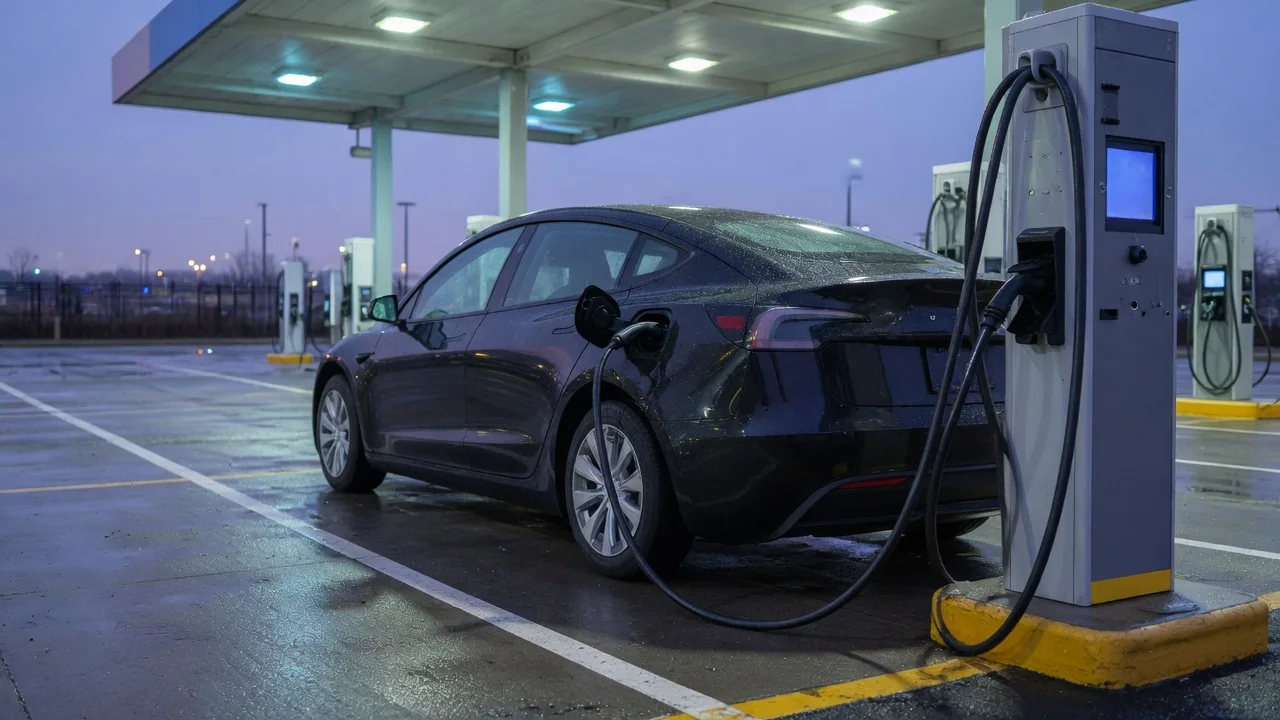
A charge session record often shows more time connected than time spent adding energy. That gap is what people usually mean by EV charging idle time, and in most cases it is not a malfunction. Idle time comes from three ordinary mechanisms. Charging power tapers as a battery fills. A session can stay open after the cable stops delivering energy. And a charging space also works as a parking space. Each one helps explain why the numbers rarely line up neatly.
Power taper: why charging slows near the top
Lithium-ion packs accept the most charging current when their state of charge is low and their cells are in a comfortable temperature range. As the pack fills, cell voltage rises toward its upper limit. To keep every cell within safe voltage bounds, the battery management system asks the charger for less current. In general terms, charging follows a constant-current, then constant-voltage pattern. Power stays relatively high for a while, then falls steadily as the battery approaches full. The charger is still connected and the session is still active, but the energy delivered each minute shrinks considerably.
Several other factors deepen the taper. A pack that is too cold or too warm may be limited from the start. The vehicle may also divert some incoming power to heating or cooling the battery instead of storing it. Near the top of the range, the system may slow down so the cells can balance, which brings lower-voltage cells up to match the others. On a session report, this stretch can look almost like idle time because the clock keeps running while very little energy is added. Where the taper begins and how sharp it is depends on the vehicle, its battery chemistry, the temperature and the charger, so no single curve applies to every EV.
Session end: when charging stops but the session does not
A charge session usually has two separate endings. Energy transfer stops when the vehicle reaches its target, which may be a full battery or a lower charge limit the driver has set. It can also stop when the charger or vehicle ends the transfer for another reason. The session itself, as the charger or network records it, often stays open until someone unplugs the connector or stops the session through the vehicle, an app or the station screen. Everything between those two moments is plugged-in time with little or no energy flowing. This is the clearest form of idle time.
Even after the target is reached, a connected vehicle may not be completely inactive. Depending on the model and its settings, it may draw small amounts of power to condition the cabin or battery before a scheduled departure or to support the low-voltage system. It may also briefly resume charging if the state of charge drifts down. These small draws can make a finished session look partly active on a log. With alternating-current charging, the station mainly signals how much current is available, and the onboard charger controls the actual flow. The station may therefore just see the vehicle stop requesting power while the connection stays in place.
Parking: connected time versus charging time
A charging space is also a parking space, and drivers rarely leave the moment energy stops flowing. They may be shopping, working or sleeping, or they may not know the session has finished. From the station's point of view, the vehicle is still connected and occupying the equipment, so that time counts toward the session even though no energy is delivered. At home this usually matters little, because the car often sits plugged in overnight and finishes charging long before it is needed.
Idle time can also appear at the start of a session. Scheduled charging lets a driver plug in on arrival while the vehicle waits for a set start time, often to match a preferred electricity rate or departure time. The cable is connected and the session may be open, but nothing flows until the schedule begins. Similar waits happen when a station is waiting for authorization, when a vehicle is warming its battery first, or when several vehicles share limited site power and one connected car waits while others receive current. In each case the connection exists, but charging does not.
An occupied but inactive charger keeps other drivers waiting, so some public networks and site operators actively manage the connected time after charging ends. Their approaches vary with the operator and local rules. They can include grace periods, notifications, time limits or idle fees. Each network sets its own terms, so the only reliable reference is the operator's own information at the time of charging.
Practical implications and limits
When reading session data, the key distinction is between connected duration and energy delivered. Dividing total energy by total session time gives an average power figure, and idle stretches can pull that figure far below what the charger and vehicle actually achieved while charging. Energy added, and power over time when the vehicle or app shows it, give a more accurate picture than session length alone. A long session with modest energy is often a short charge followed by a long wait.
On fast public charging, the taper affects when it makes sense to disconnect. If the rest of the trip needs only part of the battery, ending the session before the slowest portion saves the driver time and frees the equipment for others. Setting a charge limit in the vehicle, using app or vehicle notifications and returning promptly all reduce idle time at busy stations. For slower charging at home or at work, long connected periods are usually expected and harmless. There, a charge limit mainly reflects the driver's own range needs and battery-care preferences.
Idle time has limits as a diagnostic signal. On its own, it does not indicate a fault with the battery, the charger or the cable. A slow tail near full is normal behavior, not a sign of degradation. Taper shapes, standby draws, scheduling options and session-end behavior all differ by vehicle, software version and charging equipment, and billing rules differ by network. If a particular car consistently charges much more slowly than expected or stops unexpectedly, the owner's manual, the vehicle manufacturer or the charging network is a better source than general patterns.