How to Choose a Portable Air Compressor for Car Tires
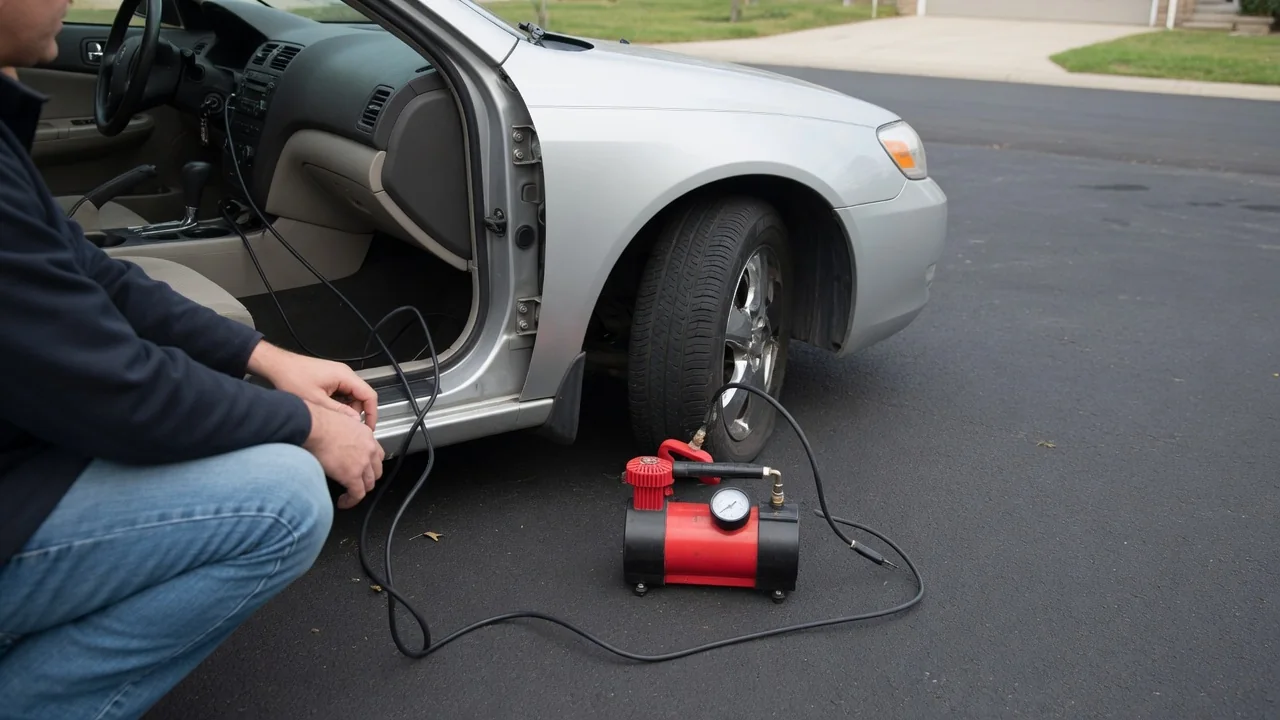
Knowing how to choose a portable air compressor for car tires comes down to matching a few practical features to your vehicle and the way you drive. Pressure capability, power supply, hose and cord length, and everyday usability matter more than headline claims. This overview explains what each feature does and how to judge it against your own car.
Pressure range
Every compressor lists a maximum pressure, and that figure needs to sit comfortably above what your tires require. The recommended cold inflation pressure is printed on a placard, usually on the driver's door jamb, and it is also in the owner's manual. The number molded into the tire sidewall is the tire's maximum, not the target for your vehicle. Many passenger cars call for moderate pressures, while heavy-duty pickups, loaded vans, and some trailers call for considerably more, so check the placard before comparing inflators.
A unit working near its upper limit tends to slow down, run hot, and take a long time to add the last few pounds. Choosing a compressor with headroom above your highest required pressure keeps it operating in a range where it works efficiently. Remember that front and rear pressures may differ, and that a compact temporary spare often needs a much higher pressure than the road tires. If you want to top up that spare, its requirement, printed on the spare itself, becomes the figure to plan around.
Power source
Portable inflators generally draw power in one of three ways: from the vehicle's 12-volt accessory socket, directly from the battery through clamps, or from a built-in rechargeable battery. Socket-powered units are simple and never need charging, but the accessory circuit is fuse-protected and can only deliver limited current. That suits smaller compressors on ordinary car tires. Larger units that move more air usually connect straight to the battery terminals because they draw more current than a dashboard socket is designed to supply.
Cordless models are convenient because nothing has to be routed through a door or window, and they can be carried to a bicycle or wheelbarrow as easily as to the car. Their trade-off is that a pack left in a trunk for months may be low when you finally need it, and extreme temperatures affect stored charge. Some vehicles switch off the accessory socket with the ignition, while others keep it live, so check how yours behaves. Running the engine during inflation helps avoid draining the vehicle battery.
Hose reach
An inflator is only useful if it can physically reach every valve stem. With a corded unit, the combined length of the power cord and the air hose must stretch from the socket or battery to the farthest wheel, which is usually a rear tire on the opposite side. Sedans and hatchbacks are relatively forgiving, but long-wheelbase trucks, three-row SUVs, and vehicles towing a trailer can easily exceed the reach of a short cord. Measuring roughly from the power point to the farthest valve gives a realistic minimum.
The position of the accessory socket matters too, since some vehicles have one in the cargo area and others only in the front console. A hose that is too short may also force the compressor to hang from the valve stem, which strains the stem and the fitting. The connector type deserves attention as well. A threaded chuck seals securely but loses a little air while being unscrewed, whereas a clamp-on chuck is quicker to attach and remove. Either works if it fits firmly on your valves without leaking.
Everyday Use and Observations
In regular use, the features you notice most are the gauge, the shutoff, and the speed. A clear, backlit display is easier to read at night on a roadside than a small analog dial. Automatic shutoff lets you set a target pressure and step back while the unit stops on its own, which reduces the chance of overinflating. Airflow determines how long you wait: a small compressor may top up a few pounds quickly yet take a long while to fill a large truck tire from very low.
Built-in gauges vary in accuracy, so comparing the reading against a separate tire gauge you trust is a sensible habit. Check pressures when the tires are cold, because driving warms the air inside and raises the reading. Expect noise, vibration, and a hot hose fitting after several minutes of running; these are normal, though the fitting can be hot enough to warrant care. A work light, a storage case, and a unit that sits stable on the ground all make a late-night top-up less frustrating.
Limits and Next Steps
Small compressors have a duty cycle, meaning they can run for a limited period before needing to cool. The instructions for each unit state its own limits, and inflating four large tires in one session may require pauses. A portable inflator also cannot reseat a tire that has come off the rim bead, and it will not overcome a large puncture or sidewall damage. If a tire has been driven on while flat, its internal structure may be damaged even when it holds air again, so have it inspected.
Adding air treats the symptom, not the cause. A tire that repeatedly loses pressure may have a nail in the tread, a leaking valve core, or corrosion where the tire meets the wheel, and a shop can find and repair the source properly. A tire pressure warning light may stay on briefly after inflation, and the reset behavior differs between vehicles, so the owner's manual is the right reference. Once you have a compressor, test it at home first so you know it reaches every wheel and works as expected.