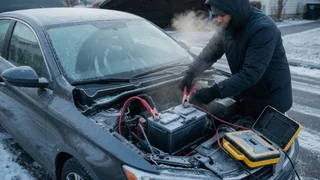
How to charge a frozen car battery
A frozen car battery presents two immediate problems: cold electrolyte may be damaged by charging, and a discharged battery freezes more readily than a charged one. Before connecting any charger, you must confirm the case is intact and the electrolyte has thawed. Charging a battery that is still frozen can warp plates, crack the housing, or release flammable gas. The safest approach is to warm the battery gradually indoors, inspect it closely, then use a low-amperage charger while watching battery terminals and system voltage for signs of trouble.
Direct answer
Do not attempt to charge a battery while its electrolyte is frozen. A fully discharged lead-acid battery can freeze at a relatively mild temperature because the sulfuric acid becomes mostly water. When charging output passes through ice, localized heating can create uneven expansion, which may bend internal plates or split the case. Remove the battery, let it thaw in a safe location away from sparks and open flame, and inspect it for bulges or cracks before attaching any charger.
Even after thawing, treat the battery as damaged until proven otherwise. A frozen cell often develops a high internal resistance, so the charger may show a low current or a voltage drop across the battery terminals that does not match the selected setting. If the case is swollen, leaking, or emitting a sharp sulfur smell, do not recharge it. The battery should be replaced, because internal shorts and plate damage from freezing cannot be reliably repaired by a standard charger.
How to proceed
Begin by disconnecting the negative cable first, then the positive cable, and remove the battery from the vehicle. Place it in a plastic tray or on a non-conductive surface in a ventilated area where it can warm slowly to room temperature. Avoid direct heat from a torch, space heater, or hot water; rapid warming can crack the case. Wait until the sides feel uniformly cool or slightly room-temperature and no ice remains visible through translucent cell caps if present.
Set a charger to the lowest suitable setting, often a 2-amp or trickle mode, and connect the positive lead to the positive battery terminal and the negative lead to the negative post or an engine ground if still installed. Monitor the first 30 minutes. If the ammeter stays at zero, the battery heats excessively, or a fuse rating-related protection in the charger trips, stop immediately. A slow charge may take many hours; after completion, check resting voltage before starting the vehicle and address any parasitic draw that may have caused the original discharge.