How Are Plastic Bumper Covers Formed? Molding, Painting and Fit
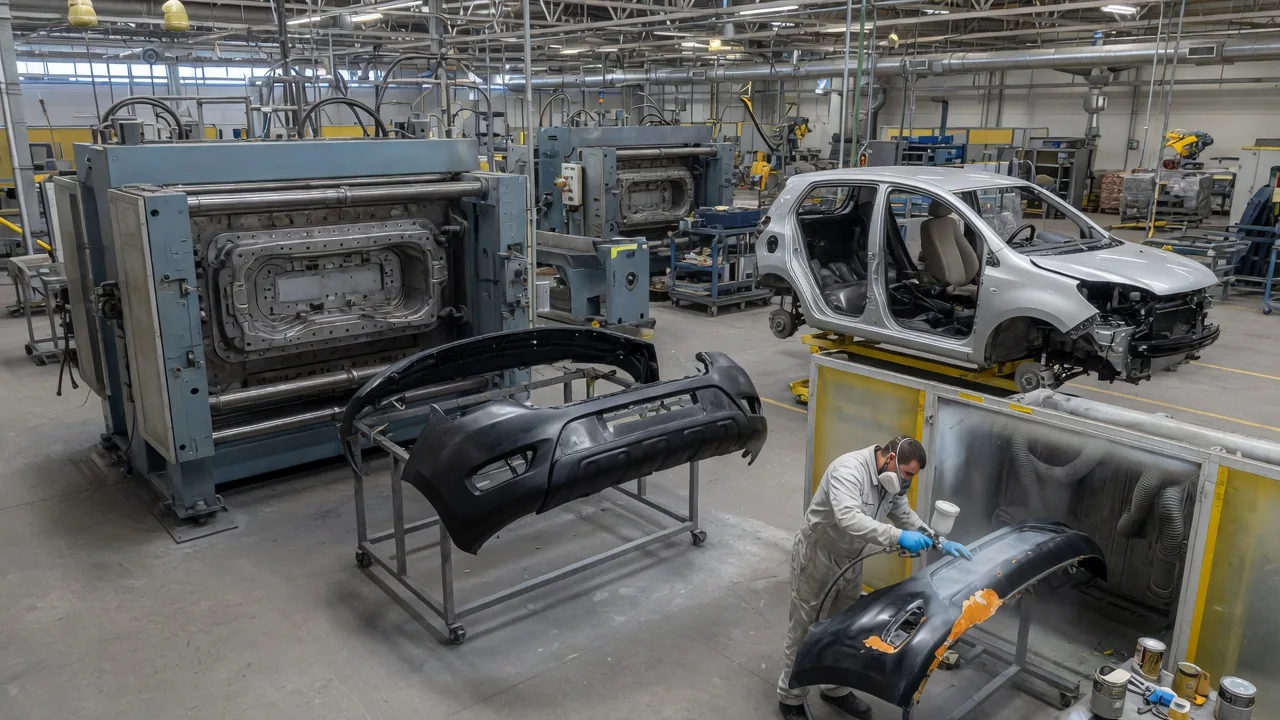
Most modern cars use a bumper cover rather than a bare metal bumper. The cover is a large, flexible plastic skin that shapes the front or rear of the vehicle and hides the impact structure behind it. Bumper cover manufacturing usually involves three linked stages: molding the shell, preparing and painting it, and making it fit the body accurately. This article explains how plastic bumper covers are formed at each stage, using general industry practice rather than the details of any particular vehicle.
Molding: Turning Plastic Pellets Into a Bumper Shell
The most common material for a modern bumper cover is a thermoplastic polyolefin, usually called TPO. It is generally a polypropylene base blended with a rubbery component such as EPDM, which improves toughness, especially in cold weather. It often also contains a mineral filler such as talc, which adds stiffness and reduces shrinkage. Some vehicles use other blends, such as polycarbonate mixed with PBT, and older or low-volume designs have used polyurethane. The choice balances flexibility, impact behavior, paint adhesion, weight and cost, and it varies by manufacturer and model.
Most TPO covers are made by injection molding. A rotating screw melts plastic pellets in a heated barrel and forces the melt under high pressure into a closed steel mold shaped like the finished cover. A bumper cover is large and relatively thin, so the mold is massive. The press must hold it shut with very high clamping force while the melt fills every corner. Molten plastic usually enters through several gates. Their placement affects how the flow fronts meet, where weld lines form and how evenly the part fills. The mold is water-cooled so the plastic solidifies quickly, and then it opens and the part is ejected. Sliding cores and lifters form features such as clip pockets, mounting tabs and undercuts around grille openings, and they move out of the way before ejection.
After molding, workers or machines usually trim excess material at the gates. Openings may be punched or cut for parking sensors, washer nozzles, tow hook covers or fog lamps, which lets one basic molding serve several trim levels. Polyurethane covers are typically produced by reaction injection molding. In that process, two liquid components are mixed as they enter the mold and react at relatively low pressure to form the solid part. Low-volume or aftermarket parts may instead use fiberglass or thermoformed sheet.
Painting: Getting Coatings to Stick to Flexible Plastic
Polyolefin plastics such as TPO have low surface energy, so paint does not wet them or bond to them well without help. For that reason, bumper covers go through surface preparation before color is applied. A typical sequence starts with washing to remove mold release agents and handling contamination. A treatment then makes the surface more receptive, such as flame treatment, plasma treatment or a chemical adhesion promoter. Without this step, paint on a polyolefin cover can peel or flake, particularly after an impact or repeated flexing.
Paint is then built up in layers similar to those on metal body panels: often a primer or conductive primer, a colored basecoat and a clear topcoat. The cover bends during minor contact and expands and contracts with temperature, so coatings for plastic are formulated or modified to stay flexible and avoid cracking when the substrate moves. Plastic parts also cannot tolerate the oven temperatures used for some steel body coatings. They are usually painted on a separate line and cured at lower temperatures. This is one reason a painted bumper can differ slightly in shade from the adjacent fender, even on a new car: the substrate, paint line and cure conditions are all different.
Not every cover is painted. Many lower sections, especially on trucks and utility vehicles, are molded in black or gray with a textured grain built into the mold surface. Molded-in color avoids paint entirely and hides scuffs better. The plastic itself must be stabilized against ultraviolet light so it resists fading.
Fit: How a Flexible Cover Lines Up With the Body
A bumper cover is mostly an appearance and aerodynamic skin. A reinforcement beam, usually metal or composite, handles the crash load. Behind the cover there is often also an energy absorber made of foam or plastic honeycomb. The cover attaches to brackets, the fenders, the radiator support or the rear body panel. It is held by clips, push fasteners, screws, bolts and molded tabs that hook into retainers. Because the part is flexible, these attachment points do much of the work of holding its shape and position.
Consistent fit starts in the mold. Plastics shrink as they cool, and large parts can warp if cooling or wall thickness is uneven. Tool designers account for expected shrinkage by making the mold cavity slightly larger and shaping it to counter predicted distortion. They then adjust the tool after measuring trial parts. Plastic also expands and contracts with temperature considerably more than steel. For that reason, mounting holes are often slotted, or the design uses designated fixed and floating points. These let the cover move without buckling or pulling away from neighboring panels.
During production, molded covers are commonly checked on holding fixtures that represent the vehicle's mounting points. This lets inspectors assess gaps and flushness to headlamps, fenders, hood or tailgate before assembly. On the vehicle, final appearance also depends on the surrounding panels and brackets. A perfectly molded cover can still show uneven gaps if a bracket is bent or a fender is out of position.
Practical Implications and Limits for Owners
The material affects how damage can be repaired. Many plastic parts carry a molded identification code on the inside surface, often a symbol enclosing letters such as PP, PP+EPDM or PC/PBT. Repair products and plastic welding rods are generally matched to that material. A filler or adhesive suited to one plastic may not bond reliably to another. Whether a crack, tear or broken tab is worth repairing depends on its size and location, and on whether the mounting features are intact.
Replacement covers are frequently supplied unpainted or in primer, so they need full surface preparation and a flexible coating system before they match the vehicle. Fit can differ between replacement sources because tooling, material blend and shrinkage behavior may not match the original part. For that reason, body shops commonly test-fit a cover before painting it. The brackets, clips and energy absorber behind the cover should be inspected as well. They influence both alignment and how the bumper system behaves in a later impact.
This is a general description of bumper cover manufacturing. Materials, molding methods, paint systems and mounting designs differ between manufacturers, models and production years, and some specialty vehicles use quite different processes. For a specific vehicle, the factory service manual or body repair information is the reliable source for fastener locations, removal steps and approved repair methods.