Diagnose a Flashing Check Engine Light on a Honda CR-V
The Short Answer
A flashing check engine light on a Honda CR-V should be treated as urgent. On vehicles built to the OBD-II standard, which covers CR-V models sold in the United States, a blinking malfunction indicator lamp generally means the engine computer has detected a misfire severe enough to risk damaging the catalytic converter. A steady light, by contrast, indicates a fault that has been stored but is not judged to cause immediate harm.
The practical guidance is to reduce load right away, avoid hard acceleration and towing, and stop driving as soon as it is safe to do so. When a cylinder misfires, unburned fuel can pass into the exhaust and burn inside the catalytic converter, overheating it. Continuing to drive with a flashing light can turn a relatively inexpensive ignition or fuel repair into a much costlier exhaust repair.
Scope note: this guide covers gasoline CR-V models, including those with naturally aspirated four-cylinder engines and the turbocharged 1.5-liter engine used in later generations. Hybrid CR-V models share the misfire logic for the gasoline engine, but their hybrid system can also trigger separate warnings, so a hybrid owner should confirm any code with a scan tool or dealer rather than assume a misfire. Exact component layouts, maintenance intervals and service procedures vary by model year and engine, and the owner's manual or factory service information for the specific vehicle should be the final reference.
What to Do Immediately
Ease off the accelerator and avoid passing, climbing steep grades or towing. Watch for rough running, shaking, loss of power, a fuel or burning smell, or smoke. Any of these strengthens the case for stopping promptly. Pull over safely and switch the engine off if the light keeps flashing or the engine runs noticeably rough. Check whether the light returns to steady or goes out after a restart. A light that flashes only under load, then steadies at idle, still indicates a misfire that needs diagnosis. Arrange towing rather than driving a long distance if the light flashes continuously or the engine shakes badly.
Stop using the vehicle and seek professional help without delay if any of the following occur: the light flashes together with a red temperature or oil pressure warning, there is visible smoke or a strong smell of burning, the engine stalls repeatedly, or there is a fuel smell under the hood. These conditions point to problems beyond a simple misfire and can create a safety risk.
Read the Codes First
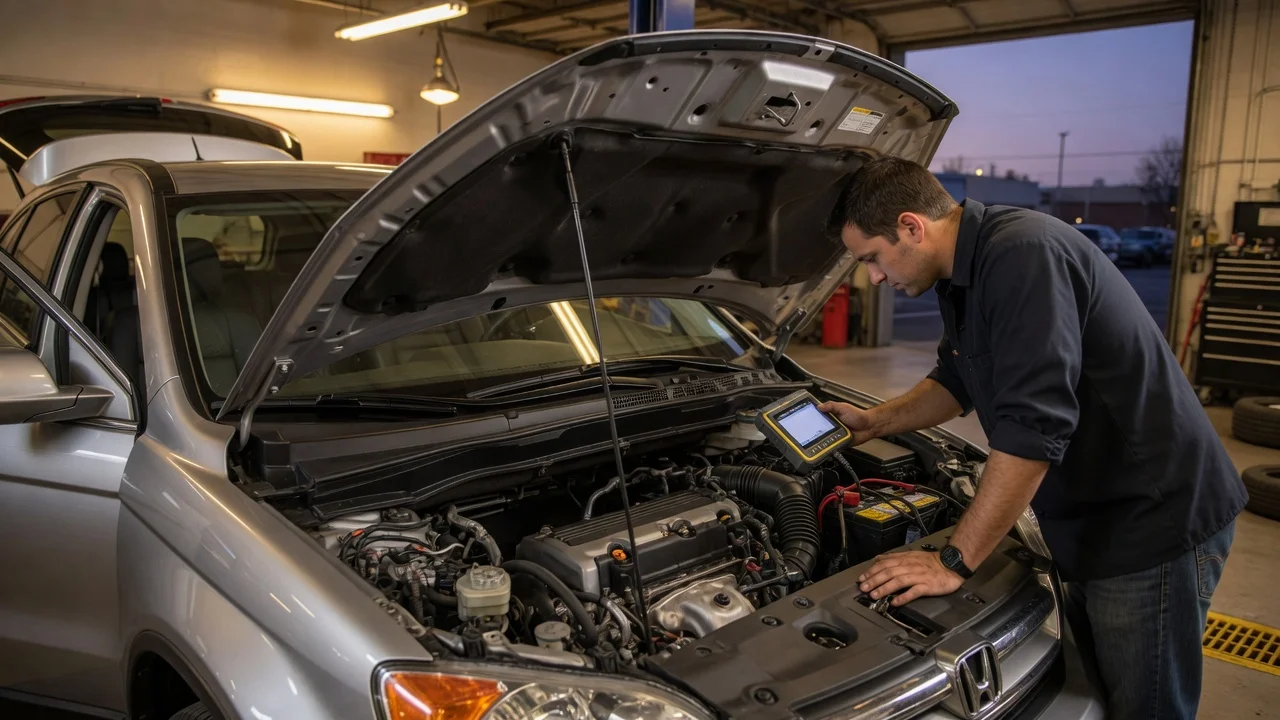
The most useful next step is to read the stored diagnostic trouble codes with an OBD-II scan tool plugged into the diagnostic port under the dashboard. Many parts retailers and repair shops can read codes, and inexpensive handheld readers are widely available. Record every code, including pending codes, before anything is cleared, because clearing codes also erases freeze-frame data that shows the conditions when the fault occurred.
A code identifies what the engine computer observed, not which part failed. A misfire code tells you a cylinder is not firing properly; it does not tell you whether the cause is a coil, a plug, an injector, air leakage or a mechanical problem. Treat each code as a starting point for testing.
Code | Meaning | What it suggests; P0300 | Random or multiple cylinder misfire | A cause affecting several cylinders, such as fuel delivery, a vacuum leak, contaminated fuel or a sensor fault; P0301 to P0304 | Misfire detected in cylinder 1, 2, 3 or 4 | A cause isolated to one cylinder, such as an ignition coil, spark plug, injector or a cylinder-specific mechanical issue; Lean condition codes (for example P0171) | Too much air or too little fuel | Vacuum or intake leaks, a weak fuel supply or an airflow measurement problem that can lead to misfire; Catalyst efficiency codes (for example P0420) | Catalytic converter performance below threshold | Possible existing converter damage, sometimes following a period of misfiring
Likely Causes and How to Narrow Them Down
Ignition coil
CR-V four-cylinder engines use an individual ignition coil on top of each spark plug. A failing coil commonly produces a misfire code for one cylinder. A widely used check is to swap the suspect coil with one from another cylinder, clear the codes and drive gently until the code returns. If the misfire follows the coil to the new cylinder, the coil is the likely fault. If the misfire stays in the original cylinder, look at the spark plug, injector or mechanical condition of that cylinder instead.
Spark plugs
Worn, fouled or cracked spark plugs can cause misfires, particularly under acceleration or load. Removing and inspecting the plug in the misfiring cylinder can reveal heavy wear, oil or fuel fouling, or a cracked insulator. Oil on a plug or in the plug well can point to a separate leak that deserves attention. Replacement intervals differ by engine and model year, so check the maintenance schedule for the specific vehicle rather than relying on a general figure.
Fuel injector or fuel supply
A clogged or failing injector can starve one cylinder, while a weak fuel pump or restricted supply can cause misfires across several cylinders. On engines with direct injection, including the turbocharged 1.5-liter, the injectors and high-pressure fuel system operate differently from port-injected engines and are typically diagnosed with professional equipment. Recent refueling followed by sudden rough running may suggest contaminated fuel, although this is less common than ignition faults.
Vacuum and intake leaks
Unmetered air entering through a cracked hose, loose intake connection or leaking gasket can make the mixture lean and cause misfires, often worse at idle. A rough idle combined with lean codes or a hissing sound from the engine bay points in this direction. Shops commonly locate such leaks with a smoke test.
Mechanical problems
If coils, plugs and injectors check out but a single cylinder keeps misfiring, the cause may be mechanical, such as low compression, valve problems or a head gasket fault. Some Honda engines require periodic valve clearance inspection, and incorrect clearance can contribute to misfires; whether this applies depends on the engine, so consult the maintenance schedule for the model year. A compression or leak-down test is the standard way to confirm mechanical issues, and these tests are generally best left to a technician.
Interpreting What You Find
Observation | What it indicates | Next step; Misfire moves with a swapped coil | Coil is the likely cause | Replace the coil and recheck; Misfire stays in the same cylinder after a coil swap | Plug, injector or mechanical cause | Inspect the plug, then test the injector and compression; Random misfires across cylinders with lean codes | Air leak or fuel delivery issue | Smoke test for leaks and check fuel pressure; Misfire with oil in the plug well | Possible seal leak fouling the plug | Repair the leak and replace the affected plug; Catalyst efficiency code alongside misfire codes | Possible converter damage | Fix the misfire first, then have the converter evaluated
When to Hand It to a Professional
Basic checks such as reading codes, inspecting plugs and swapping coils are within reach for many owners with simple tools. Professional diagnosis is the better choice when the misfire does not follow a coil or plug, when codes point to fuel pressure or direct injection components, when mechanical damage is suspected, or when the vehicle is a hybrid. It is also worth checking with a Honda dealer whether any recalls or technical service bulletins apply to the specific vehicle identification number, since these can cover known engine issues for certain model years.
Gaps in This Guide
No model-year-specific failure data, recall listings, repair costs or test findings were available for this guide, so it does not rank which cause is most common on a particular CR-V generation or estimate repair prices. The diagnostic approach described here follows standard OBD-II misfire logic and general four-cylinder engine practice; confirm specifics such as firing order, component location, torque values and maintenance intervals in the service information for the exact model year and engine.