Freightliner Cascadia Transmission Speed Sensor Identification
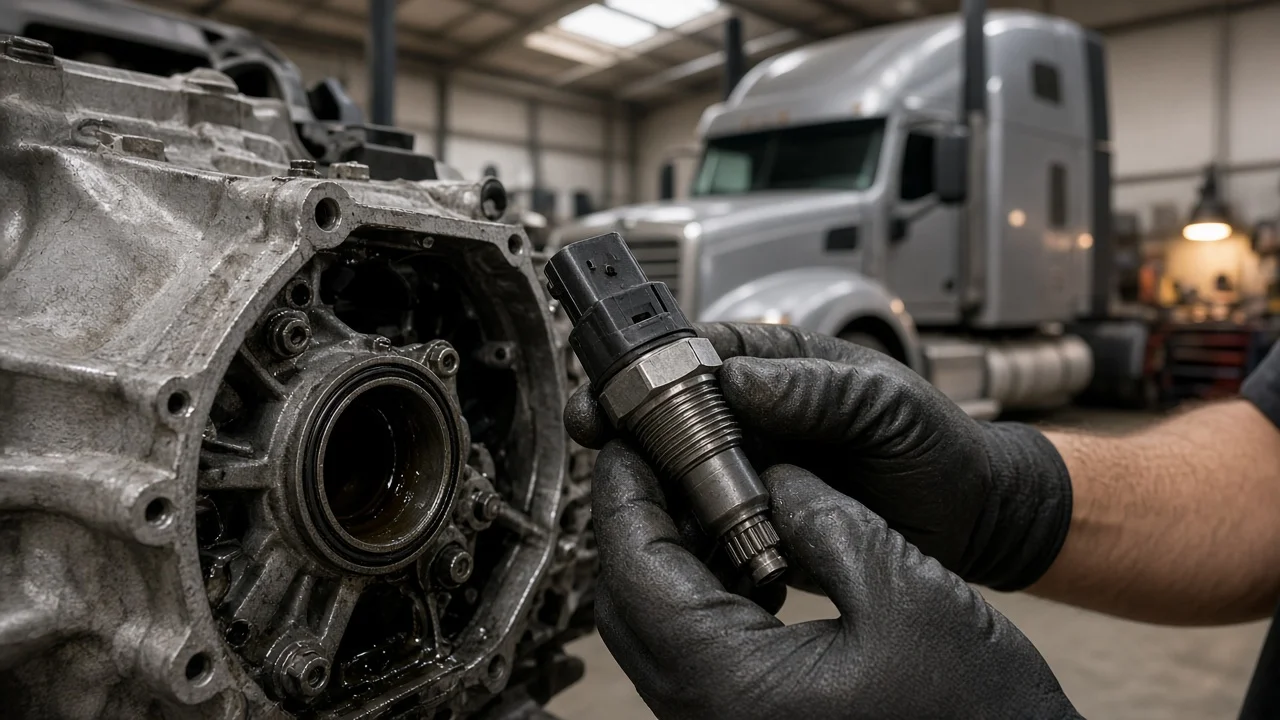
A transmission speed sensor on a Freightliner Cascadia reports shaft rotation to the electronic controls that run the speedometer and cruise control and, on automated or automatic gearboxes, make shift decisions. Finding the right sensor starts with the transmission, not the truck model. Cascadias have been built with several gearbox families, and each has its own sensor count, locations and part numbers. This guide explains how to narrow it down before you order a part or condemn one.
Short answer: identify the transmission first
There is no single Cascadia speed sensor. The one you need depends on the transmission type installed at build or later, and on which shaft the sensor reads. Manual transmissions commonly have an output shaft speed sensor at the rear of the case, near the output yoke, which supplies road speed. Automated manuals and fully automatic transmissions typically add sensors for input shaft speed and main shaft or turbine speed. The controller uses these to match gears and judge clutch or converter behavior. To identify the correct part, first record the transmission model and serial number from the tag on the housing. Confirm them against the truck's VIN-based build record. Then match the sensor by its position and by the part number printed on the existing unit, if it is still legible.
A speed-related fault code or an erratic speedometer points to a circuit, not necessarily to the sensor itself. Wiring, connectors, sensor positioning, the toothed wheel it reads and the module receiving the signal can all produce similar complaints.
How a transmission speed sensor works
Most transmission speed sensors sit in a bore in the case, facing a toothed wheel or gear on a rotating shaft. As the teeth pass the sensor tip, the sensor produces a pulsing signal whose frequency rises with shaft speed. Some designs are passive magnetic pickups that generate their own alternating voltage. Others are active sensors, powered by the control module, that output a switched signal. The design matters for testing, because a check that suits one type can give a misleading result on the other.
The controller compares the readings. On an automated or automatic transmission, the difference between input and output speeds tells the module which ratio is engaged and whether something is slipping. If one signal drops out, becomes noisy or disagrees with the others, the module may log diagnostic codes, refuse certain shifts, hold a gear or fall back to a limited operating mode. On a manual gearbox, the output signal mainly affects the speedometer, odometer, cruise control, road speed limiting and other engine-side features that depend on vehicle speed.
What changes the answer on a Cascadia
Transmission family is the biggest variable. Depending on model year, application and order, Cascadias have been specified with Eaton Fuller manual transmissions, Eaton automated manuals, the Detroit DT12 automated manual and Allison automatics. Each family has its own sensor arrangement, connectors and service procedure. On some designs the speed sensing is closely tied to the transmission control module or its harness rather than being a simple standalone part. Treat any generic description, including this one, as a starting point to check against the actual unit.
Generation also matters. The earlier Cascadia and the redesigned new-generation Cascadia differ in electrical architecture and in how modules share speed data, so the same symptom can trace back to different components. A truck that has had a transmission swap, a rebuilt unit or a harness repair may no longer match its original build record. That is why the physical tag and the service history are worth more than assumptions. Operating conditions add another layer. A fault that appears only when the truck is hot, on rough roads or after washing often points to connectors or harness chafing rather than a failed sensor.
What the owner can check
Start with documentation. Note the VIN, the transmission model and serial number from its tag, and any recent work on the driveline, the clutch or the rear of the transmission. Use a scan tool that can read both the transmission and engine modules to capture active and inactive diagnostic codes, including how many times each fault has occurred. Describe the symptom precisely: the speedometer dropping to zero, cruise control cutting out, harsh or missed shifts, a stuck gear or a warning lamp. Also note whether it happens at a particular speed, temperature or road condition.
Most owners can do a visual inspection. Park the truck safely with the engine off and the wheels chocked. Look at the sensor connector and harness for corrosion, loose locks, damaged pins, oil intrusion, rubbing against the frame and heat damage from the exhaust. Confirm that the sensor is seated and secured. Comparing the observed shift behavior with the codes helps a technician decide whether the input, output or main shaft signal is involved. If a sensor is removed or fluid is lost at its seal, top up only with the fluid specification published for that exact transmission, and check the seal for leaks afterward.
When ordering, give the parts supplier the VIN, the transmission model and serial number, and the sensor position. Matching the part number on the removed sensor is the most reliable fitment check. A sensor that looks similar may differ in length, connector or electrical design.
Repair options and their trade-offs
If testing confirms a failed sensor, replacement is usually a component-level job, but the procedure depends on the transmission. Some sensors are reachable from under the truck. Others require removing related components, or are integrated with a larger assembly in a way that changes the repair. Your repair options are an original-equipment sensor from a dealer, a quality aftermarket part with verified fitment, or, where the sensing is part of a larger assembly, repairing or replacing that assembly. Wiring and connector repairs are often cheaper, but they must restore weather sealing and proper pin fit. After any repair, clear the codes, road test the truck and confirm that speed readings and shift behavior are normal. Some automated transmissions may also need a calibration or relearn routine with the correct software.
Limitations and when to get professional help
This guide cannot tell you which sensor your specific Cascadia uses, its electrical values or its exact location. Those depend on the transmission and build configuration. Avoid replacing parts based on a code description alone. A confirmed diagnosis requires checking the signal and circuit with the manufacturer's procedure for that transmission. See a dealer or heavy-duty transmission specialist with the matching diagnostic software if codes persist after inspection, if the truck enters a limited shift mode, or if a relearn or software update may be needed. Because the speed signal feeds cruise control, speed limiting and shift control, do not keep operating a truck that shifts unpredictably or loses road speed information.