Ford Ranger Transfer Case Shift Motor: Identification by Model Year
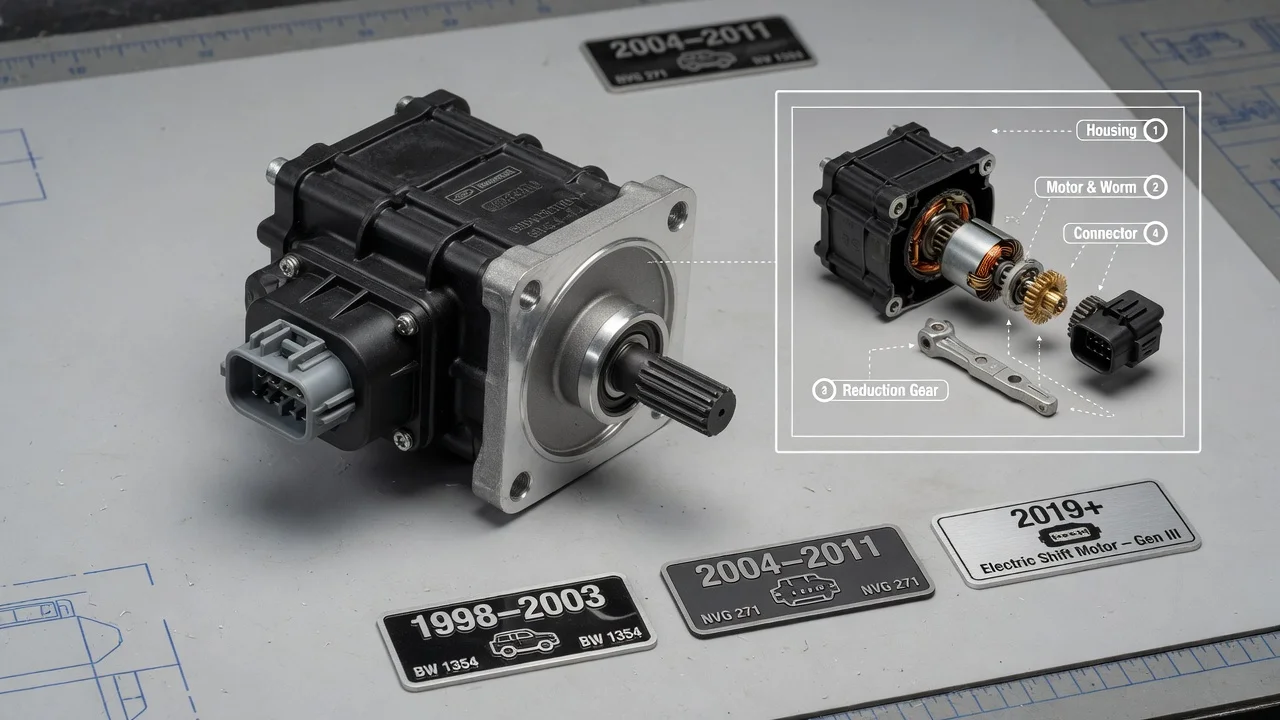
If your Ranger 4x4 selects four-wheel drive with a dash switch or buttons instead of a floor lever, an electric shift motor on the transfer case does the actual shifting. Finding the right replacement depends on more than the model year. It also depends on the exact vehicle configuration, the drivetrain, the build date and the part number on the unit already installed. This guide explains how to narrow it down for Rangers from the 1990s through 2011 and for newer trucks.
The Short Answer: Model Year Narrows It, the Part Number Confirms It
Only Ford Ranger 4x4 trucks with electronic shift have a transfer case shift motor. On these trucks, four-wheel drive is selected with a dash switch or buttons. Rangers with a floor-mounted transfer case lever do not use a shift motor, and 2WD trucks have no transfer case at all. Among electronic-shift trucks, the model year tells you which generation you have. A 1994 Ranger belongs to the 1993 to 1997 generation. A 98, 99, 2000, 2004 or 2011 Ranger belongs to the long-running generation introduced for 1998 and sold in the US through the 2011 model year. The Ranger that returned for 2019 uses a different, newer system, so treat it as a separate parts family.
Within a generation, the model year only narrows the search. It does not prove which part fits. Ford made running changes during production. A truck built late in one model year can carry parts from the next. A truck may also have had its transfer case or motor replaced in the past. The reliable identifier is the part number on the installed motor, checked against a parts lookup by VIN. If those two agree, you have your answer.
How the Shift Motor Works
The shift motor is an electric gear motor bolted to the outside of the transfer case. Its output engages a shift shaft that turns a cam inside the case. The cam moves the internal shift mechanism between two-wheel drive high, four-wheel drive high and four-wheel drive low. When you select a mode, the 4x4 control module runs the motor in one direction or the other and stops it when the target position is reached.
The module tracks the motor's position through a sensor built into the motor housing, usually a set of contacts on a plate that the motor turns. This is why one shift motor assembly can cause both mechanical and electrical-looking symptoms. A worn or corroded contact plate can confuse the module even when the motor still turns. The module also coordinates front axle engagement. On 1998 to 2011 4x4 Rangers, that engagement depends on vacuum-operated front hub locks, so a shift problem and a front-wheel engagement problem are not always the same fault.
Typical complaints include a 4x4 indicator that flashes or never lights, no response to the switch, a truck stuck in four-wheel drive, or a motor that runs without changing the mode. The same symptoms can come from a fuse, the dash switch, the module, damaged wiring, the hub locks or a problem inside the transfer case. Confirm the motor is at fault before you replace it.
What Changes the Answer for a Specific Truck
The biggest dividing line is generation. Do not assume a shift motor for a 1994 Ranger interchanges with one for a 1998 or later Ranger, because the trucks differ in transfer case hardware, control electronics and front axle engagement. Within the 1998 to 2011 range, a single motor is often listed for many years. However, listings can split by build date, transfer case version or connector, so a 2000 and a 2004 truck may or may not take the same part.
Platform twins matter too. Mazda B-Series pickups of the same era were built on the Ranger platform and may share transfer case components, but confirm this by part number rather than by badge. Service history can also override the model year entirely. If a truck received a used transfer case from a salvage vehicle, its motor may match the donor truck rather than its own VIN. Operating conditions such as frequent water crossings, road salt or pressure washing underneath do not change which part fits. They do affect the condition of the connector and contact plate.
How to Identify the Correct Motor on Your Ranger
Start in the cab. Confirm the truck has electronic shift by finding the 4x4 switch or buttons on the dash. If it has a floor lever instead, there is no shift motor to replace. Then read the vehicle certification label on the driver door or door pillar for the build month and year, and note the full VIN.
Next, look at the transfer case from underneath the truck. The motor is mounted on the rear or side of the case, with a wiring connector attached. Gently clean the housing and look for a stamped or printed Ford part number on the motor. Also look for an identification tag on the transfer case itself. Before removing anything, photograph the connector, the bolt pattern and the shape of the motor. Comparing these details with the replacement is one of the quickest ways to catch a wrong listing.
Once you have the VIN, build date and part numbers, use a parts lookup that searches by VIN, or ask a parts counter to do it. If the catalog result matches the number on your old motor, order that part. If the numbers do not match, find out why before buying. A mismatch usually points to a running change or a previous repair.
Checks Worth Doing Before Buying a Replacement
A short inspection can save you from buying a motor that was never faulty. Check the relevant fuses listed in the owner's manual. Then inspect the motor connector for green corrosion, bent terminals or water intrusion. The motor sits low and exposed, so the connector is a common weak point. With the engine running and the truck stationary, have a helper operate the switch while you listen near the transfer case. A motor that hums or clicks without completing the shift suggests a different fault than a motor that stays completely silent.
A scan tool that can read Ford 4x4 or body module codes helps separate motor, sensor and wiring faults. On 1998 to 2011 trucks, the transfer case may shift while the front wheels still do not drive. In that case, inspect the vacuum lines and hub lock components before blaming the motor. Check the transfer case fluid level and condition according to the maintenance schedule and manufacturer specifications for your truck. A new motor will not fix an internal mechanical problem.
If replacement is needed, follow the instructions supplied with the part. Replacement procedures typically require the motor and the transfer case shift shaft to be in the same position before installation. If they are not, the new motor can bind or report the wrong position. Secure the vehicle properly before working underneath it.
Limitations and the Next Step
This guide explains how to narrow down the correct shift motor, but it cannot confirm the exact part for your truck. That depends on the VIN, the build date and anything installed since the truck left the factory. Aftermarket listings in particular may cover broad year ranges that do not reflect every running change. Electrical diagnosis also requires the wiring diagram for your specific year, because connector details and module arrangements may differ between years.
Get professional help in any of these cases: the scan tool shows module or network faults, the truck is stuck in four-wheel drive and cannot be driven safely on pavement, or the transfer case shows signs of internal damage such as grinding, leaks or metal in the fluid. For most owners, the next step is simple. Record the VIN, the build date and the part number on the existing motor. Then confirm the match through a VIN-based parts lookup or a Ford dealer parts department before ordering.