Fix Too Much Oil in a Car AC System
The Essential Answer
Too much oil in a car AC system reduces cooling performance and can, in severe cases, damage the compressor. The fix is to recover the refrigerant, remove the excess oil from the system, replace the receiver drier or accumulator as applicable, evacuate the system to remove air and moisture, and then recharge it with the correct amount of refrigerant and the correct amount and type of PAG or ester oil. This is not a situation that is resolved by simply letting pressure out of a Schrader valve, because the oil is distributed through the compressor, condenser, evaporator, lines, and dryer, not held in a single drain point.
What Causes Excess Oil and What to Check Next
The most common cause is an error during a previous service. When refrigerant leaks out, oil often escapes with it, leading a technician or owner to add more oil before recharging. If the system was not flushed and the remaining oil quantity was not measured, the total oil charge can easily exceed the specification. Another cause is adding oil from a small can or syringe without knowing how much was already in the system, or using a refrigerant that already contains oil when the system did not need it.
Observable checks are limited because the oil level cannot be seen without opening the system. If you have a manifold gauge set, high high-side pressures and poor vent temperatures can suggest overcharging, but they can also indicate non-condensable gases in the system or too much refrigerant. A compressor that is noisy or hydrolocked during engagement is a more serious signal. Hydrolock is the term for liquid oil or refrigerant entering the compressor cylinders, which cannot compress liquid. If the compressor makes a hammering or knocking sound when the clutch engages, stop using the AC immediately and have the system professionally diagnosed.
A reliable next step is to compare the system's current total oil charge against the manufacturer's specification. If an accurate service history is not available, the only way to confirm excess oil is to recover the refrigerant, drain the oil from the compressor and other accessible components, and measure it. This is a professional procedure that requires a recovery machine, a vacuum pump, and a precise scale for oil. Attempting to guess the oil level from gauge readings alone is not a supported diagnostic method.
The Recovery and Correction Procedure
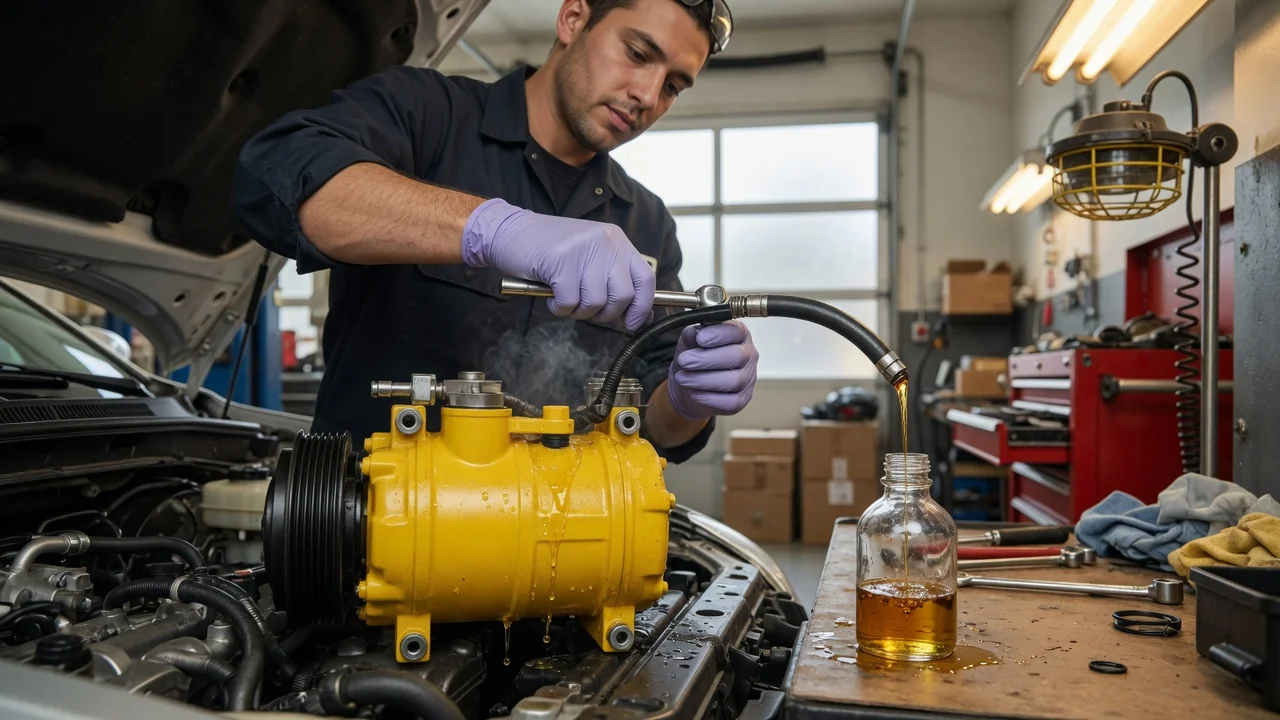
The correction starts by connecting a refrigerant recovery machine to the high and low side service ports. The machine removes the existing refrigerant and separates some of the oil, but not all of it. After recovery, the compressor may be unbolted and its oil drained through the drain plug or suction port, depending on the model. The condenser and evaporator are typically flushed with a dedicated AC flushing solvent and dried with nitrogen. The receiver drier or accumulator should be replaced at this point because it can trap oil and moisture, and replacement is standard practice whenever the system is opened for contamination or oil correction.
Once the flushing solvent is fully removed, the specified quantity of new PAG or ester oil is added. The exact amount varies by compressor, condenser, and line configuration, and must be taken from the vehicle manufacturer's service data for the specific model year and engine. After oil filling, the system is evacuated with a vacuum pump to remove air and any remaining solvent, then charged with the specified weight of refrigerant. The work is complete when the vent temperature, high and low side pressures, and compressor clutch cycling match the manufacturer's expected values under the current ambient conditions.
When to Stop and Seek Professional Help
Stop using the AC and have the system inspected if the compressor is noisy, the clutch is slipping, or there is any sign of liquid slugging. Also stop if the system has been repeatedly topped up with oil-containing refrigerant without documentation, because the uncertainty about the oil quantity makes continued operation a risk to the compressor. Do not open the system at home unless you have a refrigerant recovery machine and the legal certification to handle automotive refrigerant in your jurisdiction.